



New Perspective on the Geographic Distribution and Evolution of Lymphocytic Choriomeningitis Virus, Central Europe
Supporting Files
Public Domain

-
10 2021
-
File Language:
English
Details
-
Alternative Title:Emerg Infect Dis
-
Personal Author:
-
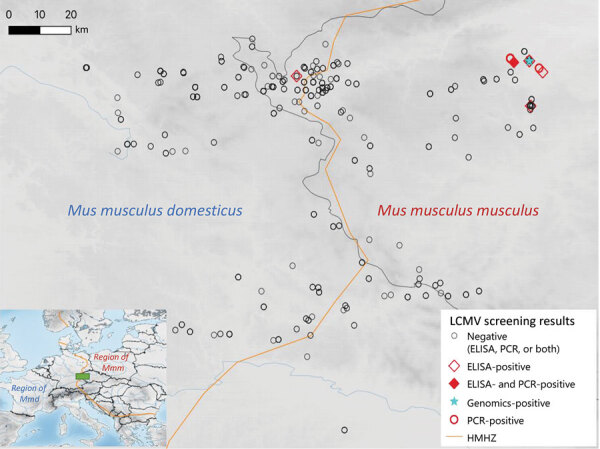
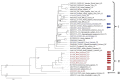
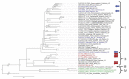
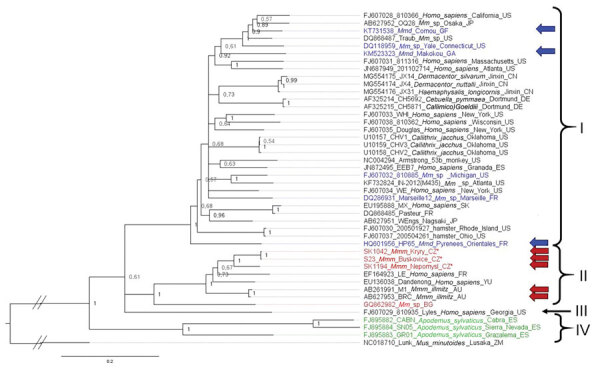
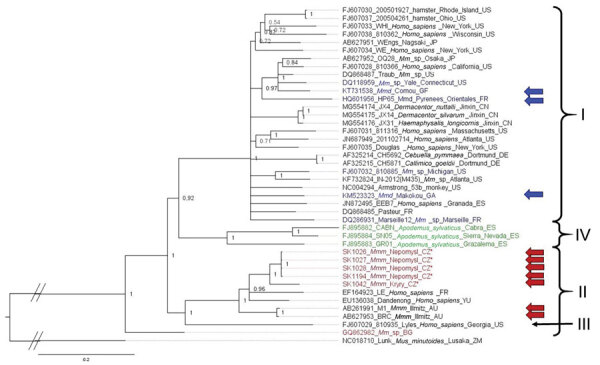
Description:Lymphocytic choriomeningitis virus (LCMV) is an Old World mammarenavirus found worldwide because of its association with the house mouse. When LCMV spills over to immunocompetent humans, the virus can cause aseptic meningitis; in immunocompromised persons, systemic infection and death can occur. Central Europe is a strategic location for the study of LCMV evolutionary history and host specificity because of the presence of a hybrid zone (genetic barrier) between 2 house mouse subspecies, Mus musculus musculus and M. musculus domesticus. We report LCMV prevalence in natural mouse populations from a Czech Republic-Germany transect and genomic characterization of 2 new LCMV variants from the Czech Republic. We demonstrate that the main division in the LCMV phylogenetic tree corresponds to mouse host subspecies and, when the virus is found in human hosts, the mouse subspecies found at the spillover location. Therefore, LCMV strains infecting humans can be predicted by the genetic structure of house mice.
-
Subjects:
-
Source:Emerg Infect Dis. 27(10):2638-2647
-
Pubmed ID:34545789
-
Pubmed Central ID:PMC8462312
-
Document Type:
-
Place as Subject:
-
Location:
-
Volume:27
-
Issue:10
-
Collection(s):
-
Main Document Checksum:urn:sha256:7d0e67b7687023ace7a750ddd99ca58c4985e560a33aa7e7f28bfc35354cbb92
-
Download URL:
-
File Type:
 [PDF
- 3.01 MB
]
[PDF
- 3.01 MB
]
Supporting Files


File Language:
English
 Was this page helpful?
 Found an issue?



CDC STACKS serves as an archival repository of CDC-published products including
scientific findings,
journal articles, guidelines, recommendations, or other public health information authored or
co-authored by CDC or funded partners.
As a repository, CDC STACKS retains documents in their original published format to ensure public access to scientific information.
As a repository, CDC STACKS retains documents in their original published format to ensure public access to scientific information.
You May Also Like
COLLECTION
Emerging Infectious Diseases