


Distribution and Characteristics of Human Plague Cases and Yersinia pestis Isolates from 4 Marmota Plague Foci, China, 1950–2019
Supporting Files
Public Domain

-
10 2021
-
File Language:
English
Details
-
Alternative Title:Emerg Infect Dis
-
Personal Author:He, Zhaokai ; Wei, Baiqing ; Zhang, Yujiang ; Liu, Jun ; Xi, Jinxiao ; Ciren, Dunzhu ; Qi, Teng ; Liang, Junrong ; Duan, Ran ; Qin, Shuai ; Lv, Dongyue ; Chen, Yuhuang ; Xiao, Meng ; Fan, Rong ; Song, Zhizhong ; Jing, Huaiqi ; Wang, Xin
-
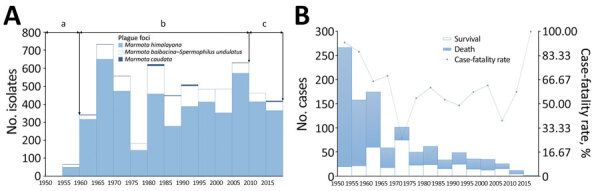
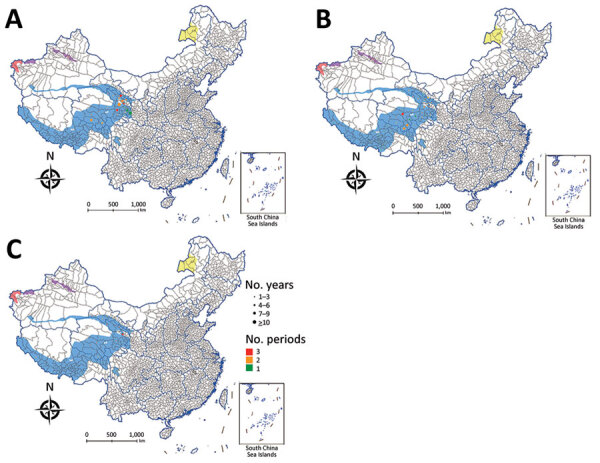
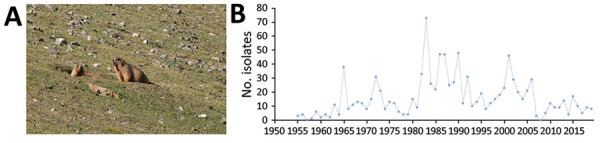
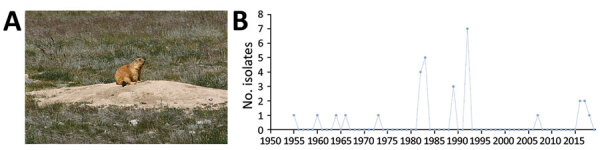
Description:We analyzed epidemiologic characteristics and distribution of 1,067 human plague cases and 5,958 Yersinia pestis isolates collected from humans, host animals, and insect vectors during 1950-2019 in 4 Marmota plague foci in China. The case-fatality rate for plague in humans was 68.88%; the overall trend slowly decreased over time but fluctuated greatly. Most human cases (98.31%) and isolates (82.06%) identified from any source were from the Marmota himalayana plague focus. The tendency among human cases could be divided into 3 stages: 1950-1969, 1970-2003, and 2004-2019. The Marmota sibirica plague focus has not had identified human cases nor isolates since 1926. However, in the other 3 foci, Y. pestis continues to circulate among animal hosts; ecologic factors might affect local Y. pestis activity. Marmota plague foci are active in China, and the epidemic boundary is constantly expanding, posing a potential threat to domestic and global public health.
-
Subjects:
-
Source:Emerg Infect Dis. 27(10):2544-2553
-
Pubmed ID:34545784
-
Pubmed Central ID:PMC8462326
-
Document Type:
-
Place as Subject:
-
Location:
-
Volume:27
-
Issue:10
-
Collection(s):
-
Main Document Checksum:urn:sha256:71b5d268263746ee57a297070c1563ab0e8e7ee908f83d590311350d83925f81
-
Download URL:
-
File Type:
 [PDF
- 3.02 MB
]
[PDF
- 3.02 MB
]
Supporting Files


File Language:
English
ON THIS PAGE







CDC STACKS serves as an archival repository of CDC-published products including
scientific findings,
journal articles, guidelines, recommendations, or other public health information authored or
co-authored by CDC or funded partners.
As a repository, CDC STACKS retains documents in their original published format to ensure public access to scientific information.
As a repository, CDC STACKS retains documents in their original published format to ensure public access to scientific information.
You May Also Like
COLLECTION
Emerging Infectious Diseases