



Etymologia: Talaromyces marneffei
Supporting Files
Public Domain

-
2021/09/01
File Language:
English
Details
-
Alternative Title:Emerg Infect Dis
-
Personal Author:
-
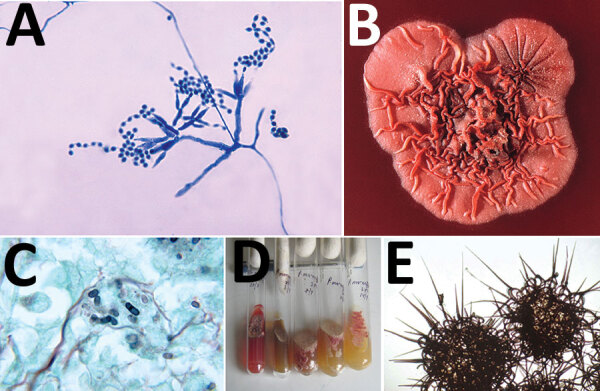
Description:Talaromyces marneffei t læ′ ɹɒ maɪ̯ s ɪz mɑ:neɪ′ ; Talaromyces marneffei (formerly Penicillium marneffei) is a thermally dimorphic fungus that causes talaromycosis, which was previously called penicilliosis. The genus name Talaromyces is derived from the Greek words tálaros (basket) and múkēs (mushroom). Talaros aptly describes the ascocarp known as a gymnothecium (composed offinewovenhyphae)inwhichasciareformed. Asexual stages of Talaromyces species were pre- viously known as the species Penicillium of the subgenus Biverticillium. Capponi and Sureau iso- lated the fungus at Institute Pasteur de Dalat in Vietnam in 1955 from Chinese bamboo rats (Rhi- zomys sinensis). In 1959, Gabriel Segretain, after an accidental finger prick with a needle containing the yeast cells, described the fungus as a new species, naming it Penicillium marneffei in honor of Hubert Marneffe (1901- 1970), the Director of the Institute in Indochina. ; Talaromycosis affects persons who live in or visit Southeast Asia, southern China, or northeastern India, and are immunocompromised because of HIV/AIDS, cancer, organ transplant, or adult-onset immunodeficiency syndrome. This disease occurs after inhalation of aerosolized fungal spores from the environ- ment. Although the precise reservoir is unknown, T. marneffei is found in bamboo rats.
-
Subjects:
-
Source:Emerg Infect Dis. 27(9):2278
-
Pubmed Central ID:PMC8386783
-
Document Type:
-
Corporate as Subject:
-
Genre:
-
Volume:27
-
Issue:9
-
Download URL:
-
File Type:
 [PDF - 1.38 MB]
 -
Collection(s):
-
Main Document Checksum:urn:sha-512:e57e46990ddd63355b358ee22d6f12ddd0b0a214f49e08ec7118b5602fa10f726d58f02ebf2425854188d8f7d7e4fb2ddfc23f2935d5842aabb9f36a38e970e4
Supporting Files


File Language:
English
 Was this page helpful?
 Found an issue?



CDC STACKS serves as an archival repository of CDC-published products including
scientific findings, journal articles, guidelines, recommendations, or other public health information authored or
co-authored by CDC or funded partners.
As a repository, CDC STACKS retains documents in their original published format to ensure public access to scientific information.
As a repository, CDC STACKS retains documents in their original published format to ensure public access to scientific information.
You May Also Like
COLLECTION
Emerging Infectious Diseases