


Multicenter Evaluation of Computer Automated versus Traditional Surveillance of Hospital-Acquired Bloodstream Infections
Supporting Files

-
12 2014
-
File Language:
English
Details
-
Alternative Title:Infect Control Hosp Epidemiol
-
Personal Author:
-
Description:OBJECTIVE.
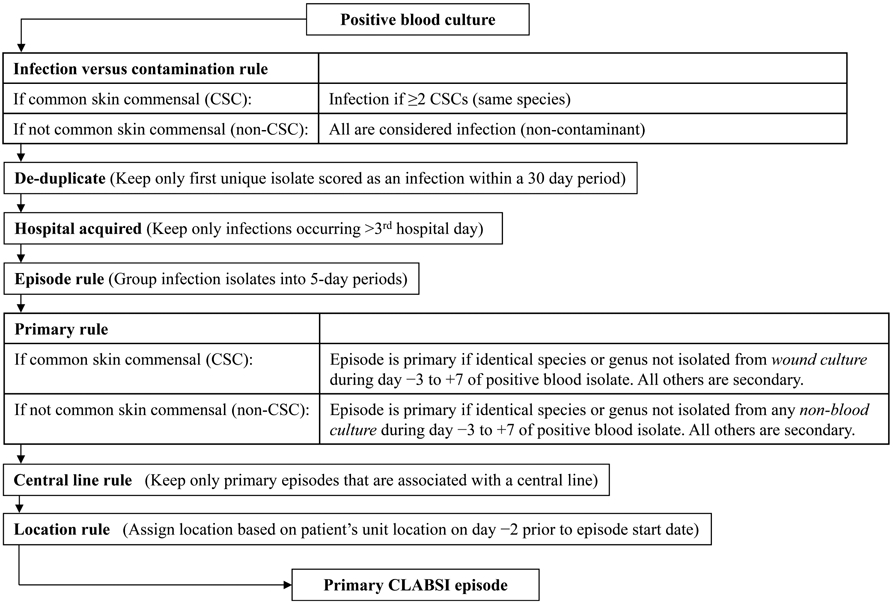
Central line–associated bloodstream infection (BSI) rates are a key quality metric for comparing hospital quality and safety. Traditional BSI surveillance may be limited by interrater variability. We assessed whether a computer-automated method of central line–associated BSI detection can improve the validity of surveillance.
DESIGN.
Retrospective cohort study.
SETTING.
Eight medical and surgical intensive care units (ICUs) in 4 academic medical centers.
METHODS.
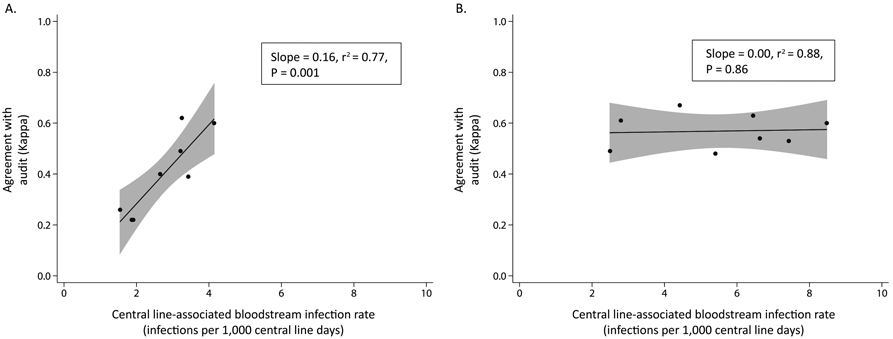
Traditional surveillance (by hospital staff) and computer algorithm surveillance were each compared against a retrospective audit review using a random sample of blood culture episodes during the period 2004–2007 from which an organism was recovered. Episode-level agreement with audit review was measured with κ statistics, and differences were assessed using the test of equal κ coefficients. Linear regression was used to assess the relationship between surveillance performance (κ) and surveillance-reported BSI rates (BSIs per 1,000 central line–days).
RESULTS.
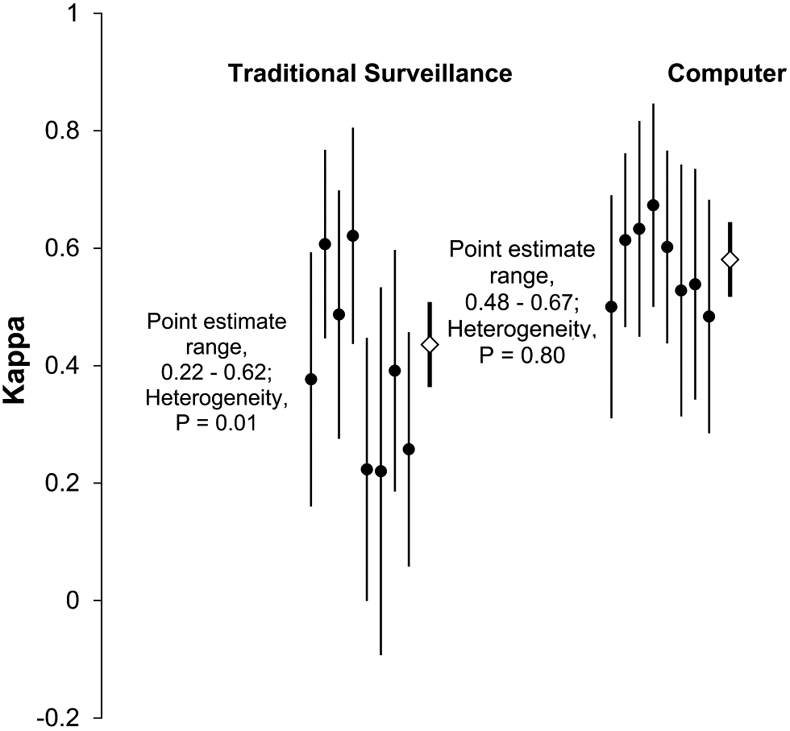
We evaluated 664 blood culture episodes. Agreement with audit review was significantly lower for traditional surveillance (κ [95% confidence interval (CI)] = 0.44 [0.37–0.51]) than computer algorithm surveillance (κ [95% CI] = 0.58 [0.52–0.64]; P = .001). Agreement between traditional surveillance and audit review was heterogeneous across ICUs (P = .01); furthermore, traditional surveillance performed worse among ICUs reporting lower (better) BSI rates (P = .001). In contrast, computer algorithm performance was consistent across ICUs and across the range of computer-reported central line–associated BSI rates.
CONCLUSIONS.
Compared with traditional surveillance of bloodstream infections, computer automated surveillance improves accuracy and reliability, making interfacility performance comparisons more valid.
-
Subjects:
-
Source:Infect Control Hosp Epidemiol. 35(12):1483-1490
-
Pubmed ID:25419770
-
Pubmed Central ID:PMC8385404
-
Document Type:
-
Funding:
-
Volume:35
-
Issue:12
-
Collection(s):
-
Main Document Checksum:urn:sha-512:2ae40559ec7802532177503c8062a41d77f65e380a5a4b6021f3fc131854531dca9435a355373bff9f7e94bc7f1a7a5bba3da0b0df49972a3d181274cc170c48
-
Download URL:
-
File Type:
 [PDF
- 436.01 KB
]
[PDF
- 436.01 KB
]
Supporting Files


File Language:
English
ON THIS PAGE



CDC STACKS serves as an archival repository of CDC-published products including
scientific findings,
journal articles, guidelines, recommendations, or other public health information authored or
co-authored by CDC or funded partners.
As a repository, CDC STACKS retains documents in their original published format to ensure public access to scientific information.
As a repository, CDC STACKS retains documents in their original published format to ensure public access to scientific information.
You May Also Like
COLLECTION
CDC Public Access