



Associations Between Social Media and Suicidal Behaviors During a Youth Suicide Cluster in Ohio
Supporting Files

-
2021/02/01
-
File Language:
English
Details
-
Alternative Title:J Adolesc Health
-
Personal Author:
-
Description:Purpose:
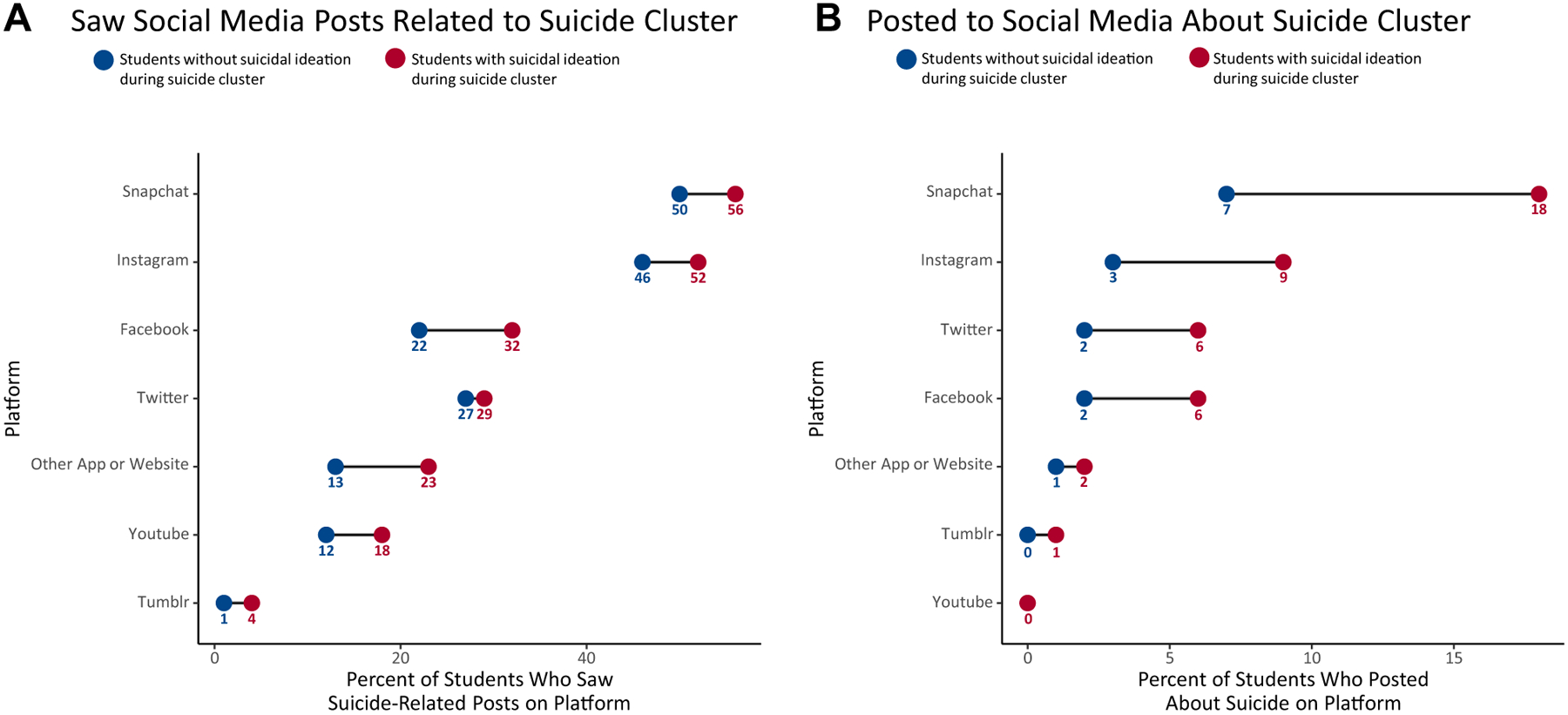
Youth suicide clusters may be exacerbated by suicide contagion-the spread of suicidal behaviors. Factors promoting suicide contagion are poorly understood, particularly in the advent of social media. Using cross-sectional data from an ongoing youth suicide cluster in Ohio, this study examines associations between suicide cluster-related social media and suicidal behaviors.
Methods:
We surveyed 7th- to 12th-grade students in northeastern Ohio during a 2017-2018 suicide cluster to assess the prevalence of suicidal ideation (SI), suicide attempts (SAs), and associations with potential contagion-promoting factors such as suicide cluster-related social media, vigils, memorials, news articles, and watching the Netflix series 13 Reasons Why before or during the cluster. Generalized estimating equations examined associations between potential contagion-promoting factors and SI/SA, adjusting for nonmodifiable risk factors. Subgroup analyses examined whether associations between cluster-related factors and SI/SA during the cluster varied by previous history of SI/SA.
Results:
Among participating students, 9.0% (876/9,733) reported SI and 4.9% attempted suicide (481/9,733) during the suicide cluster. Among students who posted suicide cluster-related content to social media, 22.9% (267/1,167) reported SI and 15.0% (175/1,167) attempted suicide during the suicide cluster. Posting suicide cluster-related content was associated with both SI (adjusted odds ratio 1.7, 95% confidence interval 1.4-2.0) and SA during the cluster (adjusted odds ratio 1.7, 95% confidence interval 1.2-2.5). In subgroup analyses, seeing suicide cluster-related posts was uniquely associated with increased odds of SI and SA during the cluster among students with no previous history of SI/SA.
Conclusions:
Exposure to suicide cluster-related social media is associated with both SI and SA during a suicide cluster. Suicide interventions could benefit from efforts to mitigate potential negative effects of social media and promote prevention messages.
-
Subjects:
-
Source:J Adolesc Health. 68(2):308-316
-
Pubmed ID:32646827
-
Pubmed Central ID:PMC8366066
-
Document Type:
-
Funding:
-
Genre:
-
Volume:68
-
Issue:2
-
Collection(s):
-
Main Document Checksum:urn:sha-512:545ae6ce7df8b4289f0eeceaebdd4c077fb988800c44bcd34c58d94bf77b0316170ef687ec1f62c8434d4cf9f416655ba061f4b2087f40558369bcde90ef267c
-
Download URL:
-
File Type:
 [PDF
- 508.56 KB
]
[PDF
- 508.56 KB
]


File Language:
English
 Was this page helpful?
 Found an issue?

CDC STACKS serves as an archival repository of CDC-published products including
scientific findings,
journal articles, guidelines, recommendations, or other public health information authored or
co-authored by CDC or funded partners.
As a repository, CDC STACKS retains documents in their original published format to ensure public access to scientific information.
As a repository, CDC STACKS retains documents in their original published format to ensure public access to scientific information.
You May Also Like
COLLECTION
CDC Public Access