



Urinary Bisphenol A Concentrations and Implantation Failure among Women Undergoing in Vitro Fertilization
Supporting Files
Peer Reviewed

-
2012/07/01
File Language:
English
Details
-
Journal Article:Environmental Health Perspectives
-
Personal Author:
-
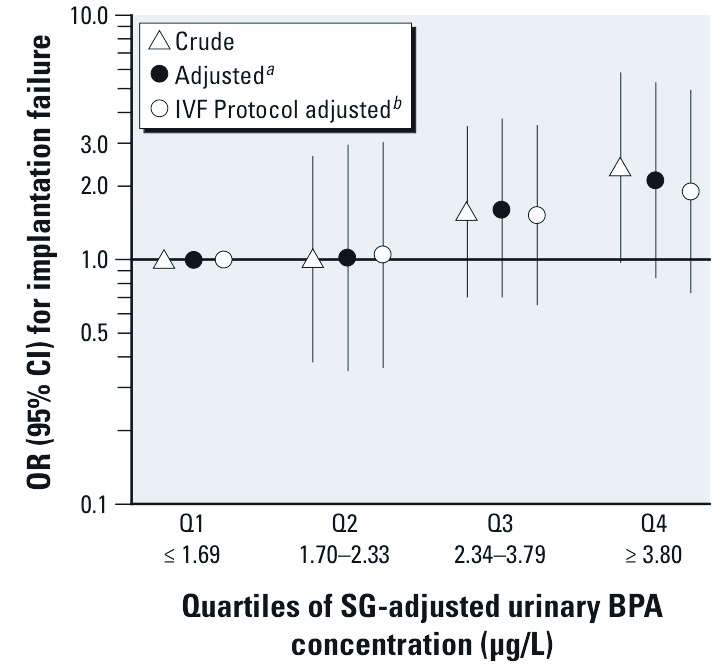
Description:BACKGROUND: Bisphenol A (BPA) is a synthetic chemical widely used in the production of polycarbonate plastic and epoxy resins found in numerous consumer products. In experimental animals, BPA increases embryo implantation failure and reduces litter size. OBJECTIVE: We evaluated the association of urinary BPA concentrations with implantation failure among women undergoing in vitro fertilization (IVF). METHODS: We used online solid phase extraction-high performance liquid chromatography-isotope dilution tandem mass spectrometry to measure urinary BPA concentrations in 137 women in a prospective cohort study among women undergoing IVF at the Massachusetts General Hospital Fertility Center in Boston, Massachusetts. We used logistic regression to evaluate the association of cycle-specific urinary BPA concentrations with implantation failure, accounting for correlation among multiple IVF cycles in the same woman using generalized estimating equations. Implantation failure was defined as a negative serum ß-human chorionic gonadotropin test (ß-hCG < 6 IU/L) 17 days after egg retrieval. RESULTS: Among 137 women undergoing 180 IVF cycles, urinary BPA concentrations had a geometric mean (SD) of 1.53 (2.22) µg/L. Overall, 42% (n = 75) of the IVF cycles resulted in implantation failure. In adjusted models, there was an increased odds of implantation failure with higher quartiles of urinary BPA concentrations {odds ratio (OR) 1.02 95% confidence interval (CI): 0.35, 2.95}, 1.60 (95% CI: 0.70, 3.78), and 2.11 (95% CI: 0.84, 5.31) for quartiles 2, 3, and 4, respectively, compared with the lowest quartile (p-trend = 0.06). CONCLUSION: There was a positive linear dose-response association between BPA urinary concentrations and implantation failure. Description provided by NIOSH
-
Subjects:
-
Keywords:
-
Source:Environ Health Perspect 2012 Jul; 120(7):978-983
-
ISSN:0091-6765
-
Pubmed ID:22484414
-
Pubmed Central ID:PMC3404656
-
Document Type:
-
Funding:
-
Genre:
-
Place as Subject:
-
CIO:
-
Topic:
-
Location:
-
Pages in Document:6 pdf pages
-
Volume:120
-
Issue:7
-
NIOSHTIC Number:nn:20041751
-
Contact Point Address:R. Hauser, Harvard School of Public Health, 665 Huntington Ave., Building I, 14th Floor, Boston, MA 02115
-
Email:rhauser@hsph.harvard.edu
-
CAS Registry Number:
-
Federal Fiscal Year:2012
-
Performing Organization:Harvard University, School of Public Health, Boston, Massachusetts
-
Peer Reviewed:True
-
Download URL:
-
File Type:
 [PDF - 298.56 KB]
 -
Collection(s):
-
Main Document Checksum:urn:sha-512:fed5f7f030843d4cad1afcdd99ffbeb4b4e4354673aaf99cf445bdb3e57c54a59d8ebf4cdfeb6913b0e4c9245c6a311297c6be8d30ee9965920806f308121419
Supporting Files


File Language:
English
 Was this page helpful?
 Found an issue?

CDC STACKS serves as an archival repository of CDC-published products including
scientific findings, journal articles, guidelines, recommendations, or other public health information authored or
co-authored by CDC or funded partners.
As a repository, CDC STACKS retains documents in their original published format to ensure public access to scientific information.
As a repository, CDC STACKS retains documents in their original published format to ensure public access to scientific information.
You May Also Like