



Association of the Neighborhood Built Environment With Incident and Prevalent Depression in the Rural South
Supporting Files

-
Jul 08 2021
File Language:
English
Details
-
Journal Article:Preventing Chronic Disease (PCD)
-
Personal Author:
-
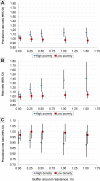
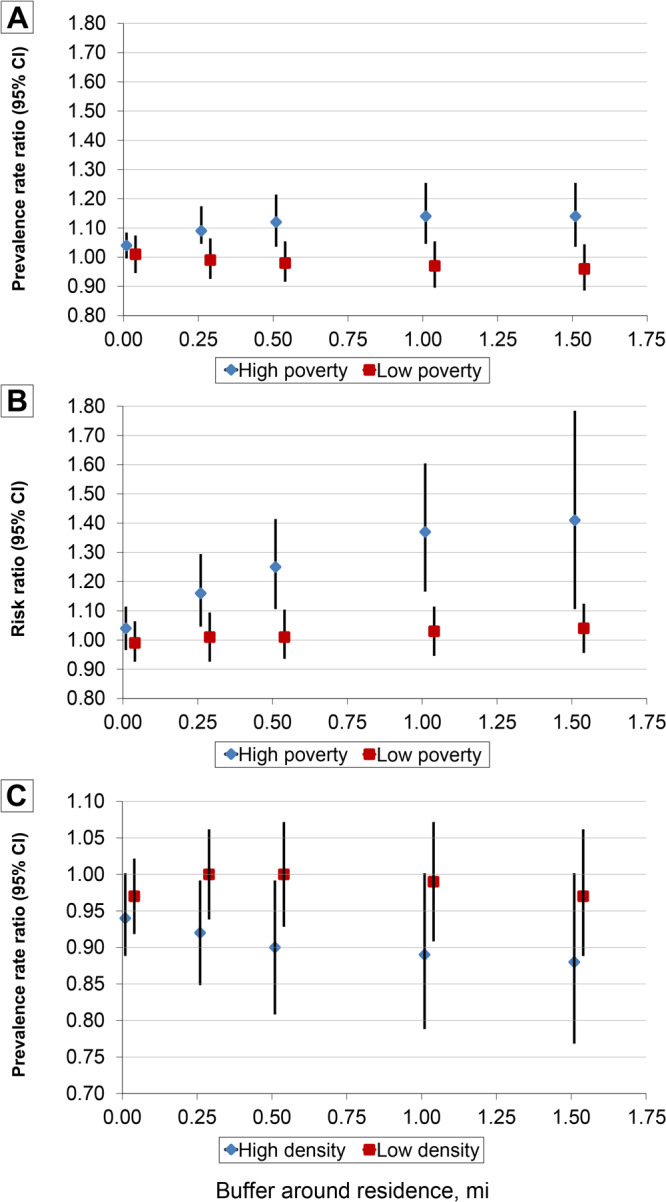
Description:Introduction ; A neighborhood’s built environment is associated with physical activity among its residents, and physical activity is associated with depression. Our study aimed to determine whether the built environment was associated with depression among residents of the rural South and whether observed associations were mediated by physical activity. ; Methods ; We selected 2,000 participants from the Bogalusa Heart Study who had a valid residential address, self-reported physical activity (minutes/week), and a complete Center for Epidemiologic Study–Depression (CES-D) scale assessment from 1 or more study visits between 1998 and 2013. We assessed the built environment with the Rural Active Living Assessment street segment audit tool and developed built environment scores. The association between built environment scores and depression (CES-D ≥16) in geographic buffers of various radii were evaluated by using modified Poisson regression, and mediation by physical activity was evaluated with mixed-effects models. ; Results ; Depression was observed in 37% of study participants at the first study visit. One-point higher physical security and aesthetic scores for the street segment of residence were associated with 1.07 times higher (95% CI, 1.02–1.11) and 0.96 times lower (95% CI, 0.92–1.00) baseline depression prevalence. One-point higher destination scores (ie, more commercial and civic facilities) in radius buffers of 0.25 miles or more were associated with 1.06 times (95% CI, 1.00–1.13) the risk of depression during follow-up. Neighborhood poverty (defined as percentage of residents with incomes below the federal poverty level and dichotomized at 28.3%) modified cross-sectional and longitudinal associations. Associations were not mediated by physical activity. ; Conclusion ; The built environment was associated with prevalence and risk of depression, and associations were stronger in high-poverty neighborhoods. Built environment improvements to promote physical activity should take neighborhood context into consideration to minimize negative side effects on mental health in high-poverty communities.
-
Subjects:
-
Source:Prev Chronic Dis. 2021; 18
-
ISSN:1545-1151
-
Pubmed ID:34237245
-
Pubmed Central ID:PMC8269752
-
Document Type:
-
Funding:
-
Volume:18
-
Download URL:
-
File Type:
 [PDF - 566.02 KB]
 -
Collection(s):
-
Main Document Checksum:urn:sha-512:1debd9e71fb3b85e1f5b54c02bf8aa2179501bf78365983ac3ad076eb1a344540b7e94566950bf7d9e33a662b5e16bfdfe465810f1a37ac7637e2acaa4fa0dee
Supporting Files


File Language:
English
 Was this page helpful?
 Found an issue?

CDC STACKS serves as an archival repository of CDC-published products including
scientific findings, journal articles, guidelines, recommendations, or other public health information authored or
co-authored by CDC or funded partners.
As a repository, CDC STACKS retains documents in their original published format to ensure public access to scientific information.
As a repository, CDC STACKS retains documents in their original published format to ensure public access to scientific information.
You May Also Like
COLLECTION
Preventing Chronic Disease