



West Nile Virus–associated Flaccid Paralysis
Supporting Files
Public Domain

-
Jul 2005
File Language:
English
Details
-
Alternative Title:Emerg Infect Dis
-
Personal Author:Sejvar, James J. ; Bode, Amy V. ; Marfin, Anthony A. ; Campbell, Grant L. ; Ewing, David ; Mazowiecki, Michael ; Pavot, Pierre V. ; Schmitt, Joseph ; Pape, John ; Biggerstaff, Brad J. ; Petersen, Lyle R.
-
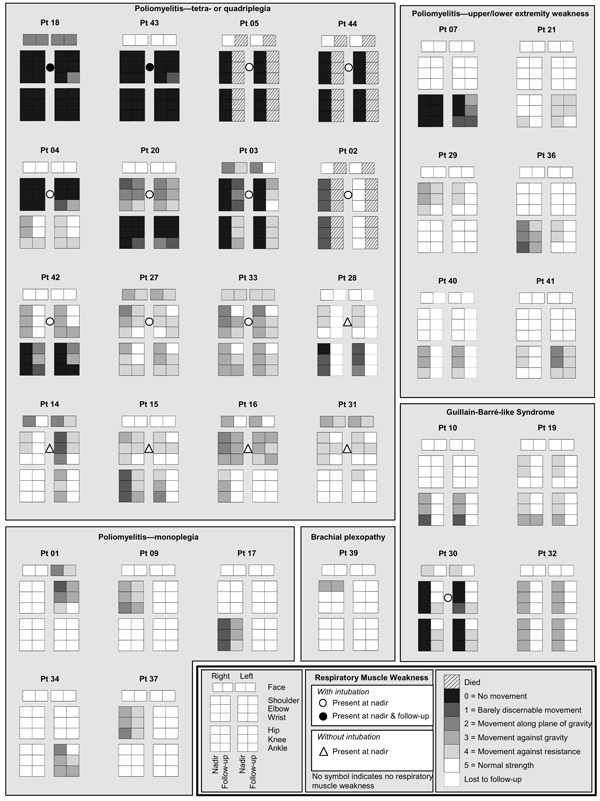
Description:The causes and frequency of acute paralysis and respiratory failure with West Nile virus (WNV) infection are incompletely understood. During the summer and fall of 2003, we conducted a prospective, population-based study among residents of a 3-county area in Colorado, United States, with developing WNV-associated paralysis. Thirty-two patients with developing paralysis and acute WNV infection were identified. Causes included a poliomyelitislike syndrome in 27 (84%) patients and a Guillain-Barré-like syndrome in 4 (13%); 1 had brachial plexus involvement alone. The incidence of poliomyelitislike syndrome was 3.7/100,000. Twelve patients (38%), including 1 with Guillain-Barré-like syndrome, had acute respiratory failure that required endotracheal intubation. At 4 months, 3 patients with respiratory failure died, 2 remained intubated, 25 showed various degrees of improvement, and 2 were lost to followup. A poliomyelitislike syndrome likely involving spinal anterior horn cells is the most common mechanism of WNV-associated paralysis and is associated with significant short- and long-term illness and death.
-
Subjects:
-
Source:Emerg Infect Dis. 11(7):1021-1027.
-
Document Type:
-
Volume:11
-
Issue:7
-
Download URL:
-
File Type:
 [PDF - 217.63 KB]
 -
Collection(s):
-
Main Document Checksum:urn:sha256:f8fbae3c6ab0953e92fdc41a36c667fbc978c945ea3743882e9484dcbc23910f
Supporting Files


File Language:
English
 Was this page helpful?
 Found an issue?







CDC STACKS serves as an archival repository of CDC-published products including
scientific findings, journal articles, guidelines, recommendations, or other public health information authored or
co-authored by CDC or funded partners.
As a repository, CDC STACKS retains documents in their original published format to ensure public access to scientific information.
As a repository, CDC STACKS retains documents in their original published format to ensure public access to scientific information.
You May Also Like
COLLECTION
Emerging Infectious Diseases