



Experimental Infection of Horses with West Nile virus
Supporting Files
Public Domain

-
Apr 2002
File Language:
English
Details
-
Alternative Title:Emerg Infect Dis
-
Personal Author:Bunning, Michel L. ; Bowen, Richard A. ; Cropp, Bruce C. ; Sullivan, Kevin G. ; Davis, Brent S. ; Komar, Nicholas ; Godsey, Marvin ; Baker, Dale ; Hettler, Danielle L. ; Holmes, Derek A. ; Biggerstaff, Brad J. ; Mitchell, Carl J.
-
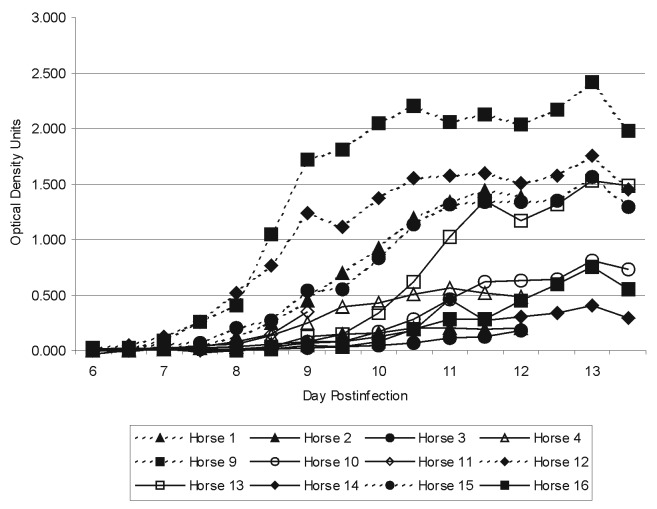
Description:A total of 12 horses of different breeds and ages were infected with West Nile virus (WNV) via the bites of infected Aedes albopictus mosquitoes. Half the horses were infected with a viral isolate from the brain of a horse (BC787), and half were infected with an isolate from crow brain (NY99-6625); both were NY99 isolates. Postinfection, uninfected female Ae. albopictus fed on eight of the infected horses. In the first trial, Nt antibody titers reached >1:320, 1:20, 1:160, and 1:80 for horses 1 to 4, respectively. In the second trial, the seven horses with subclinical infections developed Nt antibody titers >1:10 between days 7 and 11 post infection. The highest viremia level in horses fed upon by the recipient mosquitoes was approximately 460 Vero cell PFU/mL. All mosquitoes that fed upon viremic horses were negative for the virus. Horses infected with the NY99 strain of WNV develop low viremia levels of short duration; therefore, infected horses are unlikely to serve as important amplifying hosts for WNV in nature.
-
Subjects:
-
Source:Emerg Infect Dis. 8(4):380-386.
-
Document Type:
-
Volume:8
-
Issue:4
-
Download URL:
-
File Type:
 [PDF - 326.38 KB]
 -
Collection(s):
-
Main Document Checksum:urn:sha256:8842621e61aa27bd34bc947ffac25bb9d5a5ff3dca948ed706e3133379521989
Supporting Files


File Language:
English
 Was this page helpful?
 Found an issue?



CDC STACKS serves as an archival repository of CDC-published products including
scientific findings, journal articles, guidelines, recommendations, or other public health information authored or
co-authored by CDC or funded partners.
As a repository, CDC STACKS retains documents in their original published format to ensure public access to scientific information.
As a repository, CDC STACKS retains documents in their original published format to ensure public access to scientific information.
You May Also Like
COLLECTION
Emerging Infectious Diseases