



Macrolide-Resistant Mycoplasma pneumoniae Infections in Children, Ohio, USA
Supporting Files
Public Domain

-
2021
File Language:
English
Details
-
Alternative Title:Emerg Infect Dis
-
Personal Author:
-
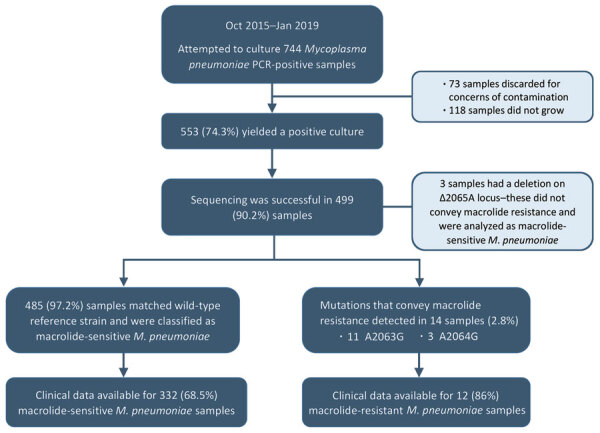
Description:Emergence of macrolide-resistant Mycoplasma pneumoniae (MRMp) challenges empiric macrolide therapy. Our goal was to determine MRMp rates and define characteristics of children infected with macrolide-sensitive M. pneumoniae (MSMp) versus MRMp in Ohio, USA. We cultured PCR-positive M. pneumoniae specimens and sequenced M. pneumoniae-positive cultures to detect macrolide resistance mutations. We reviewed medical records to compare characteristics of both groups. We identified 14 (2.8%) MRMp and 485 (97.2%) MSMp samples. Patients in these groups had similar demographics and clinical characteristics, but patients with MRMp had longer hospitalizations, were more likely to have received previous macrolides, and were more likely to have switched to alternative antimicrobial drugs. MRMp-infected patients also had ≈5-fold greater odds of pediatric intensive care unit admission. Rates of MRMp infections in children in central Ohio are low, but clinicians should remain aware of the risk for severe illness caused by these pathogens.
-
Subjects:
-
Source:Emerg Infect Dis. 27(6):1588-1597
-
Pubmed ID:34013867
-
Pubmed Central ID:PMC8153876
-
Document Type:
-
Place as Subject:
-
Volume:27
-
Issue:6
-
Download URL:
-
File Type:
 [PDF - 1.81 MB]
 -
Collection(s):
-
Main Document Checksum:urn:sha256:1e22505f9f81c84c22071eb0d819e9bee79c1200e90b41af7371ab9700627af6
Supporting Files


File Language:
English
 Was this page helpful?
 Found an issue?

CDC STACKS serves as an archival repository of CDC-published products including
scientific findings, journal articles, guidelines, recommendations, or other public health information authored or
co-authored by CDC or funded partners.
As a repository, CDC STACKS retains documents in their original published format to ensure public access to scientific information.
As a repository, CDC STACKS retains documents in their original published format to ensure public access to scientific information.
You May Also Like
COLLECTION
Emerging Infectious Diseases