


Blood lead level association with lower body weight in NHANES 1999–2006
Supporting Files

-
October 04 2013
-
File Language:
English
Details
-
Alternative Title:Toxicol Appl Pharmacol
-
Personal Author:
-
Description:Background:
Lead exposure is associated with low birth-weight. The objective of this study is to determine whether lead exposure is associated with lower body weight in children, adolescents and adults.
Methods:
We analyzed data from NHANES 1999–2006 for participants aged ≥3 using multiple logistic and multivariate linear regression. Using age- and sex-standardized BMI Z-scores, overweight and obese children (ages 3–19) were classified by BMI ≥85th and ≥95th percentiles, respectively. The adult population (age ≥20) was classified as overweight and obese with BMI measures of 25–29.9 and ≥30, respectively. Blood lead level (BLL) was categorized by weighted quartiles.
Results:
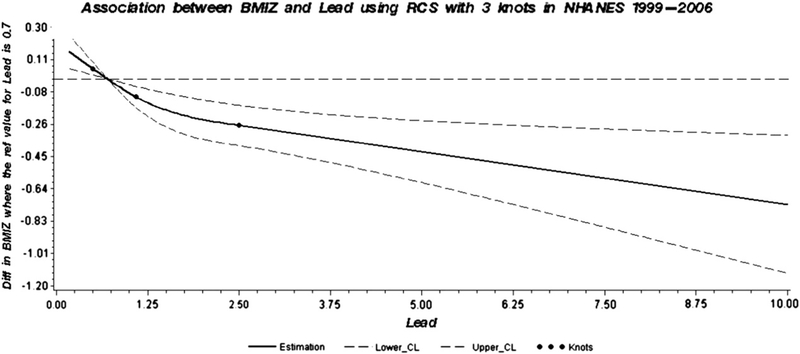
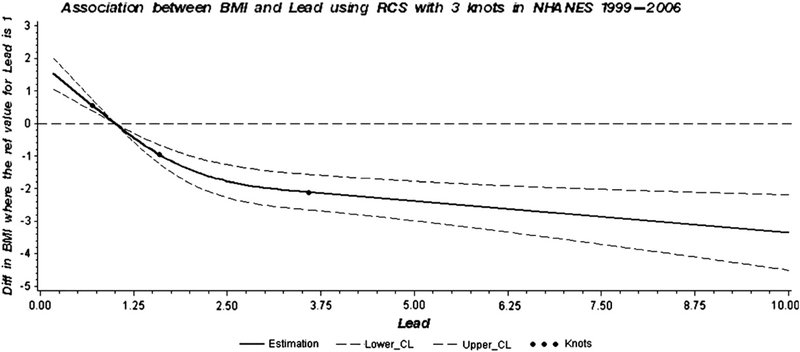
Multivariate linear regressions revealed a lower BMI Z-score in children and adolescents when the highest lead quartile was compared to the lowest lead quartile (β (SE) = −0.33 (0.07), p < 0.001), and a decreased BMI in adults (β (SE) = −2.58 (0.25), p < 0.001). Multiple logistic analyses in children and adolescents found a negative association between BLL and the percentage of obese and overweight with BLL in the highest quartile compared to the lowest quartile (OR = 0.42, 95% CI: 0.30–0.59; and OR = 0.67, 95% CI: 0.52–0.88, respectively). Adults in the highest lead quartile were less likely to be obese (OR = 0.42, 95% CI: 0.35–0.50) compared to those in the lowest lead quartile. Further analyses with blood lead as restricted cubic splines, confirmed the dose-relationship between blood lead and body weight outcomes.
Conclusions:
BLLs are associated with lower body mass index and obesity in children, adolescents and adults.
-
Subjects:
-
Source:Toxicol Appl Pharmacol. 273(3):516-523
-
Pubmed ID:24099784
-
Pubmed Central ID:PMC8158151
-
Document Type:
-
Funding:
-
Volume:273
-
Issue:3
-
Collection(s):
-
Main Document Checksum:urn:sha256:cc1eaf37e6d8f4674806e0ae3f67799c5af8c298d2ea4698e66b3eed47f48f0d
-
Download URL:
-
File Type:
 [PDF
- 865.44 KB
]
[PDF
- 865.44 KB
]
Supporting Files


File Language:
English
ON THIS PAGE

CDC STACKS serves as an archival repository of CDC-published products including
scientific findings,
journal articles, guidelines, recommendations, or other public health information authored or
co-authored by CDC or funded partners.
As a repository, CDC STACKS retains documents in their original published format to ensure public access to scientific information.
As a repository, CDC STACKS retains documents in their original published format to ensure public access to scientific information.
You May Also Like
COLLECTION
CDC Public Access