



Mental Health Stigma and Barriers to Care in World Trade Center Responders: Results from a Large, Population-Based Health Monitoring Cohort
Supporting Files

-
3 2021
-
File Language:
English
Details
-
Alternative Title:Am J Ind Med
-
Personal Author:DePierro, Jonathan ; Lowe, Sandra M. ; Haugen, Peter T. ; Cancelmo, Leo ; Schaffer, Jamie ; Schechter, Clyde ; Dasaro, Christopher R. ; Todd, Andrew C. ; Crane, Michael ; Luft, Benjamin J. ; Moline, Jacqueline M. ; Harrison, Denise ; Udasin, Iris G. ; Feder, Adriana ; Southwick, Steven M. ; Pietrzak, Robert H.
-
Description:Background.
Nearly 20 years after the terrorist attacks of 9/11/01, multiple studies have documented the adverse mental consequences among World Trade Center (WTC) rescue, recovery and cleanup workers. However, scarce research has examined mental health stigma and barriers to care in WTC-exposed individuals, and no known study has examined whether rates of endorsement may differ between police and “non-traditional” responders, the latter comprising a heterogeneous group of workers and volunteers.
Objective.
To identify the prevalence and correlates of mental health stigma and barriers to care in WTC responders.
Methods.
Mental health stigma and barriers to care and their correlates were examined in 6,777 police and 6,272 non-traditional WTC responders.
Results.
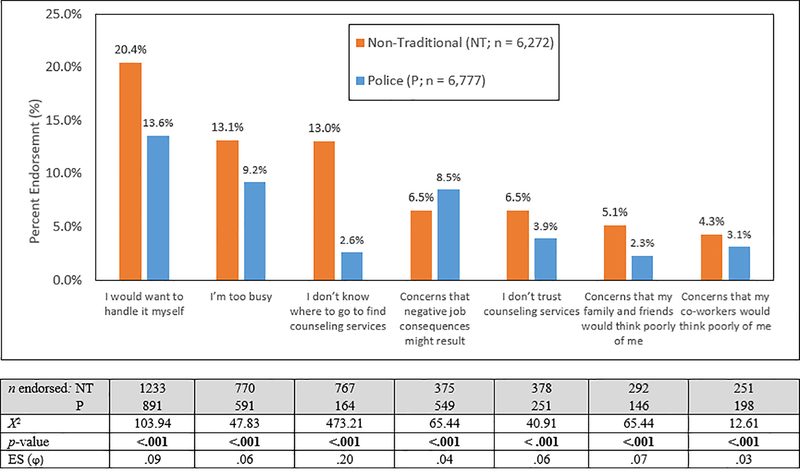
Non-traditional responders endorsed more stigma/barriers to care concerns than police responders. Within a subsample who screened positive for a psychiatric disorder, police were more likely than non-traditional responders to endorse “Concerns that negative job consequences might result” (17.9% vs. 9.1%), while non-traditional responders were more likely to endorse “I don’t know where to go to find counseling services” (18.4% vs.6.6%). Within this subsample, a mental health service need and more severe WTC-related PTSD symptoms were associated with increased likelihood of endorsing stigma or barriers; and pre-9/11 psychiatric history and non-Hispanic Black race/ethnicity were associated with lower likelihood of endorsing stigma or barriers.
Conclusions.
Results of this study underscore the burden of mental health stigma and barriers to care in WTC responders, and highlight the need for targeted interventions to address these concerns and promote mental healthcare utilization in this population.
-
Subjects:
-
Source:Am J Ind Med. 64(3):208-216
-
Pubmed ID:33241583
-
Pubmed Central ID:PMC8099036
-
Document Type:
-
Funding:
-
Place as Subject:
-
Volume:64
-
Issue:3
-
Collection(s):
-
Main Document Checksum:urn:sha256:e30f6b5c615a2a5108c4edd2b1faabb45339c338004157f9f86cd07629c0955a
-
Download URL:
-
File Type:
 [PDF
- 815.58 KB
]
[PDF
- 815.58 KB
]
Supporting Files


File Language:
English
 Was this page helpful?
 Found an issue?

CDC STACKS serves as an archival repository of CDC-published products including
scientific findings,
journal articles, guidelines, recommendations, or other public health information authored or
co-authored by CDC or funded partners.
As a repository, CDC STACKS retains documents in their original published format to ensure public access to scientific information.
As a repository, CDC STACKS retains documents in their original published format to ensure public access to scientific information.
You May Also Like
COLLECTION
CDC Public Access