


Pediatric Resident Engagement With an Online Critical Care Curriculum During the Intensive Care Rotation
Supporting Files

-
11 2020
-
File Language:
English
Details
-
Alternative Title:Pediatr Crit Care Med
-
Personal Author:
-
Description:Objectives
Residents are often assigned online learning materials as part of blended learning models, superimposed on other patient care and learning demands. Data that describe the time patterns of when residents interact with online learning materials during the ICU rotation are lacking. We describe resident engagement with assigned online curricula related to time of day and ICU clinical schedules, using website activity data.
Design
Prospective cohort study examining curriculum completion data and cross-referencing timestamps for pre- and posttest attempts with resident schedules to determine the hours that they accessed the curriculum and whether or not they were scheduled for clinical duty. Residents at each site were cohorted based on two differing clinical schedules–extended duration (>24 hr) versus shorter (maximum 16 hr) shifts.
Setting
Two large academic children’ s hospitals.
Subjects
Pediatric residents rotating in the PICU from July 2013 to June 2017.
Interventions
None.
Measurements and Main Results
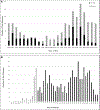
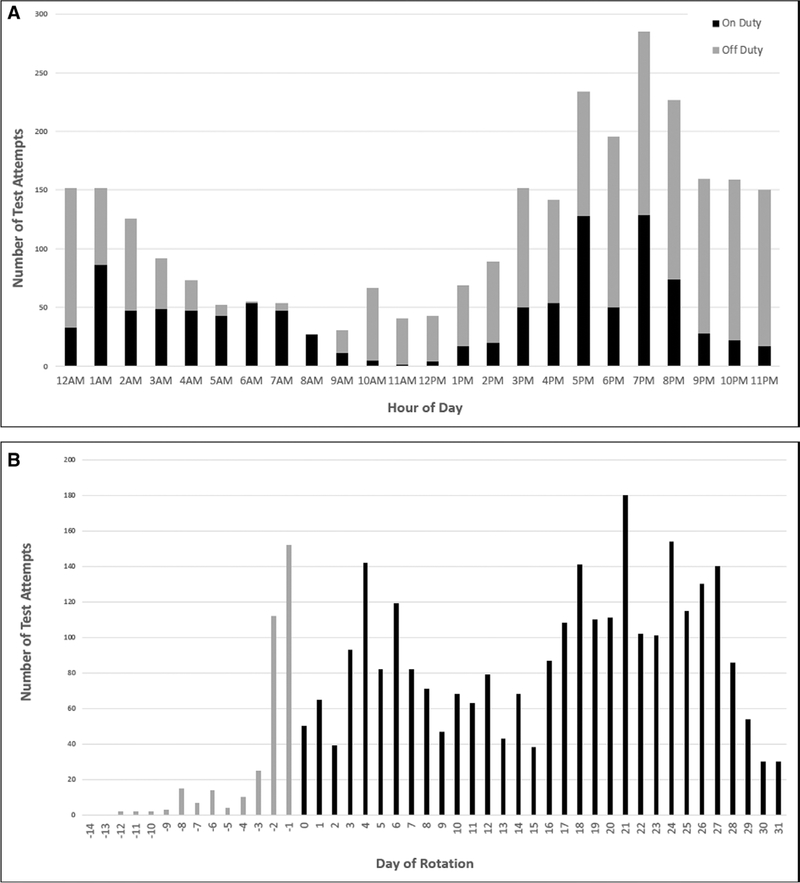
One-hundred and fifty-seven pediatric residents participated in the study. The majority of residents (106/157; 68%) completed the curriculum, with no statistically significant association between overall curriculum completion and schedule cohort at either site. Residents made more test attempts at nighttime between 6 PM and 6 AM (1,824/2,828; 64%) regardless of whether they were scheduled for clinical duty. Approximately two thirds of test attempts (1,785/2,828; 63%) occurred when residents were not scheduled to work, regardless of time of day. Forty-two percent of all test attempts (1,199/2,828) occurred between 6 PM and 6 AM while off-duty, with 12% (342/2,828) occurring between midnight and 6 AM.
Conclusions
Residents rotating in the ICU completed online learning materials mainly during nighttime and off-duty hours, including usage between midnight and 6 AM while off-duty. Increasing nighttime and off-duty workload may have implications for educational design and trainee wellness, particularly during busy, acute clinical rotations, and warrants further examination.
-
Subjects:
-
Source:Pediatr Crit Care Med. 21(11):986-991
-
Pubmed ID:32590830
-
Pubmed Central ID:PMC7597756
-
Document Type:
-
Funding:
-
Volume:21
-
Issue:11
-
Collection(s):
-
Main Document Checksum:urn:sha256:bf654337c78613bd1c17933527299b8856bf61c91d04b61dd05d1a9ba16f7e42
-
Download URL:
-
File Type:
 [PDF
- 677.36 KB
]
[PDF
- 677.36 KB
]
Supporting Files


File Language:
English
ON THIS PAGE

CDC STACKS serves as an archival repository of CDC-published products including
scientific findings,
journal articles, guidelines, recommendations, or other public health information authored or
co-authored by CDC or funded partners.
As a repository, CDC STACKS retains documents in their original published format to ensure public access to scientific information.
As a repository, CDC STACKS retains documents in their original published format to ensure public access to scientific information.
You May Also Like
COLLECTION
CDC Public Access