



Effects of Supplemental Vitamin D on Bone Health Outcomes in Women and Men in the VITamin D and OmegA-3 TriaL (VITAL)
Supporting Files

-
5 2020 ; 5-2020
-
Available in CDC Stacks on 2021-05-01T00:00:00Z
File Language:
English
Details
-
Alternative Title:J Bone Miner Res
-
Personal Author:LeBoff, Meryl S. ; Chou, Sharon H. ; Murata, Elle M. ; Donlon, Catherine M. ; Cook, Nancy R. ; Mora, Samia ; Lee, I-Min ; Kotler, Gregory ; Bubes, Vadim ; Buring, Julie E. ; Manson, JoAnn E.
-
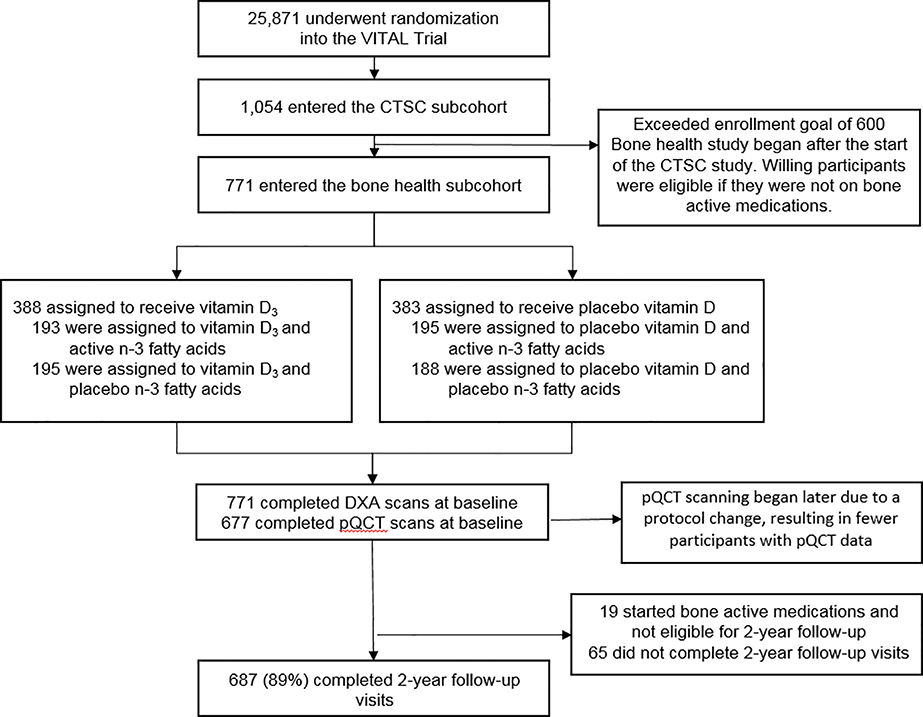
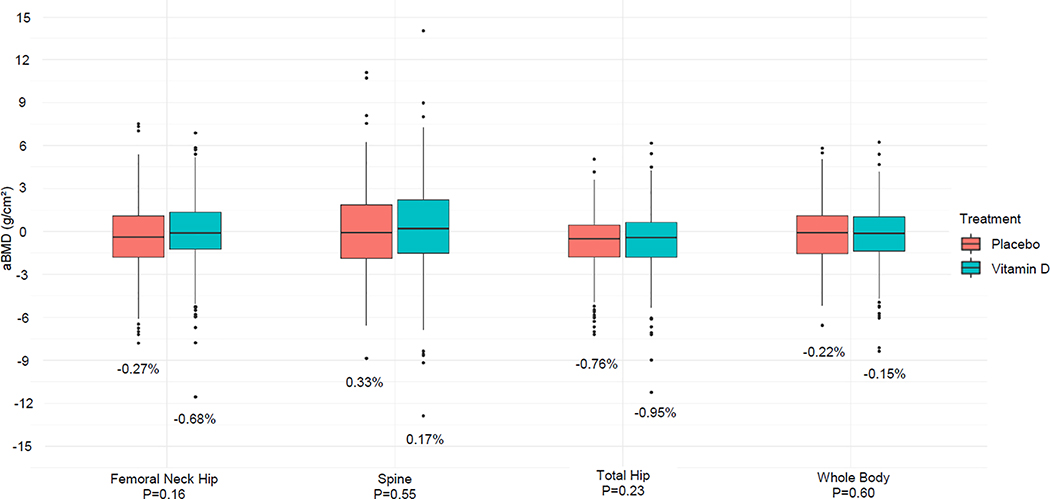
Description:Although supplemental vitamin D is used to promote bone health in the general population, data from randomized controlled trials (RCTs) have been inconsistent. We determined whether daily, vitamin D| supplementation improves bone mineral density (BMD) and/or structure. VITamin D and OmegA-3 TriaL (VITAL) is a double-blind, placebo-controlled RCT of supplemental vitamin D| (2000 IU/d) and/or omega-3 fatty acids (1 g/d) in 25,871 adults nationwide. This ancillary study included a subcohort of 771 participants (men ≥50 and women ≥55 years; not taking bone active medications) evaluated at baseline and at 2-year follow-up (89% retention). Total 25(OH)D levels were measured by liquid chromatography tandem mass spectrometry (Quest Diagnostics, San Juan Capistrano, CA, USA). Free 25(OH)D (FVD) levels were measured using the ELISA assay by Future Diagnostics Solutions BV (Wijchen, Netherlands). Primary endpoints were 2-year changes in areal (a) BMD at the spine, hip, and whole body determined by dual-energy X-ray absorptiometry (DXA). Secondary endpoints were 2-year changes in volumetric (v) BMD and cortical thickness at the radius and tibia assessed by peripheral quantitative computed tomography. Supplemental vitamin D| versus placebo had no effect on 2-year changes in aBMD at the spine (0.33% versus 0.17%; p = 0.55), femoral neck (-0.27% versus -0.68%; p = 0.16), total hip (-0.76% versus -0.95%; p = 0.23), or whole body (-0.22% versus -0.15%; p = 0.60), or on measures of bone structure. Effects did not vary by sex, race/ethnicity, body mass index, or 25(OH)D levels. Among participants with baseline FVD levels below the median (<14.2 pmol/L), there was a slight increase in spine aBMD (0.75% versus 0%; p = 0.043) and attenuation in loss of total hip aBMD (-0.42% versus -0.98%; p = 0.044) with vitamin D| . Whether baseline FVD levels help to identify those more likely to benefit from supplementation warrants further study. Supplemental vitamin D| versus placebo for 2 years in general healthy adults not selected for vitamin D insufficiency did not improve BMD or structure. © 2020 The Authors. Journal of Bone and Mineral Research published by American Society for Bone and Mineral Research.
-
Subjects:
-
Keywords:
-
Source:J Bone Miner Res. 35(5):883-893
-
Pubmed ID:31923341
-
Pubmed Central ID:PMC7217747
-
Document Type:
-
Funding:AT/NCCIH NIH HHSUnited States/ ; R01 CA138962/CA/NCI NIH HHSUnited States/ ; UL1TR001102/RR/NCRR NIH HHSUnited States/ ; R01 AR059775/AR/NIAMS NIH HHSUnited States/ ; U01 CA138962/CA/NCI NIH HHSUnited States/ ; NS/NINDS NIH HHSUnited States/ ; R01 DK112940/DK/NIDDK NIH HHSUnited States/ ; R01 AR060574/AR/NIAMS NIH HHSUnited States/ ; R01 HL134811/HL/NHLBI NIH HHSUnited States/ ; CC/CDC HHSUnited States/ ; K24 HL136852/HL/NHLBI NIH HHSUnited States/ ; R01 AR070854/AR/NIAMS NIH HHSUnited States/ ; UL1 TR001102/TR/NCATS NIH HHSUnited States/
-
Volume:35
-
Issue:5
-
Download URL:
-
File Type:
 [PDF - 556.12 KB]
 -
Collection(s):
-
Main Document Checksum:urn:sha-512:c24bbcb3f3ee65a559c97490f7c964484955ed84c39d470a7c2e12d4af863008bc8d0a6a295c9d67854d71d26195e1c56c0abbb88d11f99dc8d39c6199327dce
Supporting Files


File Language:
English
 Was this page helpful?
 Found an issue?

CDC STACKS serves as an archival repository of CDC-published products including
scientific findings, journal articles, guidelines, recommendations, or other public health information authored or
co-authored by CDC or funded partners.
As a repository, CDC STACKS retains documents in their original published format to ensure public access to scientific information.
As a repository, CDC STACKS retains documents in their original published format to ensure public access to scientific information.
You May Also Like
COLLECTION
CDC Public Access