


Physical environment and violence perpetration among male youth in Pittsburgh: A spatial analysis
Supporting Files

-
12 2020
-
File Language:
English
Details
-
Alternative Title:Inj Prev
-
Personal Author:
-
Description:Purpose:
Examine associations between features of the built environment and violence perpetration among male youth.
Methods:
We enrolled 868 male adolescents, ages 13-19 years, as part of a violence prevention study in 20 low-resource neighborhoods in Pittsburgh, PA. Exposure to built environmental features was defined using participants’ neighborhood study site. Violence perpetration was measured by three survey items: physical fighting, threatening someone with a weapon, and injuring someone with a weapon. Logistic regression models examined associations between each environmental feature and violence perpetration.
Results:
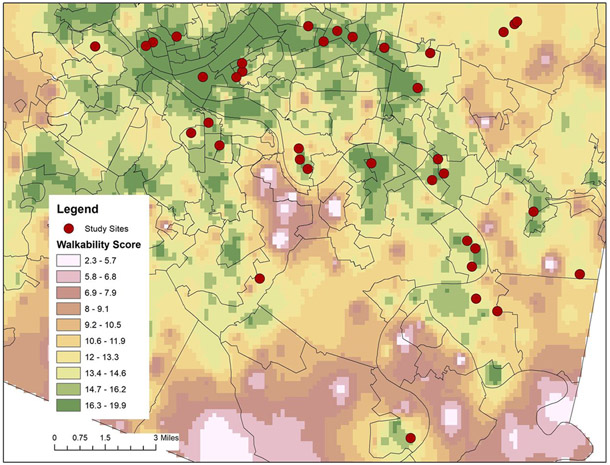
Better neighborhood walkability was associated with significantly lower odds of fighting (adjusted odds ratio (AOR)=0.86, 95%CI:0.76-0.99). Alcohol and tobacco outlets were associated with slightly lower odds of violence perpetration (AORs=0.90-0.96).
Conclusions:
This work extends previous studies from large urban centers to a mid-sized city context and suggests that walkable neighborhoods create opportunities for social interactions and may serve as a protective factor in youth violence.
-
Subjects:
-
Source:Inj Prev. 26(6):588-592
-
Pubmed ID:31300466
-
Pubmed Central ID:PMC8045459
-
Document Type:
-
Funding:
-
Place as Subject:
-
Volume:26
-
Issue:6
-
Collection(s):
-
Main Document Checksum:urn:sha256:b54137e9d898f180f8b2b76b8342287f1f05c1b502752fc495b6b2c19c7fc6a2
-
Download URL:
-
File Type:
 [PDF
- 312.71 KB
]
[PDF
- 312.71 KB
]
Supporting Files


File Language:
English
ON THIS PAGE

CDC STACKS serves as an archival repository of CDC-published products including
scientific findings,
journal articles, guidelines, recommendations, or other public health information authored or
co-authored by CDC or funded partners.
As a repository, CDC STACKS retains documents in their original published format to ensure public access to scientific information.
As a repository, CDC STACKS retains documents in their original published format to ensure public access to scientific information.
You May Also Like
COLLECTION
CDC Public Access