


Prevalence and Mortality among Children with Congenital Diaphragmatic Hernia: A Multi-Country Analysis
Supporting Files

-
4 2021
-
File Language:
English
Details
-
Alternative Title:Ann Epidemiol
-
Personal Author:Politis, Maria D. ; Bermejo-Sánchez, Eva ; Canfield, Mark A. ; Contiero, Paolo ; Cragan, Janet D. ; Dastgiri, Saeed ; de Walle, Hermien ; Feldkamp, Marcia L. ; Nance, Amy ; Groisman, Boris ; Gatt, Miriam ; Benavides-Lara, Adriana ; Hurtado-Villa, Paula ; Kallén, Kärin ; Landau, Danielle ; Nathalie Lelong, ; Lopez-Camelo, Jorge ; Martinez, Laura ; Morgan, Margery ; Mutchinick, Osvaldo M. ; Pierini, Anna ; Rissmann, Anke ; Šípek, Antonin ; Szabova, Elena ; Wertelecki, Wladimir ; Zarante, Ignacio ; Bakker, Marian K. ; Kancherla, Vijaya ; Mastroiacovo, Pierpaolo ; Nembhard, Wendy N.
-
Description:Importance
Congenital diaphragmatic hernia (CDH), a severe birth defect characterized by a diaphragmatic malformation allowing herniation by abdominal organs into the thorax, is associated with high mortality.
Objective
The purpose of our study was to examine (1) the overall CDH prevalence and (2) mortality and survival trends of infants with CDH using data collected by hospital- and population-based birth defects surveillance programs from multiple countries affiliated with the International Clearinghouse for Birth Defects Surveillance and Research (ICBDSR).
Design, Setting, and Participants Methods
Twenty-five hospital- and population-based surveillance programs in 19 countries from members of the ICBDSR provided birth defects mortality data between 1974 and 2015. Prevalence estimates and mortality rates from 2001 to 2012, a period in which the majority of the programs had the most complete data, were further examined. Included were CDH cases involving live births, stillbirths, or elective termination of pregnancy for fetal anomalies.
Main Outcomes and Measures
Prevalence and 95% confidence intervals (CI) from Poisson regression and cumulative mortality rates and 95% CI from the Kaplan-Meier Product-Limit method were calculated for each country and registry type. Joinpoint regression analyses were conducted to assess time trends.
Results
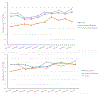
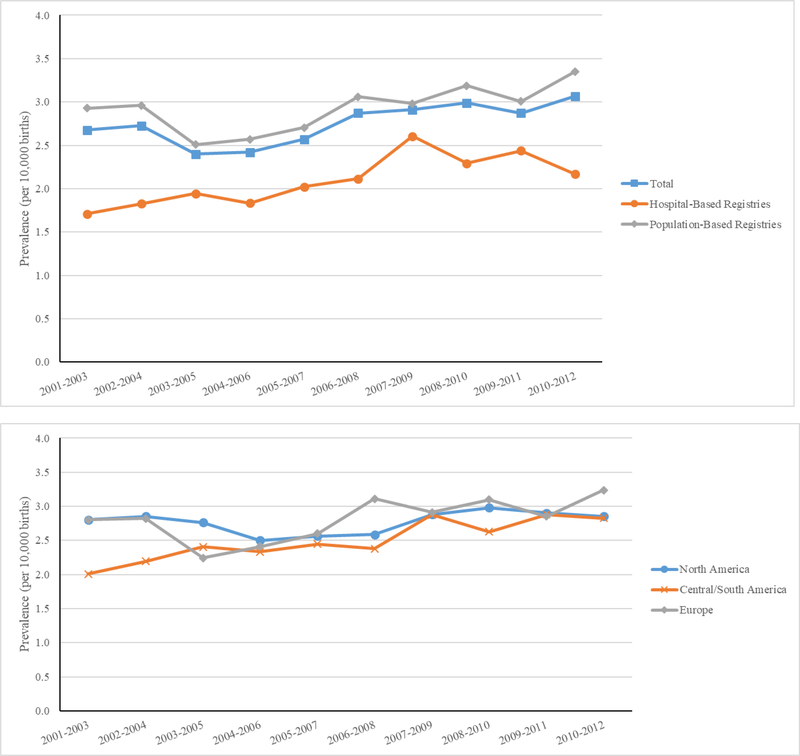
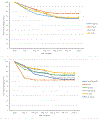
Overall, the prevalence of CDH from all countries combined was 2.6 per 10,000 total births (95% CI: 2.5–2.7), slightly increasing between 2001 and 2012 (average annual percent change [AAPC]=0.47%). The overall percent mortality of CDH was 37.7%, with hospital-based registries having more deaths involving live births than population-based registries (45.1% compared to 33.8%). Mortality rates decreased over time (AAPC=−2.43%). Infants with multiple congenital anomalies and syndromes had higher 1-week mortality rates (45.2% and 40.8%) than those with isolated defects (28.6%) overall. Most deaths due to CDH occurred among 2- to 6-day-old infants for both registry types (36.3%, hospital-based; 12.1%, population-based).
Conclusions and Relevance
The prevalence of CDH has increased over time; although the mortality rate has slightly decreased, it remains high especially during the first week of life and varied by registry type. Further research is needed to inform development of measures and interventions to decrease deaths among infants with CDH.
-
Subjects:
-
Source:Ann Epidemiol. 56:61-69.e3
-
Pubmed ID:33253899
-
Pubmed Central ID:PMC8009766
-
Document Type:
-
Funding:
-
Volume:56
-
Collection(s):
-
Main Document Checksum:urn:sha256:74b22821bf7bb7177b33902a4b6b745cbc21aca7e95f8446137107733f00b0ed
-
Download URL:
-
File Type:
 [PDF
- 674.39 KB
]
[PDF
- 674.39 KB
]
Supporting Files


File Language:
English
ON THIS PAGE


CDC STACKS serves as an archival repository of CDC-published products including
scientific findings,
journal articles, guidelines, recommendations, or other public health information authored or
co-authored by CDC or funded partners.
As a repository, CDC STACKS retains documents in their original published format to ensure public access to scientific information.
As a repository, CDC STACKS retains documents in their original published format to ensure public access to scientific information.
You May Also Like
COLLECTION
CDC Public Access