



Symptom Profiles and Progression in Hospitalized and Nonhospitalized Patients with Coronavirus Disease, Colorado, USA, 2020
Supporting Files
Public Domain

-
Feb 2021
File Language:
English
Details
-
Alternative Title:Emerg Infect Dis
-
Personal Author:Vahey, Grace M. ; Marshall, Kristen E. ; McDonald, Emily ; Martin, Stacey W. ; Tate, Jacqueline E. ; Midgley, Claire M. ; Killerby, Marie E. ; Kawasaki, Breanna ; Herlihy, Rachel K. ; Alden, Nisha B. ; Staples, J. Erin
-
Corporate Authors:
-
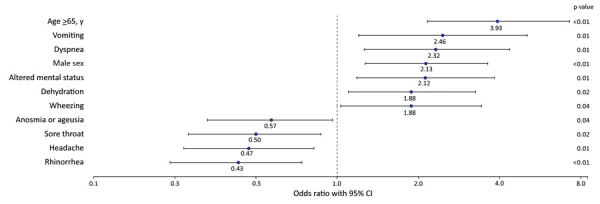
Description:To improve recognition of coronavirus disease (COVID-19) and inform clinical and public health guidance, we randomly selected 600 COVID-19 case-patients in Colorado. A telephone questionnaire captured symptoms experienced, when symptoms occurred, and how long each lasted. Among 128 hospitalized patients, commonly reported symptoms included fever (84%), fatigue (83%), cough (73%), and dyspnea (72%). Among 236 nonhospitalized patients, commonly reported symptoms included fatigue (90%), fever (83%), cough (83%), and myalgia (74%). The most commonly reported initial symptoms were cough (21%-25%) and fever (20%-25%). In multivariable analysis, vomiting, dyspnea, altered mental status, dehydration, and wheezing were significantly associated with hospitalization, whereas rhinorrhea, headache, sore throat, and anosmia or ageusia were significantly associated with nonhospitalization. General symptoms and upper respiratory symptoms occurred earlier in disease, and anosmia, ageusia, lower respiratory symptoms, and gastrointestinal symptoms occurred later. Symptoms should be considered alongside other epidemiologic factors in clinical and public health decisions regarding potential COVID-19 cases.
-
Subjects:
-
Source:Emerg Infect Dis. 27(2):385-395
-
Pubmed ID:33496225
-
Pubmed Central ID:PMC7853576
-
Document Type:
-
Place as Subject:
-
Location:
-
Volume:27
-
Issue:2
-
Download URL:
-
File Type:
 [PDF - 1.75 MB]
 -
Collection(s):
-
Main Document Checksum:urn:sha256:4b27f5e1e66cf3224b198921ba2cad5039b5c42b47f9cf86564491af9d8b72d7
Supporting Files


File Language:
English
 Was this page helpful?
 Found an issue?




CDC STACKS serves as an archival repository of CDC-published products including
scientific findings, journal articles, guidelines, recommendations, or other public health information authored or
co-authored by CDC or funded partners.
As a repository, CDC STACKS retains documents in their original published format to ensure public access to scientific information.
As a repository, CDC STACKS retains documents in their original published format to ensure public access to scientific information.
You May Also Like
COLLECTION
Emerging Infectious Diseases