



Trajectories in Estimated Glomerular Filtration Rate in Youth-Onset Type 1 and Type 2 Diabetes: The SEARCH for Diabetes in Youth Study
Supporting Files

-
2 2021
-
File Language:
English
Details
-
Alternative Title:J Diabetes Complications
-
Personal Author:
-
Description:Aims:
We sought to characterize the direction and associated factors of eGFR change following diagnosis of youth-onset type 1 and type 2 diabetes.
Methods:
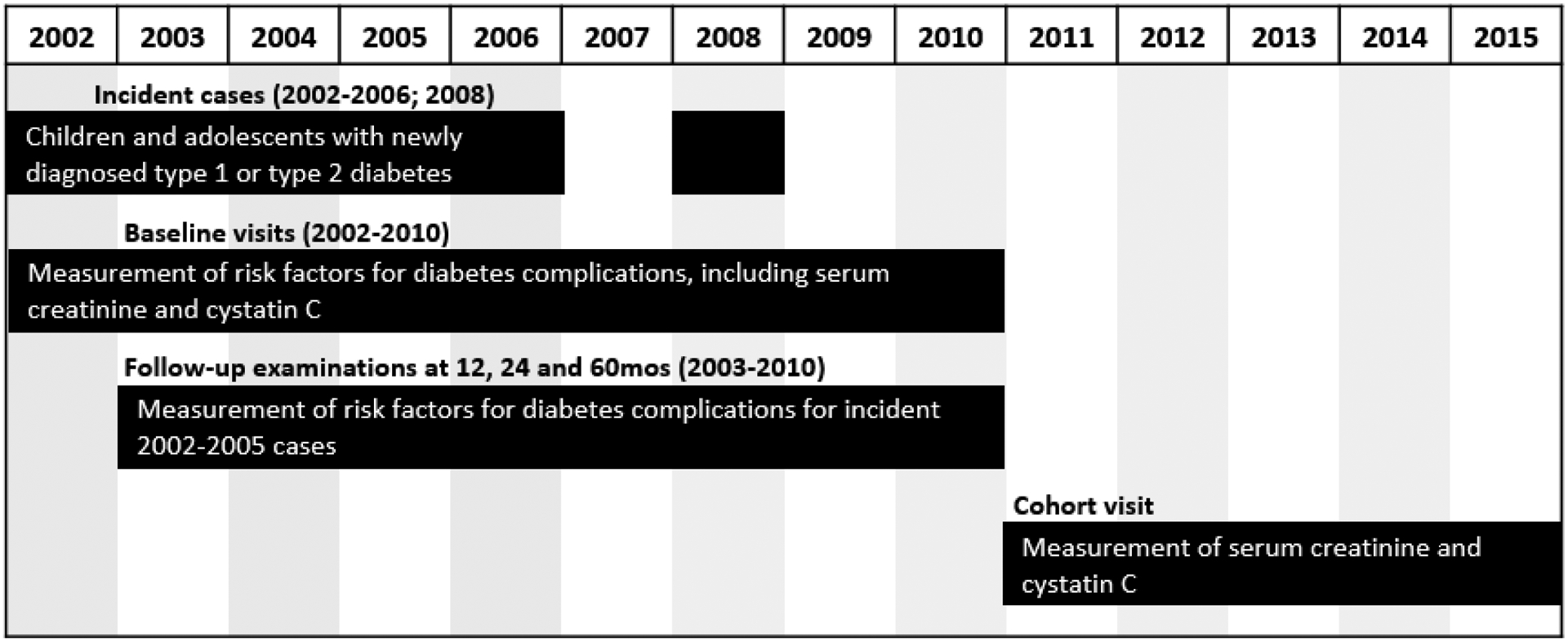
We assessed the direction of eGFR change at two visits (mean 6.6 years apart) in SEARCH, a longitudinal cohort study of youth-onset type 1 and type 2 diabetes. We used the CKiDCr-CysC equation to estimate GFR and categorized ‘rising’ and ‘declining’ eGFR as an annual change of ≥3ml/min/1.73m2 in either direction. Multivariable logistic regression evaluated factors associated with directional change in eGFR.
Results:
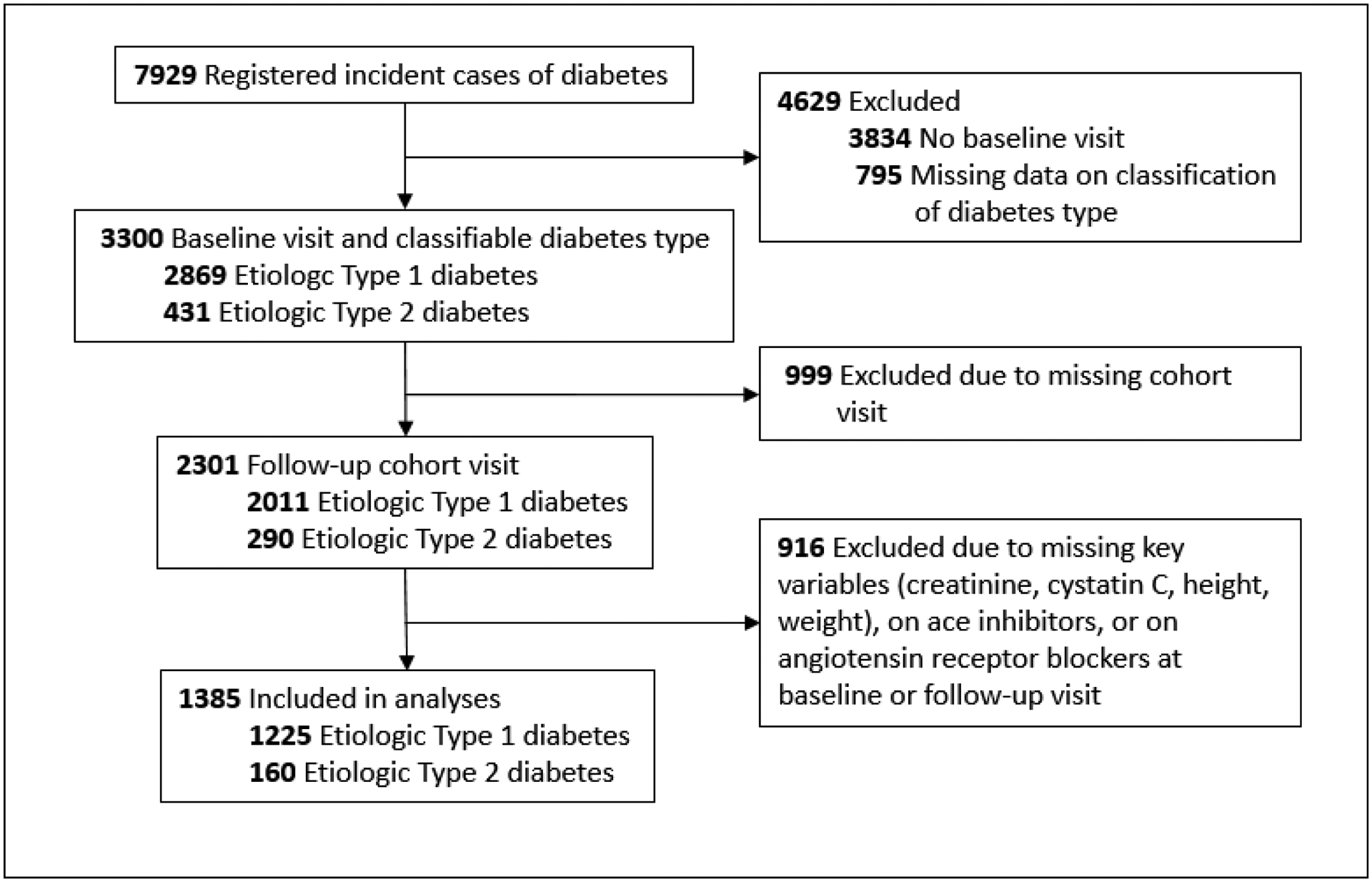
Estimated GFR declined in 23.8% and rose in 2.8% of participants with type 1 diabetes (N=1225; baseline age 11.4 years), and declined in 18.1% and rose in 15.6% of participants with type 2 diabetes (N=160; baseline age 15.0 years). Factors associated with rising and declining eGFR (versus stable) in both type 1 and type 2 diabetes included sex, age at diagnosis, baseline eGFR and difference in fasting glucose between study visits. Additional factors in type 1 diabetes included time from baseline visit, HbA1c and body mass index.
Conclusions:
Over the first decade of diabetes, eGFR decline is more common in type 1 diabetes whereas eGFR rise is more common in type 2 diabetes.
-
Subjects:
-
Keywords:
-
Source:J Diabetes Complications. 35(2):107768
-
Pubmed ID:33168393
-
Pubmed Central ID:PMC7855388
-
Document Type:
-
Funding:U01 DP000247/DP/NCCDPHP CDC HHSUnited States/ ; U18 DP002710/DP/NCCDPHP CDC HHSUnited States/ ; UL1 TR000154/TR/NCATS NIH HHSUnited States/ ; U18 DP002714/DP/NCCDPHP CDC HHSUnited States/ ; U01 DP000248/DP/NCCDPHP CDC HHSUnited States/ ; U01 DP000244/DP/NCCDPHP CDC HHSUnited States/ ; UL1 TR000062/TR/NCATS NIH HHSUnited States/ ; U18 DP002709/DP/NCCDPHP CDC HHSUnited States/ ; UL1 TR002319/TR/NCATS NIH HHSUnited States/ ; UL1 TR000077/TR/NCATS NIH HHSUnited States/ ; U01 DP000250/DP/NCCDPHP CDC HHSUnited States/ ; U18 DP002708/DP/NCCDPHP CDC HHSUnited States/ ; P30 DK057516/DK/NIDDK NIH HHSUnited States/ ; HIR 10-001/HX/HSRD VAUnited States/ ; R01 DK127208/DK/NIDDK NIH HHSUnited States/ ; UL1 TR000423/TR/NCATS NIH HHSUnited States/ ; U01 DP000246/DP/NCCDPHP CDC HHSUnited States/ ; U01 DP000254/DP/NCCDPHP CDC HHSUnited States/
-
Volume:35
-
Issue:2
-
Collection(s):
-
Main Document Checksum:urn:sha-512:fc6d46ed3f4243bc687cf59e0e410613cedbfa5aba867ad11e9d7bf98686eec177f8b299e1b4201bf5d23743a16562cfc1f4319c4682e339ea34e0afd5d678d4
-
Download URL:
-
File Type:
 [PDF
- 433.60 KB
]
[PDF
- 433.60 KB
]
Supporting Files


File Language:
English
 Was this page helpful?
 Found an issue?
CDC STACKS serves as an archival repository of CDC-published products including
scientific findings,
journal articles, guidelines, recommendations, or other public health information authored or
co-authored by CDC or funded partners.
As a repository, CDC STACKS retains documents in their original published format to ensure public access to scientific information.
As a repository, CDC STACKS retains documents in their original published format to ensure public access to scientific information.
You May Also Like
COLLECTION
CDC Public Access