



Trends in U.S. Emergency Department Visits Related to Suspected or Confirmed Child Abuse and Neglect Among Children and Adolescents Aged <18 Years Before and During the COVID-19 Pandemic — United States, January 2019–September 2020
Supporting Files
Public Domain

-
December 11 2020
File Language:
English
Details
-
Journal Article:Morbidity and Mortality Weekly Report (MMWR)
-
Personal Author:
-
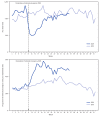
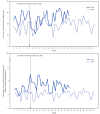
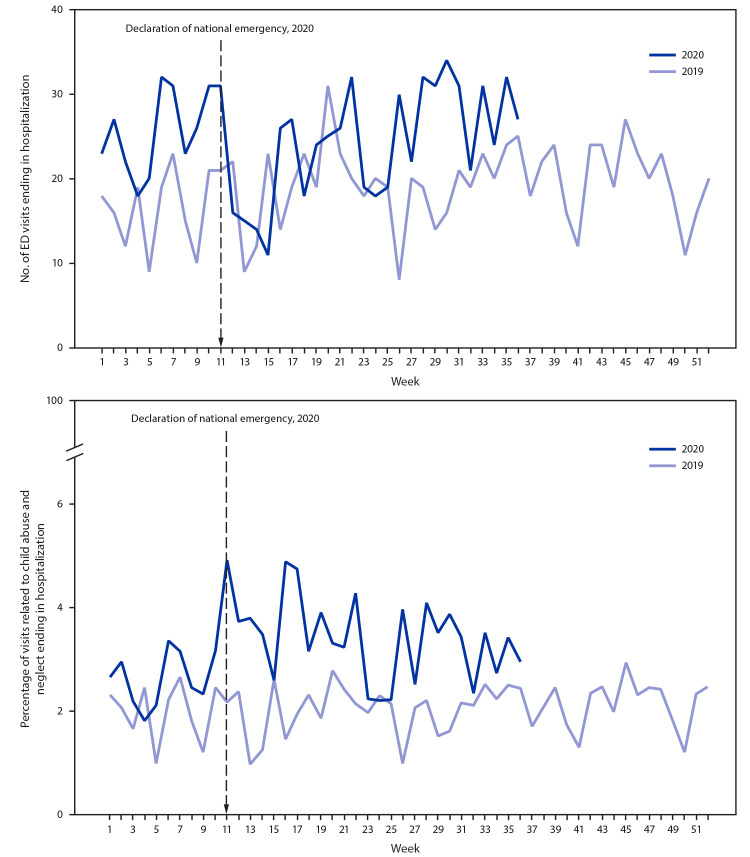
Description:Heightened stress, school closures, loss of income, and social isolation resulting from the coronaVirus disease 2019 (COVID-19) pandemic have increased the risk for child abuse and neglect (1). Using National Syndromic Surveillance Program (U.S.) (NSSP) data from January 6, 2019-September 6, 2020, CDC tabulated weekly numbers of emergency department (ED) visits related to child abuse and neglect and calculated the proportions of such visits per 100,000 ED visits, as well as the percentage of suspected or confirmed ED visits related to child abuse and neglect ending in hospitalization, overall and stratified by age group (0-4, 5-11, and 12-17 years). The total number of ED visits related to child abuse and neglect began decreasing below the corresponding 2019 period during week 11 (March 15-March 22, 2020) for all age groups examined, coinciding with the declaration of a national emergency on March 13 (2); simultaneously, the proportion of these visits per 100,000 ED visits began increasing above the 2019 baseline for all age groups. Despite decreases in the weekly number of ED visits related to child abuse and neglect, the weekly number of these visits resulting in hospitalization remained stable in 2020; however, the yearly percentage of ED visits related to child abuse and neglect resulting in hospitalization increased significantly among all age groups. Although the increased proportion of ED visits related to child abuse and neglect might be associated with a decrease in the overall number of ED visits, these findings also suggest that health care-seeking patterns have shifted during the pandemic. Hospitalizations for child abuse and neglect did not decrease in 2020, suggTesting that injury severity did not decrease during the pandemic, despite decreased ED visits. Child abuse is preventable; implementation of strategies including strengthening household economic supports and creating family-friendly work policies can reduce stress during difficult times and increase children's opportunities to thrive in safe, stable, and nurturing relationships and environments (3).
-
Subjects:
-
Source:MMWR Morbidity Mortal Weekly Rep. 69(49):1841-1847
-
Series:
-
ISSN:0149-2195 (print) ; 1545-861X (digital)
-
Pubmed ID:33301436
-
Pubmed Central ID:PMC7737689
-
Document Type:
-
Place as Subject:
-
Pages in Document:7 pdf pages
-
Volume:69
-
Issue:49
-
Download URL:
-
File Type:
 [PDF - 278.92 KB]
 -
Collection(s):
-
Main Document Checksum:urn:sha-512:94a89b6e7f3b71c5db50b843f50134b954ff97cc9c6ac95dafaeafe50f3b0883a2a4433ea6baae4ca32434ebf2f2fa7287e31609673d52a6078f3fff0ca77a82
Supporting Files


File Language:
English
 Was this page helpful?
 Found an issue?


CDC STACKS serves as an archival repository of CDC-published products including
scientific findings, journal articles, guidelines, recommendations, or other public health information authored or
co-authored by CDC or funded partners.
As a repository, CDC STACKS retains documents in their original published format to ensure public access to scientific information.
As a repository, CDC STACKS retains documents in their original published format to ensure public access to scientific information.
You May Also Like
COLLECTION
Morbidity and Mortality Weekly Report (MMWR)