



Self-Reported Exposure to Secondhand Smoke and Support for Complete Smoking Bans in Multiunit Housing Among Smokers in the United States, Canada, and the United Kingdom
Supporting Files

-
November 25 2020
File Language:
English
Details
-
Journal Article:Preventing Chronic Disease (PCD)
-
Personal Author:
-
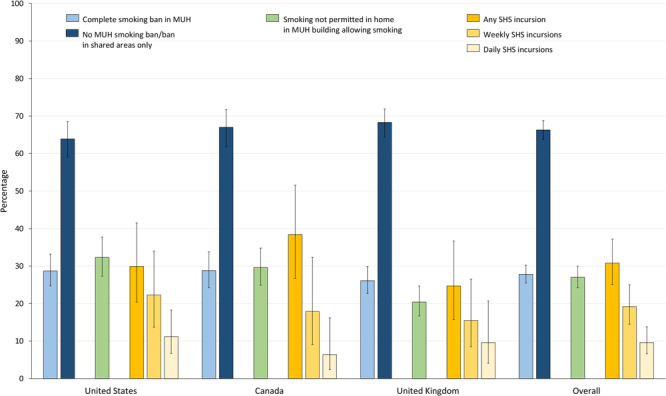
Description:Introduction ; Involuntary exposure to secondhand smoke most frequently occurs at home, which is problematic for residents of multiunit housing (MUH). The primary objective of this study was to estimate the extent of secondhand smoke incursions into the homes of MUH smokers who banned smoking in their homes but lived in buildings where smoking is allowed. ; Methods ; We used data from Wave 9 of the International Tobacco Control Four Country Survey. We estimated 1) the prevalence of complete smoking bans among smokers living in single-family homes vs MUH in the United States (n = 3,208), Canada (n = 1,592), and the United Kingdom (n = 1,403) from 2013 to 2015; 2) the extent of secondhand smoke incursions into the homes of MUH smokers who banned smoking in their units but lived in buildings that allow smoking; and 3) MUH smokers’ preferences for complete smoking bans in MUH. Weighted multivariable logistic regression estimated the country-specific adjusted prevalence of all outcomes. ; Results ; Overall, 53.0% of smokers living in single-family homes completely banned smoking in their homes, compared with 44.8% of smokers in MUH. Across all 3 countries, only 27.8% of MUH smokers reported that smoking was completely prohibited in their building. A similar percentage of MUH smokers who banned smoking in their home but lived in buildings allowing smoking reported a secondhand smoke incursion into their home in the United States (29.9%; 95% CI, 20.4%–41.5%), Canada (38.4%; 95% CI, 26.7%–51.6%), and the United Kingdom (24.7%; 95% CI, 15.7%–36.7%). Across all 3 countries, 36.1% (95% CI, 33.4%–38.9%) of smokers in MUH reported they preferred a complete smoking ban in all building areas. ; Conclusion ; A need remains to educate MUH operators and residents about the benefits of comprehensive smoke-free policies.
-
Subjects:
-
Source:Prev Chronic Dis. 2020; 17
-
ISSN:1545-1151
-
Pubmed ID:33241991
-
Pubmed Central ID:PMC7735481
-
Document Type:
-
Funding:
-
Volume:17
-
Download URL:
-
File Type:
 [PDF - 489.82 KB]
 -
Collection(s):
-
Main Document Checksum:urn:sha-512:2eaac766a997174f32c842ae3ca2c2f513ef5691605333059bf2506dcd3bd4b8a54109e5248501f18d8376d78e841ebad3f602077ff18f4d14a662a90ad8754c
Supporting Files


File Language:
English
 Was this page helpful?
 Found an issue?




CDC STACKS serves as an archival repository of CDC-published products including
scientific findings, journal articles, guidelines, recommendations, or other public health information authored or
co-authored by CDC or funded partners.
As a repository, CDC STACKS retains documents in their original published format to ensure public access to scientific information.
As a repository, CDC STACKS retains documents in their original published format to ensure public access to scientific information.
You May Also Like
COLLECTION
Preventing Chronic Disease