



Increase in Hospital-Acquired Carbapenem-Resistant Acinetobacter Baumannii Infection and Colonization in an Acute Care Hospital During a Surge in COVID-19 Admissions — New Jersey, February–July 2020
Supporting Files
Public Domain

-
December 04 2020
File Language:
English
Details
-
Journal Article:Morbidity and Mortality Weekly Report (MMWR)
-
Personal Author:
-
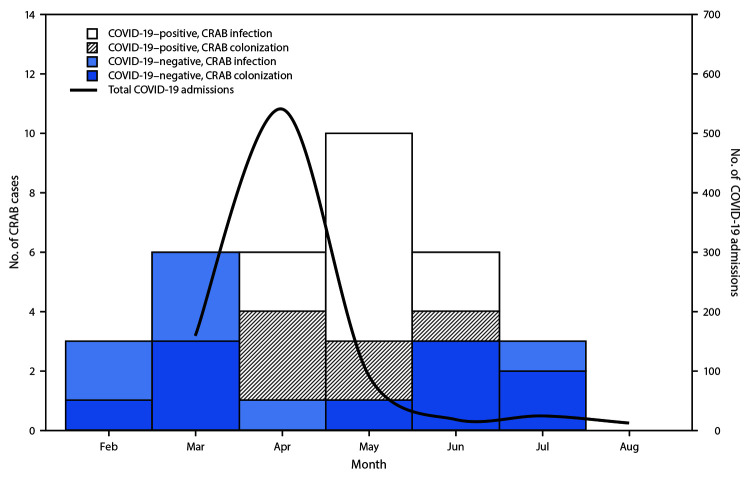
Description:Carbapenem-resistant Acinetobacter Baumannii (CRAB), an opportunistic pathogen primarily associated with hospital-acquired infections, is an urgent public health threat (1). In health care facilities, CRAB readily contaminates the patient care environment and health care providers' hands, survives for extended periods on dry surfaces, and can be spread by asymptomatically colonized persons; these factors make CRAB outbreaks in acute care hospitals difficult to control (2,3). On May 28, 2020, a New Jersey hospital (hospital A) reported a cluster of CRAB infections during a surge in patients hospitalized with coronaVirus disease 2019 (COVID-19). Hospital A and the New Jersey Department of Health (NJDOH) conducted an investigation, and identified 34 patients with hospital-acquired multidrug-resistant CRAB infection or colonization during February-July 2020, including 21 (62%) who were admitted to two intensive care units (ICUs) dedicated to caring for COVID-19 patients. In late March, increasing COVID-19-related hospitalizations led to shortages in personnel, personal protective equipment (PPE), and medical equipment, resulting in changes to conventional infection Prevention and control (IPC) practices. In late May, hospital A resumed normal operations, including standard IPC measures, as COVID-19 hospitalizations decreased, lessening the impact of personnel and supply chain shortages on hospital functions. CRAB cases subsequently returned to a pre-COVID-19 baseline of none to two cases monthly. The occurrence of this cluster underscores the potential for multidrug-resistant organisms (MDROs) to spread during events when standard hospital practices might be disrupted; conventional IPC strategies should be reinstated as soon as capacity and resources allow.
-
Subjects:
-
Source:MMWR Morbidity Mortal Weekly Rep. 69(48):1827-1831
-
Series:
-
ISSN:0149-2195 (print) ; 1545-861X (digital)
-
Pubmed ID:33270611
-
Pubmed Central ID:PMC7714028
-
Document Type:
-
Place as Subject:
-
Pages in Document:5 pdf pages
-
Volume:69
-
Issue:48
-
Download URL:
-
File Type:
 [PDF - 136.96 KB]
 -
Collection(s):
-
Main Document Checksum:urn:sha-512:b4f03f1a9674b32b6c5d757fe1bce20d1f1c87ba8e390735c204ba0b29c1a34dd7ac9c860785e0abcd5acade36b2ccd819dea6805995145f8c18c1defe4bab5b
Supporting Files


File Language:
English
 Was this page helpful?
 Found an issue?

CDC STACKS serves as an archival repository of CDC-published products including
scientific findings, journal articles, guidelines, recommendations, or other public health information authored or
co-authored by CDC or funded partners.
As a repository, CDC STACKS retains documents in their original published format to ensure public access to scientific information.
As a repository, CDC STACKS retains documents in their original published format to ensure public access to scientific information.
You May Also Like
COLLECTION
Morbidity and Mortality Weekly Report (MMWR)