



COVID-19 Outbreak — New York City, February 29–June 1, 2020
Supporting Files
Public Domain

-
November 20 2020
File Language:
English
Details
-
Journal Article:Morbidity and Mortality Weekly Report (MMWR)
-
Personal Author:Thompson, Corinne N. ; Baumgartner, Jennifer ; Pichardo, Carolina ; Toro, Brian ; Li, Lan ; Arciuolo, Robert ; Chan, Pui Ying ; Chen, Judy ; Culp, Gretchen ; Davidson, Alexander ; Devinney, Katelynn ; Dorsinville, Alan ; Eddy, Meredith ; English, Michele ; Fireteanu, Ana Maria ; Graf, Laura ; Geevarughese, Anita ; Greene, Sharon K. ; Guerra, Kevin ; Huynh, Mary ; Hwang, Christina ; Iqbal, Maryam ; Jessup, Jillian ; Knorr, Jillian ; Latash, Julia ; Lee, Ellen ; Lee, Kristen ; Li, Wenhui ; Mathes, Robert ; McGibbon, Emily ; McIntosh, Natasha ; Montesano, Matthew ; Moore, Miranda S. ; Murray, Kenya ; Ngai, Stephanie ; Paladini, Marc ; Paneth-Pollak, Rachel ; Parton, Hilary ; Peterson, Eric ; Pouchet, Renee ; Ramachandran, Jyotsna ; Reilly, Kathleen ; Sanderson Slutsker, Jennifer ; Van Wye, Gretchen ; Wahnich, Amanda ; Winters, Ann ; Layton, Marcelle ; Jones, Lucretia ; Reddy, Vasudha ; Fine, Anne
-
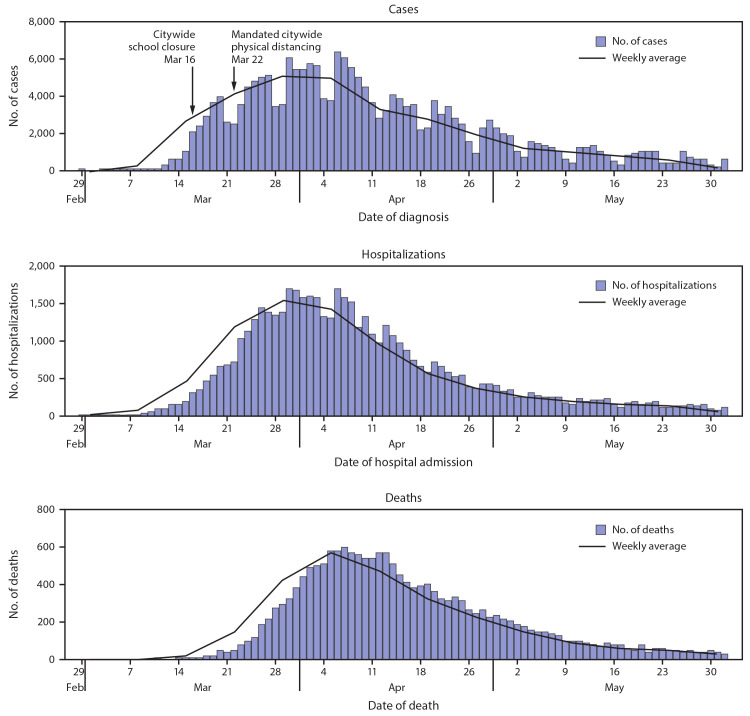
Description:New York City (NYC) was an epicenter of the coronaVirus disease 2019 (COVID-19) outbreak in the United States during spring 2020 (1). During March-May 2020, approximately 203,000 laboratory-confirmed COVID-19 cases were reported to the NYC Department of Health and Mental Hygiene (DOHMH). To obtain more complete data, DOHMH used supplementary information sources and relied on direct data importation and matching of patient identifiers for data on hospitalization status, the occurrence of death, race/ethnicity, and presence of underlying medical conditions. The highest rates of cases, hospitalizations, and deaths were concentrated in communities of color, high-poverty areas, and among persons aged ≥75 years or with underlying conditions. The crude fatality rate was 9.2% overall and 32.1% among hospitalized patients. Using these data to prevent additional infections among NYC residents during subsequent waves of the pandemic, particularly among those at highest risk for hospitalization and death, is critical. Mitigating COVID-19 Transmission among vulnerable groups at high risk for hospitalization and death is an urgent priority. Similar to NYC, other jurisdictions might find the use of supplementary information sources valuable in their efforts to prevent COVID-19 infections.
-
Subjects:
-
Source:MMWR Morbidity Mortal Weekly Rep. 69(46):1725-1729
-
Series:
-
ISSN:0149-2195 (print) ; 1545-861X (digital)
-
Pubmed ID:33211680
-
Pubmed Central ID:PMC7676643
-
Document Type:
-
Place as Subject:
-
Pages in Document:5 pdf pages
-
Volume:69
-
Issue:46
-
Download URL:
-
File Type:
 [PDF - 856.84 KB]
 -
Collection(s):
-
Main Document Checksum:urn:sha-512:e4adfa69b73ba4b756e144aa8f7766cb2224dace3933399a5b3eeeeddd513977d61e95ac5d6043325766ac14b26f87c188ec0d0db2212f66021aa13e8d685009
Supporting Files

Related Documents


File Language:
English
 Was this page helpful?
 Found an issue?




CDC STACKS serves as an archival repository of CDC-published products including
scientific findings, journal articles, guidelines, recommendations, or other public health information authored or
co-authored by CDC or funded partners.
As a repository, CDC STACKS retains documents in their original published format to ensure public access to scientific information.
As a repository, CDC STACKS retains documents in their original published format to ensure public access to scientific information.
You May Also Like
COLLECTION
Morbidity and Mortality Weekly Report (MMWR)