



Routine Vaccination Coverage — Worldwide, 2019
Supporting Files
Public Domain

-
November 13 2000
Details
-
Journal Article:Morbidity and Mortality Weekly Report (MMWR)
-
Personal Author:
-
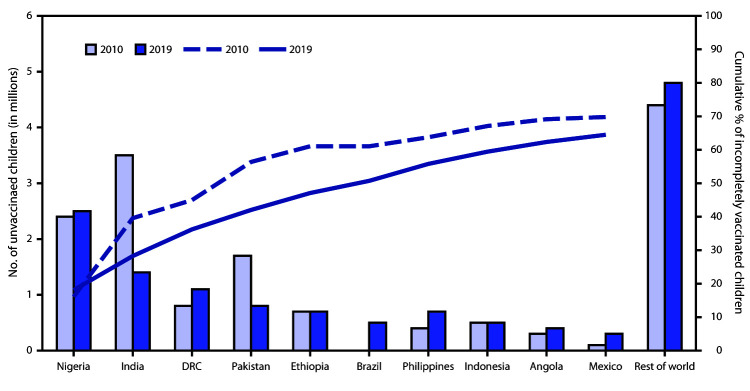
Description:Endorsed by the World Health Assembly in 2020, the Immunization Agenda 2030 strives to reduce morbidity and Mortality from vaccine-preventable Diseases across the life course (1). This report, which updates previous reports (2), presents global, regional,* and national vaccination coverage estimates and Trends as of 2019 and describes the number of surviving infants who did not receive the first dose of diphtheria and tetanus toxoids and pertussis-containing vaccine (DTP1) during the first year of life (i.e., zero-dose children), which serves as a proxy for children with poor access to immunization and other health services. Global estimates of coverage with the third dose of DTP (DTP3), the first dose of measles-containing vaccine (MCV1), and the third dose of polio vaccine (Pol3) ranged from 84% to 86% during 2010-2019. Worldwide, 19.7 million children (15%) were not vaccinated with DTP3 in 2019, 13.8 million (70%) of whom were zero-dose children. During 2010-2019, the number of zero-dose children increased in the African, Americas, and Western Pacific regions. Global coverage with the second MCV dose (MCV2) increased from 42% in 2010 to 71% in 2019. During 2010-2019, global coverage with underused vaccines increased for the completed series of rotaVirus vaccine (rota), pneumococcal conjugate vaccine (PCV), rubella-containing vaccine (RCV), Haemophilus influenzae type b vaccine (Hib), hepatitis B vaccine (HepB), and human papillomaVirus vaccine (HPV). Achieving universal coverage with all recommended vaccines will require tailored, context-specific strategies to reach communities with substantial proportions of zero-dose and incompletely vaccinated children, particularly those in remote rural, urban poor, and conflict-affected communities (3).
-
Subjects:
-
Source:MMWR Morbidity Mortal Weekly Rep. 69(45):1706-1710
-
Series:
-
ISSN:0149-2195 (print) ; 1545-861X (digital)
-
Pubmed ID:33187395
-
Pubmed Central ID:PMC7660669
-
Document Type:
-
Corporate as Subject:
-
Pages in Document:5 pdf pages
-
Volume:69
-
Issue:45
-
Download URL:
-
File Type:
 [PDF - 118.51 KB]
 -
Collection(s):
-
Main Document Checksum:urn:sha-512:77228916ef6f7a8df04f96e20ac480381b51bd264d16d22cf2167e69124974ed4fe4fe38e45bca1e9c080db2484cf06824ba6976f11405adb03e34ac90322061
Supporting Files


 Was this page helpful?
 Found an issue?

CDC STACKS serves as an archival repository of CDC-published products including
scientific findings, journal articles, guidelines, recommendations, or other public health information authored or
co-authored by CDC or funded partners.
As a repository, CDC STACKS retains documents in their original published format to ensure public access to scientific information.
As a repository, CDC STACKS retains documents in their original published format to ensure public access to scientific information.
You May Also Like
COLLECTION
Morbidity and Mortality Weekly Report (MMWR)