



Quantification of selection bias in studies of risk factors for birth defects among live births
Supporting Files

-
11 2020
-
Available in CDC Stacks on November 01, 2021, 12:00 AM
File Language:
English
Details
-
Journal Article:Paediatr Perinat Epidemiol
-
Personal Author:
-
Description:Background
Risk factors for birth defects are frequently investigated using data limited to liveborn infants. By conditioning on survival, results of such studies may be distorted by selection bias, also described as “live birth bias”. However, the implications of live birth bias on risk estimation remain poorly understood.
Objectives
We sought to quantify live birth bias and to investigate the conditions under which it arose.
Methods
We used data on 3,994 birth defects cases and 11,829 controls enrolled in the National Birth Defects Prevention Study to compare odds ratio (OR) estimates of the relationship between three established risk factors (antiepileptic drug use, smoking, and multifetal pregnancy) and four birth defects (anencephaly, spina bifida, omphalocele, and cleft palate) when restricted to live births as compared to among live births, stillbirths, and elective terminations. Exposures and birth defects represented varying strengths of association with live birth; all controls were liveborn. We performed a quantitative bias analysis to evaluate the sensitivity of our results to excluding terminated and stillborn controls.
Results
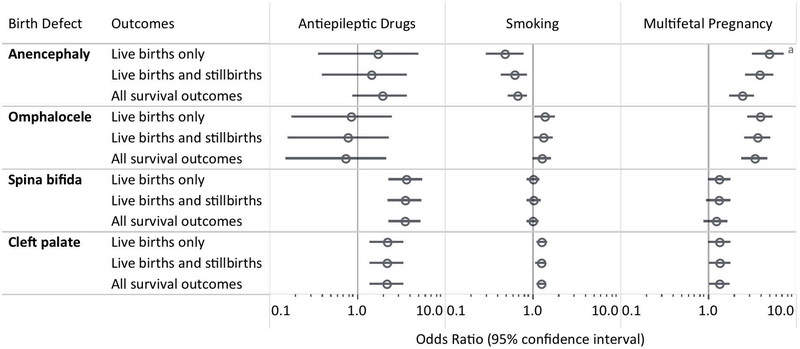
Cases ranged from 33% live born (anencephaly) to 99% (cleft palate). Smoking and multifetal pregnancy were associated with live birth among anencephaly (crude OR cOR 0.61 and cOR 3.15, respectively) and omphalocele cases (cOR 2.22 and cOR 5.22, respectively). For analyses of the association between exposures and birth defects, restricting to live births produced negligible differences in estimates except for anencephaly and multifetal pregnancy, which was two-fold higher among live births (adjusted OR aOR 4.93) as among all pregnancy outcomes (aOR 2.44). Within tested scenarios, bias analyses suggested that results were not sensitive to the restriction to liveborn controls.
Conclusions
Selection bias was generally limited except for high mortality defects in the context of exposures strongly associated with livebirth. Findings indicate that substantial live birth bias is unlikely to affect studies of risk factors for most birth defects. -
Subjects:
-
Source:Paediatr Perinat Epidemiol. 34(6):655-664
-
DOI:
-
Pubmed ID:32249969
-
Pubmed Central ID:PMC7541428
-
Document Type:
-
Funding:P30 ES010126/ES/NIEHS NIH HHSUnited States/ ; U01 DD000491/DD/NCBDD CDC HHSUnited States/ ; U01 DD001224/DD/NCBDD CDC HHSUnited States/ ; T32HD060454/HD/NICHD NIH HHSUnited States/ ; U01 DD001227/DD/NCBDD CDC HHSUnited States/ ; U01 DD000493/DD/NCBDD CDC HHSUnited States/ ; T03MC07648/HRSA/HRSA HHSUnited States/ ; EP-D-18-001/EPA/EPAUnited States/ ; T32 HD060454/HD/NICHD NIH HHSUnited States/ ; U01DD001037/DD/NCBDD CDC HHSUnited States/ ; U01 DD001226/DD/NCBDD CDC HHSUnited States/ ; U01 DD001223/DD/NCBDD CDC HHSUnited States/ ; U01DD000493/DD/NCBDD CDC HHSUnited States/ ; 5U01DD000491/DD/NCBDD CDC HHSUnited States/ ; CDP 13-003/HX/HSRD VAUnited States/ ; U01DD001037/ACL/ACL HHSUnited States/ ; U01 DD001035/DD/NCBDD CDC HHSUnited States/
-
Genre:
-
Volume:34
-
Issue:6
-
Download URL:
-
File Type:
 [PDF - 774.99 KB]
 -
Collection(s):
-
Main Document Checksum:urn:sha-512:87663920c472ce1e12d50f5632d2af22629702cfca5ffa15e4d227620f723da7b9bab14e380b1f54cd6d9643a4ebc4176112b9f21da870ecc3bde7d36c3425ca
Supporting Files


File Language:
English
 Was this page helpful?
 Found an issue?




CDC STACKS serves as an archival repository of CDC-published products including
scientific findings, journal articles, guidelines, recommendations, or other public health information authored or
co-authored by CDC or funded partners.
As a repository, CDC STACKS retains documents in their original published format to ensure public access to scientific information.
As a repository, CDC STACKS retains documents in their original published format to ensure public access to scientific information.
You May Also Like
COLLECTION
CDC Public Access