



Increased pulmonary artery diameter is associated with reduced FEV1 in former World Trade Center workers
Supporting Files

-
10 2019
-
Available in CDC Stacks on 2020-10-01T00:00:00Z

File Language:
English
Details
-
Journal Article:Clin Respir J
-
Personal Author:
-
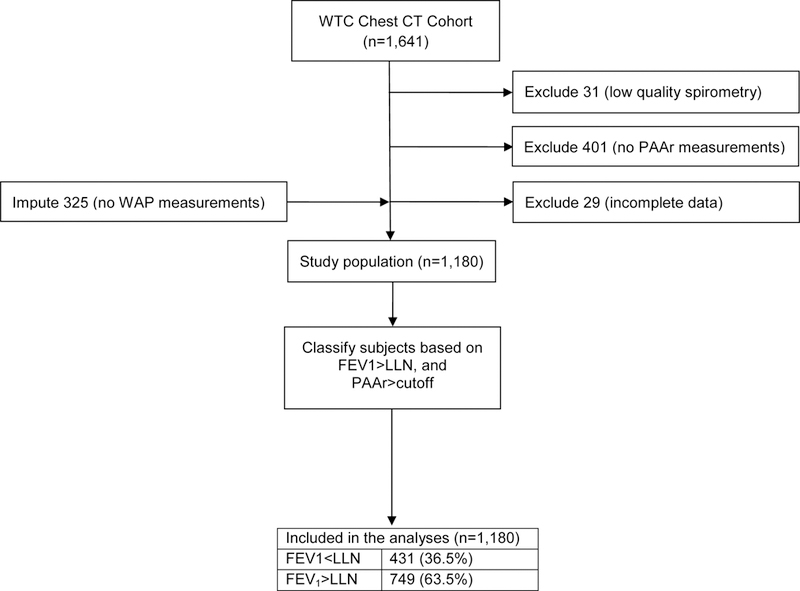
Description:Rationale: ; Occupational exposures at the WTC site after September 11, 2001 have been associated with several presumably inflammatory lower airway diseases. Pulmonary arterial enlargement, as suggested by an increased ratio of the diameter of the pulmonary artery to the diameter of the aorta (PAAr) has been reported as a computed tomographic (CT) scan marker of adverse respiratory health outcomes, including WTC-related disease. In this study, we sought to utilize a novel quantitative CT (QCT) measurement of PAAr to test the hypothesis that an increased ratio is associated with FEV1 below each subject’s statistically determined lower limit of normal (FEV1
; Results: ; Unadjusted analyses showed a statistically significant association of FEV1 ; Conclusions: ; In WTC workers, FEV1 ; Trial registration: ; ClinicalTrials.gov identifier . -
Subjects:
- Adult
- Bronchodilator Agents
- Female
- Forced Expiratory Volume
- Humans
- Male
- Middle Aged
- New York
- Occupational Exposure
- Pulmonary Artery
- Pulmonary Disease, Chronic Obstructive
- Respiratory Function Tests
- September 11 Terrorist Attacks
- Smoke Inhalation Injury
- Stress Disorders, Post-Traumatic
- Tomography, X-Ray Computed
-
Keywords:
-
Source:Clin Respir J. 13(10):614-623
-
DOI:
-
Pubmed ID:31347281
-
Pubmed Central ID:PMC6783324
-
Document Type:
-
Funding:
-
Genre:
-
Volume:13
-
Issue:10
-
Download URL:
-
File Type:
 [PDF - 522.13 KB]
 -
Collection(s):
-
Main Document Checksum:urn:sha-512:57f08def9b39c8f8252264f120dd0a8997eda5eef5c969f89544c40a4872dd66e33f0ce64f5cea1c6407e44c353d117e5e89d6e1734fea968c3bf0709cb5cb49
Supporting Files


File Language:
English
 Was this page helpful?
 Found an issue?



CDC STACKS serves as an archival repository of CDC-published products including
scientific findings, journal articles, guidelines, recommendations, or other public health information authored or
co-authored by CDC or funded partners.
As a repository, CDC STACKS retains documents in their original published format to ensure public access to scientific information.
As a repository, CDC STACKS retains documents in their original published format to ensure public access to scientific information.
You May Also Like
COLLECTION
CDC Public Access