



Community and Close Contact Exposures Associated with COVID-19 Among Symptomatic Adults ≥18 Years in 11 Outpatient Health Care Facilities — United States, July 2020
Supporting Files
Public Domain

-
September 11 2020
File Language:
English
Details
-
Journal Article:Morbidity and Mortality Weekly Report (MMWR)
-
Personal Author:Fisher, Kiva A. ; Tenforde, Mark W. ; Feldstein, Leora R. ; Lindsell, Christopher J. ; Shapiro, Nathan I. ; Files, D. Clark ; Gibbs, Kevin W. ; Erickson, Heidi L. ; Prekker, Matthew E. ; Steingrub, Jay S. ; Exline, Matthew C. ; Henning, Daniel J. ; Wilson, Jennifer G. ; Brown, Samuel M. ; Peltan, Ithan D. ; Rice, Todd W. ; Hager, David N. ; Ginde, Adit A. ; Talbot, H. Keipp ; Casey, Jonathan D. ; Grijalva, Carlos G. ; Flannery, Brendan ; Patel, Manish M. ; Self, Wesley H. ; Hart, Kimberly W. ; McClellan, Robert ; Tan, Hsi-nien ; Baughman, Adrienne ; Hennesy, Nora A. ; Grear, Brittany ; Wu, Michael ; Mlynarczyk, Kristin ; Marzano, Luc ; Plata, Zuwena ; Caplan, Alexis ; Olson, Samantha M. ; Ogokeh, Constance E. ; Smith, Emily R. ; Kim, Sara S. ; Griggs, Eric P. ; Richards, Bridget ; Robinson, Sonya ; Kim, Kaylee ; Kassem, Ahmed M. ; Sciarratta, Courtney N. ; Marcet, Paula L.
-
Corporate Authors:
-
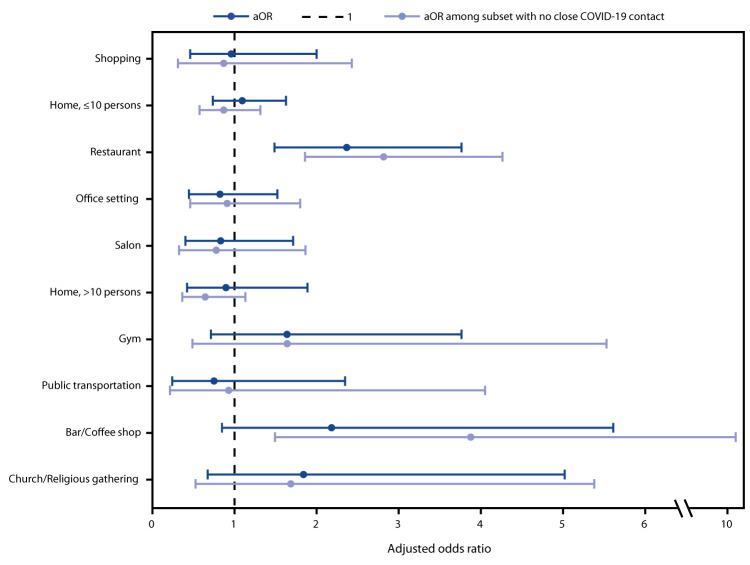
Description:Community and close contact exposures continue to drive the coronaVirus disease 2019 (COVID-19) pandemic. CDC and other public health authorities recommend community mitigation strategies to reduce Transmission of SARS-CoV-2, the Virus that causes COVID-19 (1,2). Characterization of community exposures can be difficult to assess when widespread Transmission is occurring, especially from asymptomatic persons within inherently interconnected communities. Potential exposures, such as close contact with a person with confirmed COVID-19, have primarily been assessed among COVID-19 cases, without a non-COVID-19 comparison group (3,4). To assess community and close contact exposures associated with COVID-19, exposures reported by case-patients (154) were compared with exposures reported by control-participants (160). Case-patients were symptomatic adults (persons aged ≥18 years) with SARS-CoV-2 infection confirmed by reverse transcription-polymerase chain reaction (RT-PCR) tTesting. Control-participants were symptomatic outpatient adults from the same health care facilities who had negative SARS-CoV-2 test results. Close contact with a person with known COVID-19 was more commonly reported among case-patients (42%) than among control-participants (14%). Case-patients were more likely to have reported dining at a restaurant (any area designated by the restaurant, including indoor, patio, and outdoor seating) in the 2 weeks preceding illness onset than were control-participants (adjusted odds ratio aOR = 2.4; 95% confidence interval CI = 1.5-3.8). Restricting the Analysis to participants without known close contact with a person with confirmed COVID-19, case-patients were more likely to report dining at a restaurant (aOR = 2.8, 95% CI = 1.9-4.3) or going to a bar/coffee shop (aOR = 3.9, 95% CI = 1.5-10.1) than were control-participants. Exposures and activities where mask use and social distancing are difficult to maintain, including going to places that offer on-site eating or drinking, might be important risk factors for acquiring COVID-19. As communities reopen, efforts to reduce possible exposures at locations that offer on-site eating and drinking options should be considered to protect customers, employees, and communities.
-
Subjects:
-
Source:MMWR Morbidity Mortal Weekly Rep. 69(36):1258-1264
-
Series:
-
ISSN:0149-2195 (print) ; 1545-861X (digital)
-
Pubmed ID:32915165
-
Pubmed Central ID:PMC7499837
-
Document Type:
-
Place as Subject:
-
Pages in Document:7 pdf pages
-
Volume:69
-
Issue:36
-
Download URL:
-
File Type:
 [PDF - 133.34 KB]
 -
Collection(s):
-
Main Document Checksum:urn:sha-512:1142e4afc7bd51431ade3c9177f602cefa6097734885e4b6a9a8e696dae671c0227e0a518b5b80ce4a4f99ea28ca33f84ca5f5b603ade2123e9e45f460654f02
Supporting Files


File Language:
English
 Was this page helpful?
 Found an issue?


CDC STACKS serves as an archival repository of CDC-published products including
scientific findings, journal articles, guidelines, recommendations, or other public health information authored or
co-authored by CDC or funded partners.
As a repository, CDC STACKS retains documents in their original published format to ensure public access to scientific information.
As a repository, CDC STACKS retains documents in their original published format to ensure public access to scientific information.
You May Also Like
COLLECTION
Morbidity and Mortality Weekly Report (MMWR)