



Hurricane Evacuation Laws in Eight Southern U.S. Coastal States — December 2018
Supporting Files
Public Domain

-
September 11 2020
File Language:
English
Details
-
Journal Article:Morbidity and Mortality Weekly Report (MMWR)
-
Personal Author:
-
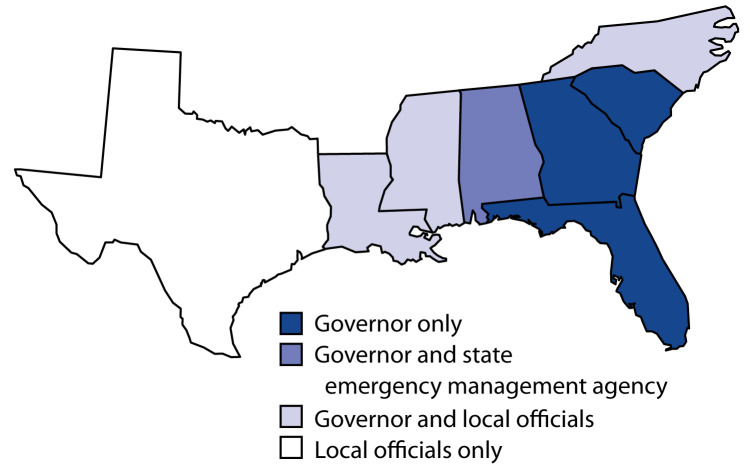
Description:National Preparedness month is observed every September as a public service reminder of the importance of personal and community preparedness for all events; it coincides with the peak of the hurricane season in the United States Severe storms and hurricanes can have long-lasting effects at all community levels. Persons who are prepared and well-informed are often better able to protect themselves and others (1). Major hurricanes can devastate low-lying coastal areas and cause injury and loss of life from storm surge, flooding, and high winds (2). State and local government entities play a significant role in preparing communities for hurricanes and by evacuating coastal communities before landfall to reduce loss of life from flooding, wind, and power outages (3). Laws can further improve planning and outreach for catastrophic events by ensuring explicit statutory authority over evacuations of communities at risk (4). State evacuation laws vary widely and might not adequately address information and communication flows to reach populations living in disaster-prone areas who are at risk. To understand the range of evacuation laws in coastal communities that Historyically have been affected by hurricanes, a systematic policy scan of the existing laws supporting hurricane evacuation in eight southern coastal states (Alabama, Florida, Georgia, Louisiana, Mississippi, North Carolina, South Carolina, and Texas) was conducted. After conducting a thematic Analysis, this report found that all eight states have laws to execute evacuation orders, traffic control (egress/ingress), and evacuation to shelters. However, only four of the states have laws related to community outreach, delivery of public education programs, and public notice requirements. The findings in this report suggest a need for authorities in hurricane-prone states to review how to execute evacuation policies, particularly with respect to community outreach and communication to populations at risk. Implementation of state evacuation laws and policies that support hurricane evacuation management can help affected persons avoid harm and enhance community resiliency (5). Newly emerging and re-emerging infectious Diseases, such as SARS-CoV-2, the Virus that causes coronaVirus disease 2019 (COVID-19), have and will continue to additionally challenge hurricane evacuations.
-
Subjects:
-
Source:MMWR Morbidity Mortal Weekly Rep. 69(36):1233-1237
-
Series:
-
ISSN:0149-2195 (print) ; 1545-861X (digital)
-
Pubmed ID:32914768
-
Pubmed Central ID:PMC7499836
-
Document Type:
-
Place as Subject:
-
Pages in Document:5 pdf pages
-
Volume:69
-
Issue:36
-
Download URL:
-
File Type:
 [PDF - 166.60 KB]
 -
Collection(s):
-
Main Document Checksum:urn:sha-512:fa872846ab4a4d8cc6f1b768b155fb4c62509b2683b8fc634272cc34fdbbf9ef28f19bcdaaea0833642a6e22d2a50c33ce9609d5e8b2b5885334f5bdb57232c5
Supporting Files


File Language:
English
 Was this page helpful?
 Found an issue?


CDC STACKS serves as an archival repository of CDC-published products including
scientific findings, journal articles, guidelines, recommendations, or other public health information authored or
co-authored by CDC or funded partners.
As a repository, CDC STACKS retains documents in their original published format to ensure public access to scientific information.
As a repository, CDC STACKS retains documents in their original published format to ensure public access to scientific information.
You May Also Like
COLLECTION
Morbidity and Mortality Weekly Report (MMWR)