


283. Potentially Achievable Hepatitis A Vaccination Coverage with Simultaneous Administration of Vaccines Among Young Children in the United States
Supporting Files
Public Domain

-
2019 Oct
-
File Language:
English
Details
-
Alternative Title:Open Forum Infect Dis
-
Personal Author:
-
Description:Background
The Advisory Committee on Immunization Practices recommends simultaneous administration of all age-appropriate doses of vaccines. We estimated the vaccination coverage for ≥2 doses of hepatitis A vaccine (≥2 HepA) that could have been achieved if opportunities for simultaneous administration with other recommended childhood vaccines had not been missed.
Methods
We analyzed National Immunization Survey-Child data for 2008–2017 in the United States. We defined potentially achievable ≥2 HepA coverage by age 24 months as the possible coverage if opportunities for simultaneous administration with other age-appropriate doses of vaccines for children by age 24 months had not been missed. We compared potentially achievable vaccination coverage to reported ≥2 HepA vaccination coverage by birth years 2007 to 2015. For children born in 2015, we stratified estimates by state and by selected socio-demographic factors. Both potentially achievable and reported ≥2 HepA coverage were evaluated using a Kaplan–Meier survival procedure to account for censoring of vaccination status.
Results
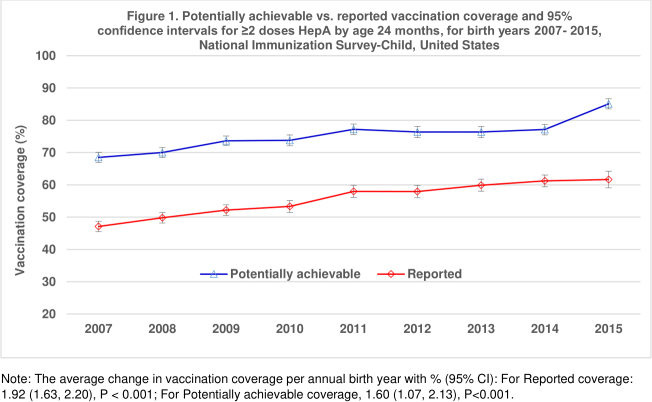
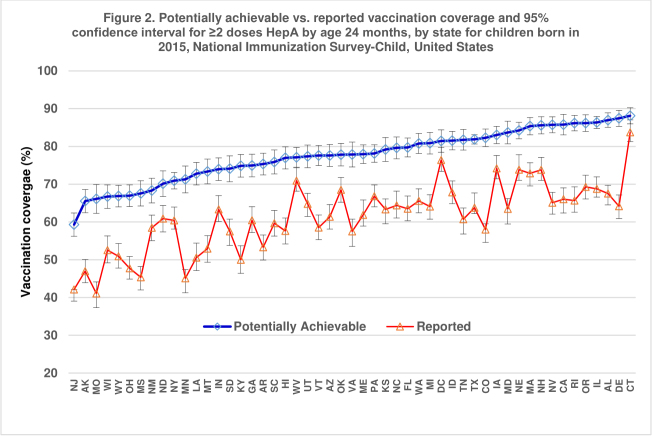
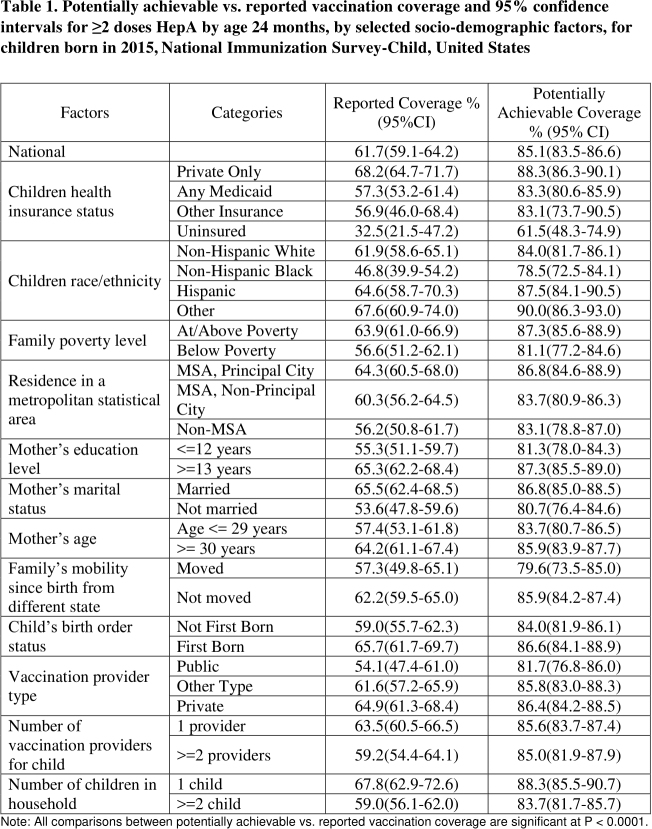
Compared with reported vaccination coverage, potentially achievable coverage for ≥2 HepA was at least 10 percentage points higher across birth years 2007 to 2015 and would have surpassed the 85% target of Healthy People 2020 for children born in 2015 (Figure 1). For the 2015 birth cohort, potentially achievable ≥2 HepA coverage exceeded the 85% Healthy People 2020 target in ten states (Figure 2). In addition, potentially achievable vaccination coverage was higher than reported coverage across all selected socio-demographic factors, with differences ranging from 20.1 percentage-points (private insurance only) to 31.7 percentage-points (non-Hispanic Black) (Table 1).
Conclusion
Potentially achievable coverage with ≥2 HepA consistently exceeded reported coverage for children from nine recent birth cohorts and across all selected socio-demographic characteristics. Coverage could increase substantially if missed opportunities were eliminated. Evidence-based interventions such as establishment of standing orders, use of provider reminders, and use of immunization information systems are recommended to increase HepA coverage among young children.
Disclosures
All authors: No reported disclosures.
-
Subjects:
-
Source:Open Forum Infect Dis. 2019; 6(Suppl 2):S154-S155
-
Pubmed Central ID:PMC6809844
-
Document Type:
-
Volume:6
-
Collection(s):
-
Main Document Checksum:urn:sha256:6bec8d0505fb509ae9d9f3aefba5082a7e8f869ad097d89384d7bf4ef28d3294
-
Download URL:
-
File Type:
 [PDF
- 1.39 MB
]
[PDF
- 1.39 MB
]
Supporting Files


File Language:
English
ON THIS PAGE

CDC STACKS serves as an archival repository of CDC-published products including
scientific findings,
journal articles, guidelines, recommendations, or other public health information authored or
co-authored by CDC or funded partners.
As a repository, CDC STACKS retains documents in their original published format to ensure public access to scientific information.
As a repository, CDC STACKS retains documents in their original published format to ensure public access to scientific information.
You May Also Like
COLLECTION
CDC Public Access