


Assessment of immunity to polio among Rohingya children in Cox’s Bazar, Bangladesh, 2018: A cross-sectional survey
Supporting Files

-
2020 Mar 31
File Language:
English
Details
-
Alternative Title:PLoS Med
-
Personal Author:
-
Description:Background
We performed a cross-sectional survey in April–May 2018 among Rohingya in Cox’s Bazar, Bangladesh, to assess polio immunity and inform vaccination strategies.
Methods and findings
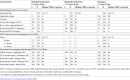
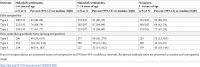
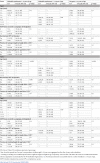
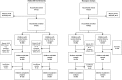
Rohingya children aged 1–6 years (younger group) and 7–14 years (older group) were selected using multi-stage cluster sampling in makeshift settlements and simple random sampling in Nayapara registered camp. Surveyors asked parents/caregivers if the child received any oral poliovirus vaccine (OPV) in Myanmar and, for younger children, if the child received vaccine in any of the 5 campaigns delivering bivalent OPV (serotypes 1 and 3) conducted during September 2017–April 2018 in Cox’s Bazar. Dried blood spot (DBS) specimens were tested for neutralizing antibodies to poliovirus types 1, 2, and 3 in 580 younger and 297 older children. Titers ≥ 1:8 were considered protective. Among 632 children (335 aged 1–6 years, 297 aged 7–14 years) enrolled in the study in makeshift settlements, 51% were male and 89% had arrived after August 9, 2017. Among 245 children (all aged 1–6 years) enrolled in the study in Nayapara, 54% were male and 10% had arrived after August 9, 2017. Among younger children, 74% in makeshift settlements and 92% in Nayapara received >3 bivalent OPV doses in campaigns. Type 1 seroprevalence was 85% (95% CI 80%–89%) among younger children and 91% (95% CI 86%–95%) among older children in makeshift settlements, and 92% (88%–95%) among younger children in Nayapara. Type 2 seroprevalence was lower among younger children than older children in makeshift settlements (74% [95% CI 68%–79%] versus 97% [95% CI 94%–99%], p < 0.001), and was 69% (95% CI 63%–74%) among younger children in Nayapara. Type 3 seroprevalence was below 75% for both age groups and areas. The limitations of this study are unknown routine immunization history and poor retention of vaccination cards.
Conclusions
Younger Rohingya children had immunity gaps to all 3 polio serotypes and should be targeted by future campaigns and catch-up routine immunization. DBS collection can enhance the reliability of assessments of outbreak risk and vaccination strategy impact in emergency settings.
Why was this study done?
What did the researchers do and find?
What do these findings mean?
-
Subjects:
-
Source:PLoS Med. 17(3)
-
Pubmed ID:32231366
-
Pubmed Central ID:PMC7108688
-
Document Type:
-
Funding:
-
Place as Subject:
-
Volume:17
-
Issue:3
-
Collection(s):
-
Main Document Checksum:urn:sha256:138506e41a20b9fc13db9b29b8ec2b6cef6d0702cc94fa466889ec9a9c320d01
-
Download URL:
-
File Type:
 [PDF
- 1.02 MB
]
[PDF
- 1.02 MB
]
Supporting Files


File Language:
English
ON THIS PAGE






CDC STACKS serves as an archival repository of CDC-published products including
scientific findings,
journal articles, guidelines, recommendations, or other public health information authored or
co-authored by CDC or funded partners.
As a repository, CDC STACKS retains documents in their original published format to ensure public access to scientific information.
As a repository, CDC STACKS retains documents in their original published format to ensure public access to scientific information.
You May Also Like
COLLECTION
CDC Public Access