


2902. Pertussis Antibody Levels in Preterm Infants After Maternal Tdap Immunization During Pregnancy
Supporting Files
Public Domain

-
2019 Oct
-
File Language:
English
Details
-
Alternative Title:Open Forum Infect Dis
-
Personal Author:
-
Description:Background
Maternal immunization with tetanus, diphtheria, acellular pertussis vaccine (Tdap) in the third trimester reduces infant pertussis, but data are lacking on how this strategy impacts pertussis antibody levels in large cohorts of preterm infants
Methods
We collected paired maternal delivery-cord sera from infants of women who received Tdap ≥7 days before birth. IgG to pertussis toxin (PT), filamentous hemagglutinin (FHA), fimbrial proteins (FIM) and pertactin (PRN) was quantified by Luminex assay (IU/mL). Geometric mean concentrations (GMC) with 95% confidence intervals (CI) for pertussis antibodies were calculated. Four infant groups were compared by weeks of gestation: very (<32), moderate (32–33) and late preterm (34–36), and term (≥37).
Results
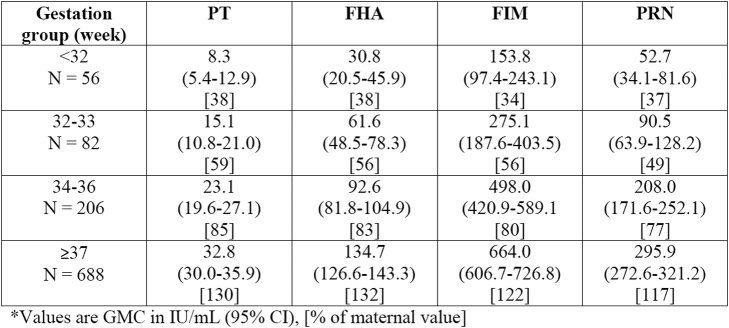
344 preterm and 688 term mother-infant pairs were included. Among preterm infants, mean maternal age was 31.2 years (range 15.1–39.3); 37% were white, 37% Hispanic, 17% Black, 8% Asian and 1% other. Fifty-six were very preterm infants (16%, mean gestation 30.5 weeks), 82 moderate (24%, 33.1 weeks), and 206 late (60%, 35.4 weeks); 17 (5%) were born at <30 weeks. For preterm infants, Tdap was administered at a mean gestation of 29.9 weeks (very 27.9; moderate 29.7; late 30.4; [P < .001]), and at a mean interval of 29.3 days before delivery (very 17.9; moderate 24; late 34.5 [P <.001]). Eleven (3%) women received Tdap during the second trimester (8 very, 2 moderate, 1 late). GMCs (95% CI) of pertussis-specific IgG at birth varied by gestation (table). Infant antibody levels as a proportion of maternal antibodies increased from 24 to 32% in infants < 30 weeks to 117 to 132% in those ≥37 weeks (P<.001).
Conclusion
Although levels are lower than in term infants, maternal immunization with Tdap results in substantial pertussis-specific antibodies in most preterm infants, especially late preterm infants.
Disclosures
All Authors: No reported Disclosures.
-
Subjects:
-
Source:Open Forum Infect Dis. 2019; 6(Suppl 2):S83
-
Pubmed Central ID:PMC6809112
-
Document Type:
-
Volume:6
-
Collection(s):
-
Main Document Checksum:urn:sha256:bd0ef6350f79e7adc11da289140aea883c5470566d9439e863d81f2ab7498e4a
-
Download URL:
-
File Type:
 [PDF
- 179.45 KB
]
[PDF
- 179.45 KB
]
Supporting Files


File Language:
English
ON THIS PAGE

CDC STACKS serves as an archival repository of CDC-published products including
scientific findings,
journal articles, guidelines, recommendations, or other public health information authored or
co-authored by CDC or funded partners.
As a repository, CDC STACKS retains documents in their original published format to ensure public access to scientific information.
As a repository, CDC STACKS retains documents in their original published format to ensure public access to scientific information.
You May Also Like
COLLECTION
CDC Public Access