


484. Metallo-β-Lactamase-Positive Carbapenem-Resistant Enterobacteriaceae and Pseudomonas aeruginosa in the Antibiotic Resistance Laboratory Network, 2017–2018
Supporting Files
Public Domain

-
October 23 2019
-
Details
-
Alternative Title:Open Forum Infect Dis
-
Personal Author:
-
Description:Background
Infections with metallo-β-lactamase (MBL)-producing organisms are emerging in the United States. Treatment options for these infections are limited. We describe MBL genes among carbapenemase positive carbapenem-resistant Enterobacteriaceae (CP-CRE) and Pseudomonas aeruginosa (CP-CRPA) isolates tested during the first two years of the Antibiotic Resistance Laboratory Network (AR Lab Network).
Methods
State and local public health laboratories tested CRE and CRPA isolates for organism identification, antimicrobial susceptibility, and PCR-based detection of blaKPC, blaNDM, blaOXA-48-like, blaVIM, and blaIMP carbapenemase genes. All testing results were sent to CDC at least monthly.
Results
Since January 2017, the AR Lab Network tested 21,733 CRE and 14,141 CRPA. CP-CRE were detected in 37% of CRE; 2% of CRPA were CP-CRPA. Among CP-CRE, 9% (686/8016) were MBL-producers (NDM, VIM, or IMP). Among MBL-producers, a blaNDM gene was detected most often (81%; 551/686). blaNDM were most common among Klebsiella spp. (47%; 261/551), blaIMP were most common among Providencia spp. (53%; 40/75), blaVIM was most common among Enterobacter spp. (19%; 25/62). Twelve percent (96) of MBL CP-CRE contained more than one carbapenemase gene. Among CP-CRPA, 73% (218/300) were MBL producers and blaVIM was the most common gene (62%; 186). Three (1%) MBL CP-CRPA contained more than one carbapenemase.
Conclusion
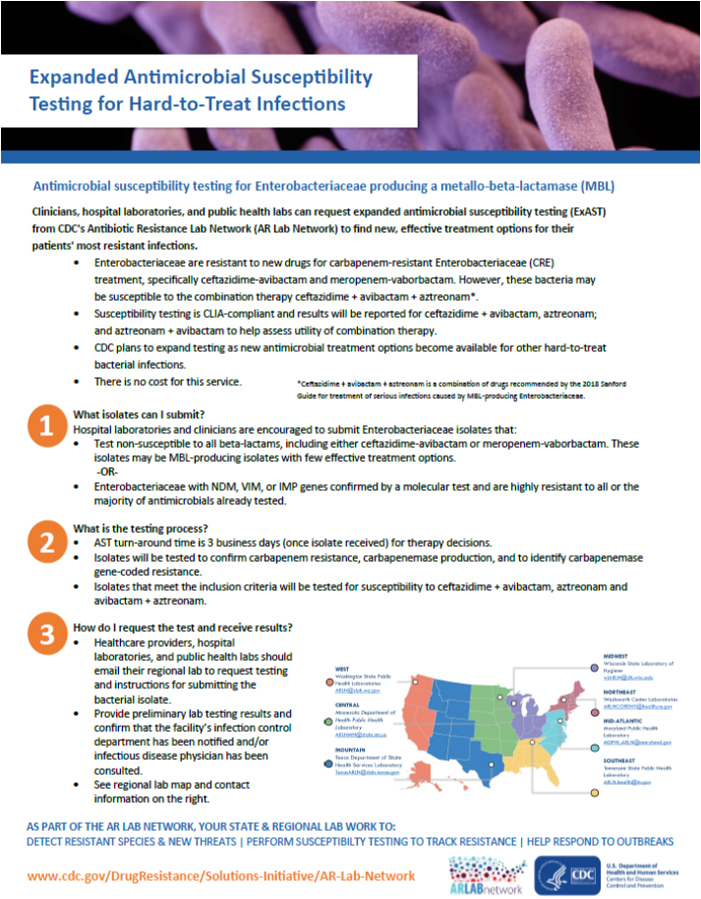
Increased testing of CRE and CRPA isolates through the AR Lab Network has facilitated early and rapid detection of hard-to-treat infections caused by MBL-producing organisms across the United States. The widespread distribution of MBL genes highlights the continued need for containment strategies that help prevent transmission between patients and among healthcare facilities. To support therapeutic decisions for severe infections caused by MBL-producing organisms, the AR Lab Network is now offering rapid susceptibility testing against aztreonam/avibactam, using digital dispenser technology. This testing program aims to close the gap between the availability of new drugs or drug combinations and the availability of commercial AST methods, thereby improving patient safety and antimicrobial stewardship.
Disclosures
All authors: No reported disclosures.
-
Subjects:
-
Source:Open Forum Infect Dis. 2019; 6(Suppl 2):S237
-
Pubmed Central ID:PMC6811257
-
Document Type:
-
Volume:6
-
Collection(s):
-
Main Document Checksum:urn:sha256:cf7421d0cffa07f5434ba919d8ebd0975a90f47d3a1cb9870d87ccd5f9709a08
-
Download URL:
-
File Type:
 [PDF
- 606.81 KB
]
[PDF
- 606.81 KB
]
Supporting Files


ON THIS PAGE

CDC STACKS serves as an archival repository of CDC-published products including
scientific findings,
journal articles, guidelines, recommendations, or other public health information authored or
co-authored by CDC or funded partners.
As a repository, CDC STACKS retains documents in their original published format to ensure public access to scientific information.
As a repository, CDC STACKS retains documents in their original published format to ensure public access to scientific information.
You May Also Like
COLLECTION
CDC Public Access