


491. Working Together: A Tale of Carbapenemase-Producing Organism Investigations in Three New York City Nursing Homes
Supporting Files
Public Domain

-
October 23 2019
-
Details
-
Alternative Title:Open Forum Infect Dis
-
Personal Author:
-
Description:Background
New York State Department of Health (NYSDOH) and Wadsworth Center (WC) participate in the Centers for Disease Control and Prevention’s Antibiotic Resistance Laboratory Network (AR Lab Network), including identification and characterization of specific bla genes in carbapenemase-producing organisms (CPO). Three investigations from November 2018–March 2019 illustrate the findings and challenges investigating CPO in a blaKPC endemic setting.
Methods
NYSDOH WC testing includes organism identification, drug susceptibility testing, detection of carbapenemase production, detection of carbapenemase genes, and whole-genome sequencing (WGS). NYSDOH epidemiologic (epi) investigations of novel resistance mechanisms review demographic and exposure data, conduct contact tracing with targeted rectal screening to identify colonized persons, and assess infection control (IC) and public health (PH) practices and provide recommendations.
Results
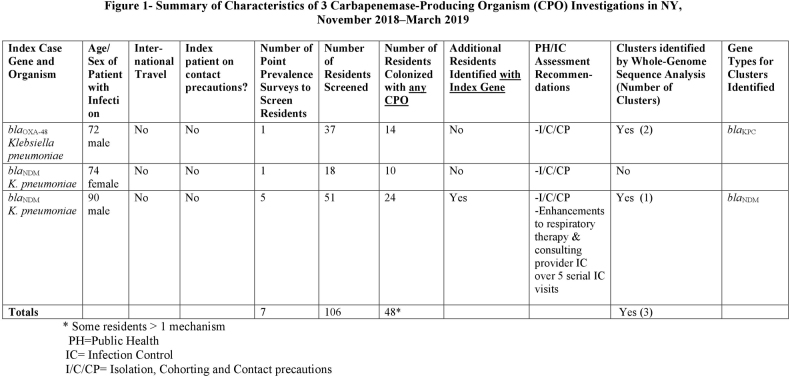
NYSDOH identified three nursing home residents infected with CPO with novel carbapenemase genes (Figure 1) with no travel history but multiple co-morbidities, including mechanical ventilation: blaOXA-48Klebsiella pneumoniae (KP) (Facility A), blaNDM KP (Facility B and C). Epi investigations identified CPO in 48 of 106 residents screened for rectal colonization; most isolates had genes other than the index gene. Facility A and Facility B each had no additional residents colonized with CPO with the index gene after screening; 14 and 10 residents, respectively from Facility A and B, had CPO with endemic blaKPC gene. WGS analysis identified 2 clusters of blaKPC KP within Facility A and no clusters of CPO were detected in Facility B. IC/PH recommendations were made after diagnosis at all 3 facilities; serial IC/PH assessments/recommendations and screening were needed to interrupt transmission at Facility C, where 24 residents were colonized with CPO, including 7 residents with CPO with the index gene (blaNDM), and a subset of the blaNDM isolates were related to the index case by both epi and WGS analysis.
Conclusion
Epi investigation and WGS were complementary to detect transmission, identify clusters within an endemic setting, and inform PH response and IC measures for these emerging CPO in NY Healthcare Facilities.
Disclosures
All authors: No reported disclosures.
-
Subjects:
-
Source:Open Forum Infect Dis. 2019; 6(Suppl 2):S239
-
Pubmed Central ID:PMC6809173
-
Document Type:
-
Volume:6
-
Collection(s):
-
Main Document Checksum:urn:sha256:953fd306f9ee82791647a97da689c69e37bb1d80ea98702ca6098dc05dacfe4d
-
Download URL:
-
File Type:
 [PDF
- 445.68 KB
]
[PDF
- 445.68 KB
]
Supporting Files


ON THIS PAGE

CDC STACKS serves as an archival repository of CDC-published products including
scientific findings,
journal articles, guidelines, recommendations, or other public health information authored or
co-authored by CDC or funded partners.
As a repository, CDC STACKS retains documents in their original published format to ensure public access to scientific information.
As a repository, CDC STACKS retains documents in their original published format to ensure public access to scientific information.
You May Also Like
COLLECTION
CDC Public Access