



Overdose Education and Naloxone Distribution Within Syringe Service Programs — United States, 2019
Supporting Files
Public Domain

-
August 21 2020
File Language:
English
Details
-
Journal Article:Morbidity and Mortality Weekly Report (MMWR)
-
Personal Author:
-
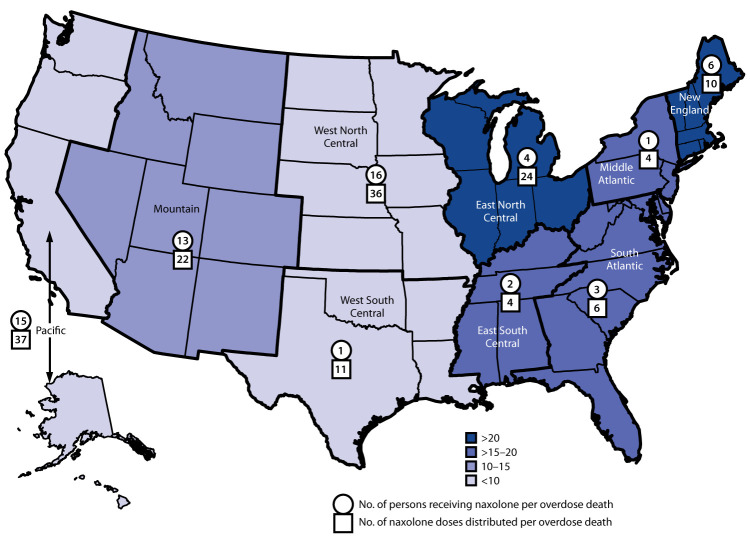
Description:Syringe service programs (SSPs), which provide access to sterile syringes and other injection equipment and their safe disposal after use,* represent a highly successful human immunodeficiency Virus (HIV) Prevention intervention. SSPs are associated with a 58% reduction in the incidence of HIV infection among persons who inject drugs (1). In addition, SSPs have led efforts to prevent opioid overdose deaths by integrating evidence-based opioid overdose education and naloxone distribution (OEND) programs (2-4). OEND programs train laypersons to respond during overdose events and provide access to naloxone and directions for drug delivery (2-4). SSPs are ideal places for OEND because they provide culturally relevant services designed to reach persons at high risk for experiencing or observing an opioid overdose. A 2013 survey found that only 55% of SSPs in the United States had implemented OEND (5). To characterize current implementation of OEND among SSPs, and to describe the current reach (i.e., the ratio of persons who received naloxone per opioid overdose death and the ratio of naloxone doses distributed per opioid overdose death) of SSP-based OEND programs by U.S. Census division,| a survey of known U.S. SSPs was conducted in 2019, which found that 94% of SSPs had implemented OEND. In addition, the reach of SSP-based OEND programs varied by U.S. Census division. Scaling up of SSP-based OEND delivery programs could be a critical component for areas of the country with high opioid overdose death rates and low reach.
-
Subjects:
-
Source:MMWR Morbidity Mortal Weekly Rep. 69(33):1117-1121
-
Series:
-
ISSN:0149-2195 (print) ; 1545-861X (digital)
-
Pubmed ID:32817603
-
Pubmed Central ID:PMC7439981
-
Document Type:
-
Place as Subject:
-
Pages in Document:5 pdf pages
-
Volume:69
-
Issue:33
-
Download URL:
-
File Type:
 [PDF - 291.93 KB]
 -
Collection(s):
-
Main Document Checksum:urn:sha-512:c9d904c81e1d8bfdf3f71cac0132827ecd9b21af87ec2f9fd47d7a8273bc039220cb4eb5047f933e7fb4a90f4c769344827d3b00471a843c644b458eebb0b393
Supporting Files


File Language:
English
 Was this page helpful?
 Found an issue?


CDC STACKS serves as an archival repository of CDC-published products including
scientific findings, journal articles, guidelines, recommendations, or other public health information authored or
co-authored by CDC or funded partners.
As a repository, CDC STACKS retains documents in their original published format to ensure public access to scientific information.
As a repository, CDC STACKS retains documents in their original published format to ensure public access to scientific information.
You May Also Like
COLLECTION
Morbidity and Mortality Weekly Report (MMWR)