



U.S. County “Food Swamp” Severity and Hospitalization Rates among Adults with Diabetes: A Nonlinear Relationship
Supporting Files

-
2 15 2020
-
Available in CDC Stacks on August 15, 2021, 12:00 AM
File Language:
English
Details
-
Journal Article:Soc Sci Med
-
Personal Author:
-
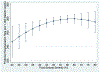
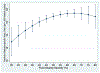
Description:The relationship between food environments and diabetes morbidity is vastly understudied, despite the well-recognized linkage between dietary quality and diabetes complications. Further, literature demonstrates that attributes of places can have nonlinear relationships with health outcomes. This study examines the extent to which "food swamps" are associated with greater rates of hospitalizations for complications among adults with diabetes over time as well as the linearity of this relationship. We conduct a longitudinal county-level analysis of 832 counties across 16 U.S. states in 2010, 2012, and 2014 using data from the USDA Food Environment Atlas and the AHRQ Health Care Cost and Utilization Project State Inpatient Databases. Food swamp severity is measured as the percentage of food outlets in a county that sell primarily unhealthy foods. Hierarchical linear mixed models with county random intercepts are estimated, controlling for area-level covariates and state and year fixed effects. Curvilinear relationships are explored by additively incorporating quadratic terms. We find that, over the study period, mean food swamp severity remained relatively stable. Mean hospitalization rates decreased from 296.72 to 262.82 hospitalizations per 1000 diabetic adults (p < 0.001). In adjusted models, greater food swamp severity was associated with higher hospitalization rates in a curvilinear manner (severity: β = 2.181, p = 0.02; severity2: β = -0.017, p = 0.04), plateauing at approximately 64% unhealthy outlets, a saturation point observed in 17% of observations. Policies that limit saturation of the environment with unhealthy outlets may help in the prevention of diabetic complications, but more saturated counties will likely require more extensive intervention.
-
Subjects:
-
Source:Soc Sci Med. 249:112858
-
DOI:
-
Pubmed ID:32088514
-
Pubmed Central ID:PMC7430494
-
Document Type:
-
Funding:
-
Genre:
-
Volume:249
-
Download URL:
-
File Type:
 [PDF - 430.77 KB]
 -
Collection(s):
-
Main Document Checksum:urn:sha-512:f2e80b85bf4282bd6706fd46d29426c279e920d21ced0d6f2915fc1c7fe3ed7dd5e0cfcacddd454c67da568214f22d5356945830c8b080ef491e12d7219e1a93
Supporting Files


File Language:
English
 Was this page helpful?
 Found an issue?



CDC STACKS serves as an archival repository of CDC-published products including
scientific findings, journal articles, guidelines, recommendations, or other public health information authored or
co-authored by CDC or funded partners.
As a repository, CDC STACKS retains documents in their original published format to ensure public access to scientific information.
As a repository, CDC STACKS retains documents in their original published format to ensure public access to scientific information.
You May Also Like
COLLECTION
CDC Public Access