



Kidney Function Surveillance in the National Spina Bifida Patient Registry: A Retrospective Cohort Study.
Supporting Files

-
9 2020
-
Available in CDC Stacks on 2021-09-01T00:00:00Z
File Language:
English
Details
-
Journal Article:J Urol
-
Personal Author:
-
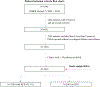
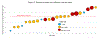
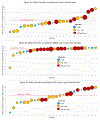
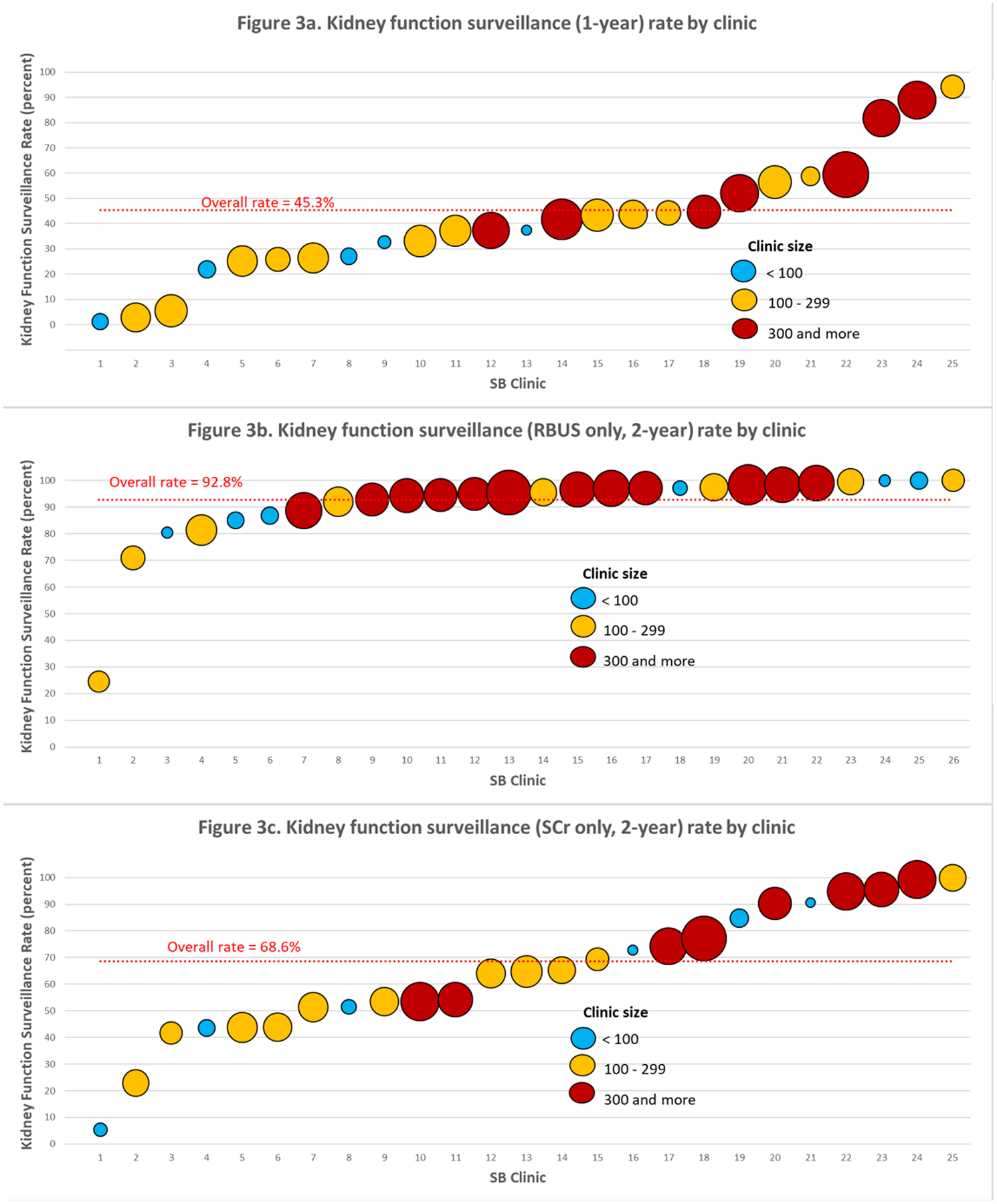
Description:Purpose: ; Chronic kidney disease affects 25–50% of patients with spina bifida. Guidelines recommend kidney function surveillance in these patients, but practice patterns are unknown. Variations in kidney function surveillance were assessed across patients with spina bifida, with the hypothesis that the treating clinic and spina bifida type would be associated with kidney function surveillance. ; Materials and Methods: ; A retrospective cohort study was conducted from 2013–2018 within the National Spina Bifida Patient Registry in the United States. Follow-up was anchored at the 2013 visit. Participants with either an outcome event within 2 years of follow-up or >2 years of follow-up without an outcome event were included. Primary outcome was kidney function surveillance, defined as at least one renal ultrasound and serum creatinine within 2 years of follow-up. Primary exposures were clinic and spina bifida type, which were analyzed with covariates including sociodemographic and clinical characteristics in logistic regression models for their association with the outcome. Sensitivity analyses were performed using different kidney function surveillance definitions. ; Results: ; Of 8351 total patients, 5445 were included, with median 3.0 years’ follow-up. Across 23 treating clinics, kidney function surveillance rates averaged 62% (range 6–100%). In multivariable models, kidney function surveillance was associated with clinic, younger age, functional lesion level, non-ambulatory status, and prior bladder augmentation. Treating clinic remained a significant predictor of kidney function surveillance in all sensitivity analyses. ; Conclusions: ; Within the National Spina Bifida Patient Registry, wide variation exists in practice of kidney function surveillance across treating clinics, despite adjustment for key patient characteristics.
-
Subjects:
-
Keywords:
-
Source:J Urol. 204(3):578-586
-
DOI:
-
Pubmed ID:32141805
-
Pubmed Central ID:PMC7415638
-
Document Type:
-
Funding:U01 DD000742/DD/NCBDD CDC HHSUnited States/ ; U01 DD000383/DD/NCBDD CDC HHSUnited States/ ; U01 DD001078/DD/NCBDD CDC HHSUnited States/ ; U01 DD000773/DD/NCBDD CDC HHSUnited States/ ; U01 DD000745/DD/NCBDD CDC HHSUnited States/ ; U01 DD000766/DD/NCBDD CDC HHSUnited States/ ; R01 DK110087/DK/NIDDK NIH HHSUnited States/ ; U01 DD001080/DD/NCBDD CDC HHSUnited States/ ; U01 DD000770/DD/NCBDD CDC HHSUnited States/ ; U01 DD000388/DD/NCBDD CDC HHSUnited States/ ; U01 DD000381/DD/NCBDD CDC HHSUnited States/ ; U01 DD000738/DD/NCBDD CDC HHSUnited States/ ; U01 DD000771/DD/NCBDD CDC HHSUnited States/ ; U01 DD001069/DD/NCBDD CDC HHSUnited States/ ; U01 DD001074/DD/NCBDD CDC HHSUnited States/ ; U01 DD001082/DD/NCBDD CDC HHSUnited States/ ; U01 DD001093/DD/NCBDD CDC HHSUnited States/ ; U01 DD000382/DD/NCBDD CDC HHSUnited States/ ; U01 DD000768/DD/NCBDD CDC HHSUnited States/ ; U01 DD001071/DD/NCBDD CDC HHSUnited States/ ; U01 DD001063/DD/NCBDD CDC HHSUnited States/ ; U01 DD000767/DD/NCBDD CDC HHSUnited States/ ; U01 DD000740/DD/NCBDD CDC HHSUnited States/ ; U01 DD000769/DD/NCBDD CDC HHSUnited States/ ; K24 HL150235/HL/NHLBI NIH HHSUnited States/ ; U01 DD000385/DD/NCBDD CDC HHSUnited States/ ; U01 DD001073/DD/NCBDD CDC HHSUnited States/ ; U01 DD000387/DD/NCBDD CDC HHSUnited States/ ; U01 DD000737/DD/NCBDD CDC HHSUnited States/ ; U01 DD001057/DD/NCBDD CDC HHSUnited States/ ; U01 DD000772/DD/NCBDD CDC HHSUnited States/ ; U01 DD000774/DD/NCBDD CDC HHSUnited States/ ; U01 DD001072/DD/NCBDD CDC HHSUnited States/ ; U01 DD000744/DD/NCBDD CDC HHSUnited States/ ; U01 DD000386/DD/NCBDD CDC HHSUnited States/ ; U01 DD001062/DD/NCBDD CDC HHSUnited States/ ; U01 DD000389/DD/NCBDD CDC HHSUnited States/ ; U01 DD000736/DD/NCBDD CDC HHSUnited States/ ; U01 DD001065/DD/NCBDD CDC HHSUnited States/ ; U01 DD001091/DD/NCBDD CDC HHSUnited States/ ; U01 DD000743/DD/NCBDD CDC HHSUnited States/
-
Genre:
-
Volume:204
-
Issue:3
-
Download URL:
-
File Type:
 [PDF - 673.30 KB]
 -
Collection(s):
-
Main Document Checksum:urn:sha-512:c7b91a6d29a4f21f5f7342dad16392e792332f902416a787649fb8f403ab85a67335b06ed7bf0150b8a54844554d11e26a7a6028bcc2b9852b58ddabcbe5a6ef
Supporting Files


File Language:
English
 Was this page helpful?
 Found an issue?



CDC STACKS serves as an archival repository of CDC-published products including
scientific findings, journal articles, guidelines, recommendations, or other public health information authored or
co-authored by CDC or funded partners.
As a repository, CDC STACKS retains documents in their original published format to ensure public access to scientific information.
As a repository, CDC STACKS retains documents in their original published format to ensure public access to scientific information.
You May Also Like
COLLECTION
CDC Public Access