



Outbreak of Norovirus Illness Among Wildfire Evacuation Shelter Populations — Butte and Glenn Counties, California, November 2018
Supporting Files
Public Domain

-
May 22 2020
File Language:
English
Details
-
Journal Article:Morbidity and Mortality Weekly Report (MMWR)
-
Personal Author:Karmarkar, Ellora ; Jain, Seema ; Higa, Jeff ; Fontenot, Jazmin ; Bertolucci, Regina ; Huynh, Thalia ; Hammer, Gwendolyn ; Brodkin, Alice ; Thao, May ; Brousseau, Blake ; Hopkins, Danielle ; Kelly, Emily ; Sheffield, Madison ; Henley, Sandy ; Whittaker, Holly ; Herrick, Robert L. ; Pan, Chao-Yang ; Chen, Alice ; Kim, Janice ; Schaumleffel, Lori ; Khwaja, Zenith ; Epson, Erin ; Chai, Shua J. ; Wadford, Debra ; Vugia, Duc ; Lewis, Linda
-
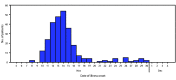
Description:The Camp Fire, California's deadliest wildfire, began November 8, 2018, and was extinguished November 25 (1). Approximately 1,100 evacuees from the fire sought emergency shelter. On November 10, acute gastroenteritis (AGE) was reported in two evacuation shelters; noroVirus illness was suspected, because it is commonly detected in shelter-associated AGE outbreaks. NoroVirus is highly contagious and resistant to several disinfectants. Butte County Public Health Department (BCPHD), assisted by the California Department of Public Health (CDPH), initiated active Surveillance to identify cases, confirm the etiology, and assess shelter infection Prevention and control (IPC) practices to guide recommendations. During November 8-30, a total of 292 patients with AGE were identified among nine evacuation shelters; noroVirus was detected in 16 of 17 unique patient stool specimens. Shelter IPC assessments revealed gaps in illness Surveillance, isolation practices, cleaning, disinfection, and handwashing. CDPH and BCPHD collaborated with partner agencies to implement AGE screening, institute isolation protocols and 24-hour cleaning services, and promote proper hand hygiene. During disasters with limited resources, damaged infrastructure, and involvement of multiple organizations, establishing shelter disease Surveillance and IPC is difficult. However, prioritizing effective Surveillance and IPC at shelter activation is necessary to prevent, identify, and contain outbreaks.
-
Subjects:
-
Series:
-
DOI:
-
ISSN:0149-2195 (print) ; 1545-861X (digital)
-
Pubmed ID:32437337
-
Pubmed Central ID:PMC7357343
-
Document Type:
-
Genre:
-
Place as Subject:
-
Rights:Public Domain
-
Pages in Document:5 pdf pages
-
Volume:69
-
Issue:20
-
Citation:MMWR Morbidity Mortal Weekly Rep. 69(20):613-617
-
Download URL:
-
File Type:
 [PDF - 157.22 KB]
 -
Collection(s):
-
Main Document Checksum:urn:sha-512:87e9857c95e9e67e48e0199ee270f17fd9c94793be39943833bf82691f2364c131e88fe117722788d643f338660897d45975058090f9cb79470cc796ba3abb8e
Supporting Files


File Language:
English
 Was this page helpful?
 Found an issue?


CDC STACKS serves as an archival repository of CDC-published products including
scientific findings, journal articles, guidelines, recommendations, or other public health information authored or
co-authored by CDC or funded partners.
As a repository, CDC STACKS retains documents in their original published format to ensure public access to scientific information.
As a repository, CDC STACKS retains documents in their original published format to ensure public access to scientific information.
You May Also Like
COLLECTION
Morbidity and Mortality Weekly Report (MMWR)