



Heterogeneity in risk and protection among Alaska Native/American Indian and non-Native children
Supporting Files

-
1 2020 ; 1-2020
-
Available in CDC Stacks on January 01, 2021, 12:00 AM
File Language:
English
Details
-
Alternative Title:Prev Sci
-
Personal Author:
-
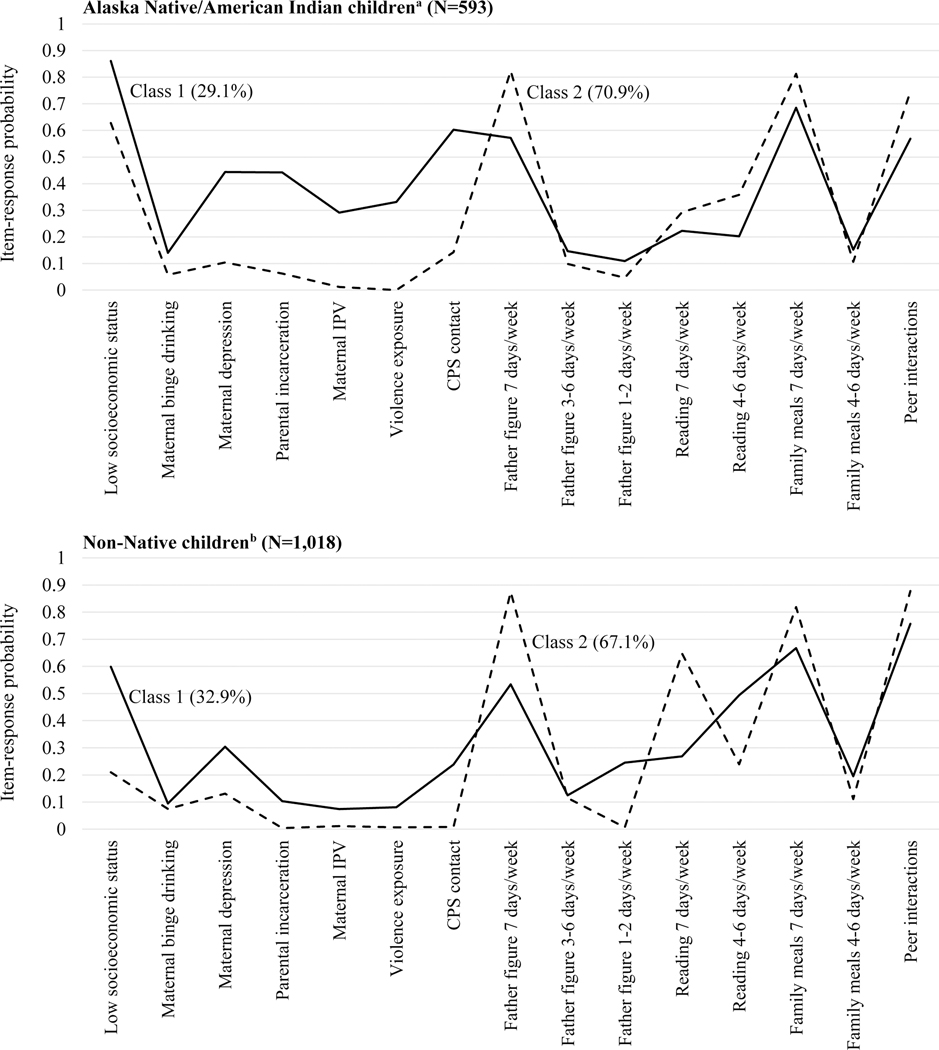
Description:Currently, little is known about patterns of co-occurring risk and protective factors among young children. Understanding variations in co-occurring risk and protective factors among children in Alaska is important as experiences of collective trauma may contribute to differences in the intersection of risk and protective factors between Alaska Native/American Indian (AN/AI) and non-Native children. Using data from the Alaska Longitudinal Child Abuse and Neglect Linkage (ALCANLink) project, a linkage of the 2009-2011 Alaska Pregnancy Risk Assessment Monitoring System survey and administrative data sources, and the 2012-2014 Childhood Understanding Behaviors Survey, we conducted latent class analysis to identify classes of AN/AI (N = 593) and non-Native (N = 1018) children in terms of seven risk factors (poverty, maternal depression, maternal binge drinking, parental incarceration, intimate partner violence exposure, other violence exposure, child maltreatment) and four protective factors (father figure involvement, reading by adults, family meals, peer interactions) experienced prior to age 3 years. We identified two classes among AN/AI children: (1) high risk-moderate protection (29.1%) and (2) low socioeconomic status-high protection (70.9%). We identified two classes among non-Native children: (1) moderate risk-high protection (32.9%) and (2) low risk-high protection (67.1%). A test of invariance revealed that risk and protective factor probabilities differed significantly for corresponding classes of AN/AI and non-Native children. Overall, results demonstrate heterogeneity within and between AN/AI and non-Native children in early experiences of risk and protection and suggest that interventions will be more effective if tailored to the experiences and developmental needs of specific groups of Alaska children.
-
Subjects:
-
Keywords:
-
Source:Prev Sci. 21(1):86-97
-
Pubmed ID:31773468
-
Pubmed Central ID:PMC7364379
-
Document Type:
-
Funding:
-
Volume:21
-
Issue:1
-
Download URL:
-
File Type:
 [PDF - 703.01 KB]
 -
Collection(s):
-
Main Document Checksum:urn:sha256:79971c58524c97ea97eae3c4b55372e4657075b67136413f9f82584ebf1af616
Supporting Files


File Language:
English
 Was this page helpful?
 Found an issue?

CDC STACKS serves as an archival repository of CDC-published products including
scientific findings, journal articles, guidelines, recommendations, or other public health information authored or
co-authored by CDC or funded partners.
As a repository, CDC STACKS retains documents in their original published format to ensure public access to scientific information.
As a repository, CDC STACKS retains documents in their original published format to ensure public access to scientific information.
You May Also Like
COLLECTION
CDC Public Access