


Geographical distribution of Anopheles stephensi in eastern Ethiopia
Supporting Files
Public Domain

-
January 20 2020
-
File Language:
English
Details
-
Alternative Title:Parasit Vectors
-
Personal Author:
-
Description:Background
The recent detection of the South Asian malaria vector Anopheles stephensi in Ethiopia and other regions in the Horn of Africa has raised concerns about its potential impact on malaria transmission. We report here the findings of a survey for this species in eastern Ethiopia using both morphological and molecular methods for species identification.
Methods
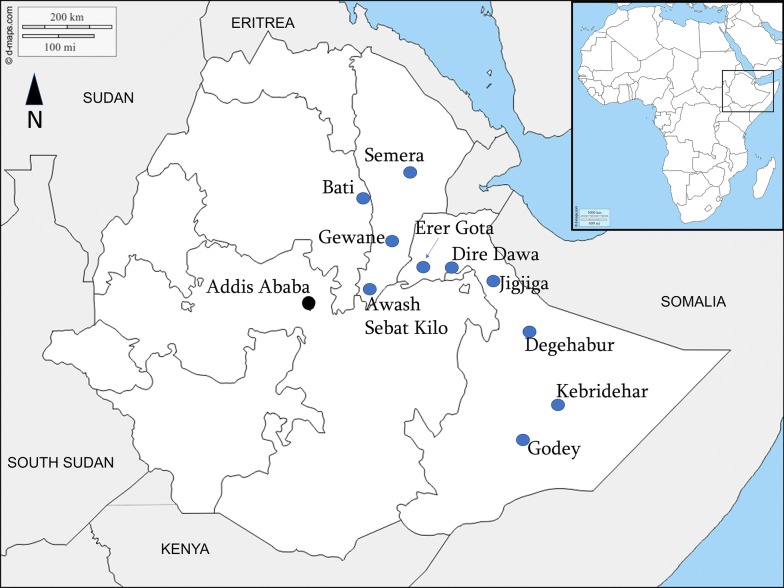
Adult and larval/pupal collections were conducted at ten sites in eastern Ethiopia and Anopheles specimens were identified using standard morphological keys and genetic analysis.
Results
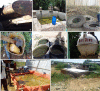
In total, 2231 morphologically identified An. stephensi were collected. A molecular approach incorporating both PCR endpoint assay and sequencing of portions of the internal transcribed spacer 2 (ITS2) and cytochrome c oxidase subunit 1 (cox1) loci confirmed the identity of the An. stephensi in most cases (119/124 of the morphologically identified An. stephensi confirmed molecularly). Additionally, we observed Aedes aegypti larvae and pupae at many of the An. stephensi larval habitats.
Conclusions
Our findings show that An. stephensi is widely distributed in eastern Ethiopia and highlight the need for further surveillance in the southern, western and northern parts of the country and throughout the Horn of Africa.
-
Subjects:
-
Source:Parasit Vectors. 13
-
Pubmed ID:31959237
-
Pubmed Central ID:PMC6971998
-
Document Type:
-
Place as Subject:
-
Volume:13
-
Collection(s):
-
Main Document Checksum:urn:sha256:9e9a6f74ff3f9ce877658488924fc2f42256f2845d08076bb1afff1bd7357720
-
Download URL:
-
File Type:
 [PDF
- 1.51 MB
]
[PDF
- 1.51 MB
]
Supporting Files


File Language:
English
ON THIS PAGE


CDC STACKS serves as an archival repository of CDC-published products including
scientific findings,
journal articles, guidelines, recommendations, or other public health information authored or
co-authored by CDC or funded partners.
As a repository, CDC STACKS retains documents in their original published format to ensure public access to scientific information.
As a repository, CDC STACKS retains documents in their original published format to ensure public access to scientific information.
You May Also Like
COLLECTION
CDC Public Access