


Density of Upper Respiratory Colonization With Streptococcus pneumoniae and Its Role in the Diagnosis of Pneumococcal Pneumonia Among Children Aged <5 Years in the PERCH Study
Supporting Files

-
Jun 15 2017
-
File Language:
English
Details
-
Alternative Title:Clin Infect Dis
-
Personal Author:Baggett, Henry C ; Watson, Nora L ; Deloria Knoll, Maria ; Brooks, W Abdullah ; Feikin, Daniel R ; Hammitt, Laura L ; Howie, Stephen R C ; Kotloff, Karen L ; Levine, Orin S ; Madhi, Shabir A ; Murdoch, David R ; Scott, J Anthony G ; Thea, Donald M ; Antonio, Martin ; Awori, Juliet O ; Baillie, Vicky L ; DeLuca, Andrea N ; Driscoll, Amanda J ; Duncan, Julie ; Ebruke, Bernard E ; Goswami, Doli ; Higdon, Melissa M ; Karron, Ruth A ; Moore, David P ; Morpeth, Susan C ; Mulindwa, Justin M ; Park, Daniel E ; Paveenkittiporn, Wantana ; Piralam, Barameht ; Prosperi, Christine ; Sow, Samba O ; Tapia, Milagritos D ; Zaman, Khalequ ; Zeger, Scott L ; O’Brien, Katherine L
-
Corporate Authors:
-
Description:Background
Previous studies suggested an association between upper airway pneumococcal colonization density and pneumococcal pneumonia, but data in children are limited. Using data from the Pneumonia Etiology Research for Child Health (PERCH) study, we assessed this potential association.
Methods
PERCH is a case-control study in 7 countries: Bangladesh, The Gambia, Kenya, Mali, South Africa, Thailand, and Zambia. Cases were children aged 1–59 months hospitalized with World Health Organization–defined severe or very severe pneumonia. Controls were randomly selected from the community. Microbiologically confirmed pneumococcal pneumonia (MCPP) was confirmed by detection of pneumococcus in a relevant normally sterile body fluid. Colonization density was calculated with quantitative polymerase chain reaction analysis of nasopharyngeal/oropharyngeal specimens.
Results
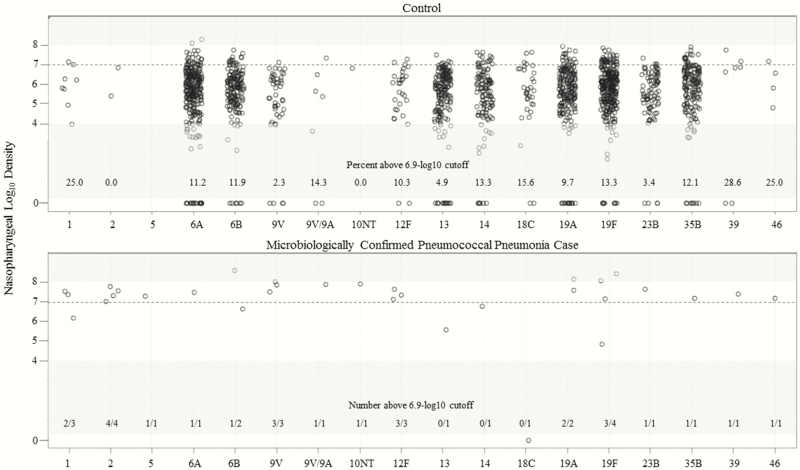
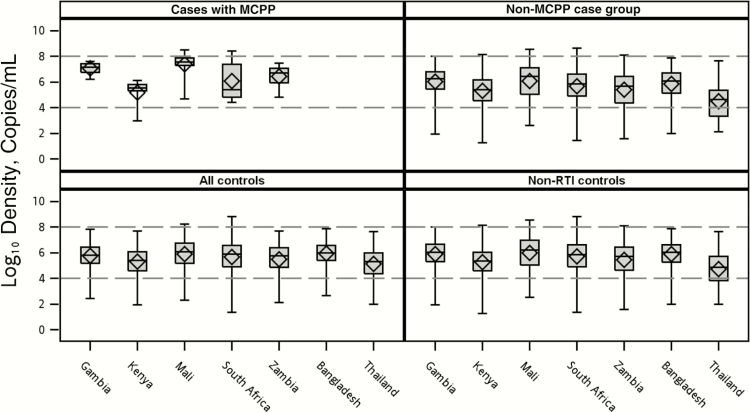
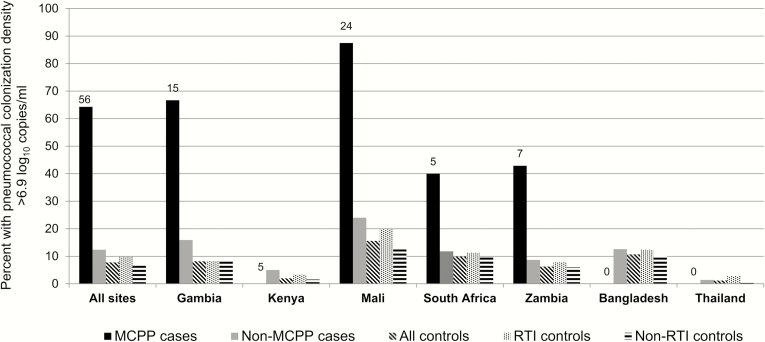
Median colonization density among 56 cases with MCPP (MCPP cases; 17.28 × 10⁶ copies/mL) exceeded that of cases without MCPP (non-MCPP cases; 0.75 × 10⁶) and controls (0.60 × 10⁶) (each P < .001). The optimal density for discriminating MCPP cases from controls using the Youden index was >6.9 log10 copies/mL; overall, the sensitivity was 64% and the specificity 92%, with variable performance by site. The threshold was lower (≥4.4 log10 copies/mL) when MCPP cases were distinguished from controls who received antibiotics before specimen collection. Among the 4035 non-MCPP cases, 500 (12%) had pneumococcal colonization density >6.9 log10 copies/mL; above this cutoff was associated with alveolar consolidation at chest radiography, very severe pneumonia, oxygen saturation <92%, C-reactive protein ≥40 mg/L, and lack of antibiotic pretreatment (all P< .001).
Conclusions
Pneumococcal colonization density >6.9 log10 copies/mL was strongly associated with MCPP and could be used to improve estimates of pneumococcal pneumonia prevalence in childhood pneumonia studies. Our findings do not support its use for individual diagnosis in a clinical setting.
-
Subjects:
-
Source:Clin Infect Dis. 2017; 64(Suppl 3):S317-S327
-
Pubmed ID:28575365
-
Pubmed Central ID:PMC5850437
-
Document Type:
-
Funding:
-
Place as Subject:
-
Volume:64
-
Collection(s):
-
Main Document Checksum:urn:sha256:dda955bec7cefb8089a72eae38fa73601341867c556e7b0ea0b818ccfdb1aaa2
-
Download URL:
-
File Type:
 [PDF
- 684.98 KB
]
[PDF
- 684.98 KB
]
Supporting Files


File Language:
English
ON THIS PAGE


CDC STACKS serves as an archival repository of CDC-published products including
scientific findings,
journal articles, guidelines, recommendations, or other public health information authored or
co-authored by CDC or funded partners.
As a repository, CDC STACKS retains documents in their original published format to ensure public access to scientific information.
As a repository, CDC STACKS retains documents in their original published format to ensure public access to scientific information.
You May Also Like
COLLECTION
CDC Public Access