



Multicountry Distribution and Characterization of Extended-spectrum β-Lactamase–associated Gram-negative Bacteria From Bloodstream Infections in Sub-Saharan Africa
Supporting Files
Public Domain

-
October 30 2019
-
Available in CDC Stacks on 2019-10-30T00:00:00Z
File Language:
English
Details
-
Alternative Title:Clin Infect Dis
-
Personal Author:Toy, Trevor ; Pak, Gi Deok ; Duc, Trung Pham ; Campbell, James I ; El Tayeb, Muna Ahmed ; Von Kalckreuth, Vera ; Im, Justin ; Panzner, Ursula ; Cruz Espinoza, Ligia Maria ; Eibach, Daniel ; Dekker, Denise Myriam ; Park, Se Eun ; Jeon, Hyon Jin ; Konings, Frank ; Mogeni, Ondari D ; Cosmas, Leonard ; Bjerregaard-Andersen, Morten ; Gasmelseed, Nagla ; Hertz, Julian T ; Jaeger, Anna ; Krumkamp, Ralf ; Ley, Benedikt ; Thriemer, Kamala ; Kabore, Leon Parfait ; Niang, Aissatou ; Raminosoa, Tiana Mirana ; Sampo, Emmanuel ; Sarpong, Nimako ; Soura, Abdramane ; Owusu-Dabo, Ellis ; Teferi, Mekonnen ; Yeshitela, Biruk ; Poppert, Sven ; May, Jürgen ; Kim, Jerome H ; Chon, Yun ; Park, Jin Kyung ; Aseffa, Abroaham ; Breiman, Robert F ; Schütt-Gerowitt, Heidi ; Aaby, Peter ; Adu-Sarkodie, Yaw ; Crump, John A ; Rakotozandrindrainy, Raphaël ; Meyer, Christian G ; Sow, Amy Gassama ; Clemens, John D ; Wierzba, Thomas F ; Baker, Stephen ; Marks, Florian
-
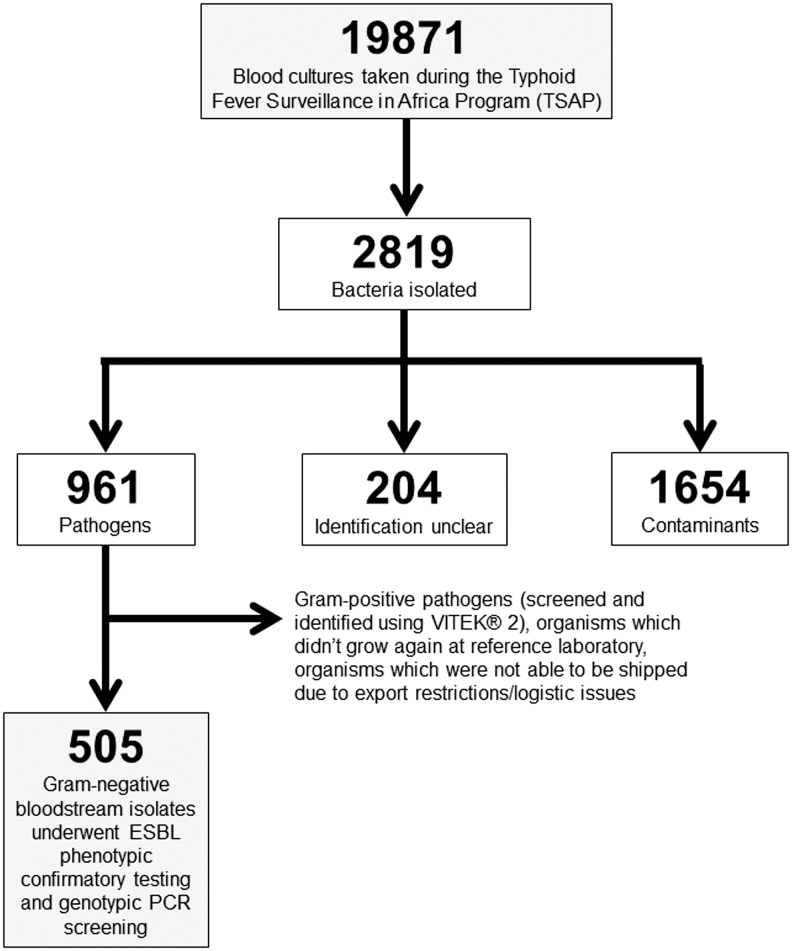
Description:Background ; Antimicrobial resistance (AMR) is a major global health concern, yet, there are noticeable gaps in AMR surveillance data in regions such as sub-Saharan Africa. We aimed to measure the prevalence of extended-spectrum β-lactamase (ESBL) producing Gram-negative bacteria in bloodstream infections from 12 sentinel sites in sub-Saharan Africa. ; Methods ; Data were generated during the Typhoid Fever Surveillance in Africa Program (TSAP), in which standardized blood cultures were performed on febrile patients attending 12 health facilities in 9 sub-Saharan African countries between 2010 and 2014. Pathogenic bloodstream isolates were identified at the sites and then subsequently confirmed at a central reference laboratory. Antimicrobial susceptibility testing, detection of ESBL production, and conventional multiplex polymerase chain reaction (PCR) testing for genes encoding for β-lactamase were performed on all pathogens. ; Results ; Five hundred and five pathogenic Gram-negative bloodstream isolates were isolated during the study period and available for further characterization. This included 423 Enterobacteriaceae. Phenotypically, 61 (12.1%) isolates exhibited ESBL activity, and genotypically, 47 (9.3%) yielded a PCR amplicon for at least one of the screened ESBL genes. Among specific Gram-negative isolates, 40 (45.5%) of 88 Klebsiella spp., 7 (5.7%) of 122 Escherichia coli, 6 (16.2%) of 37 Acinetobacter spp., and 2 (1.3%) of 159 of nontyphoidal Salmonella (NTS) showed phenotypic ESBL activity. ; Conclusions ; Our findings confirm the presence of ESBL production among pathogens causing bloodstream infections in sub-Saharan Africa. With few alternatives for managing ESBL-producing pathogens in the African setting, measures to control the development and proliferation of AMR organisms are urgently needed.
-
Subjects:
-
Source:Clin Infect Dis. 2019; 69(Suppl 6):S449-S458
-
Pubmed ID:31665776
-
Pubmed Central ID:PMC6821266
-
Document Type:
-
Place as Subject:
-
Volume:69
-
Download URL:
-
File Type:
 [PDF - 537.98 KB]
 -
Collection(s):
-
Main Document Checksum:urn:sha256:77b019345f3036002d0deb8e2eb3d3afdd60f0417285d5fad023399e6d2404dc
Supporting Files


File Language:
English
 Was this page helpful?
 Found an issue?

CDC STACKS serves as an archival repository of CDC-published products including
scientific findings, journal articles, guidelines, recommendations, or other public health information authored or
co-authored by CDC or funded partners.
As a repository, CDC STACKS retains documents in their original published format to ensure public access to scientific information.
As a repository, CDC STACKS retains documents in their original published format to ensure public access to scientific information.
You May Also Like
COLLECTION
CDC Public Access