


Incidence and etiology of infectious diarrhea from a facility-based surveillance system in Guatemala, 2008–2012
Supporting Files

-
October 22 2019
-
File Language:
English
Details
-
Alternative Title:BMC Public Health
-
Personal Author:Arvelo, Wences ; Hall, Aron J. ; Henao, Olga ; Lopez, Beatriz ; Bernart, Chris ; Moir, Juan C. ; Reyes, Lissette ; Montgomery, Susan P. ; Morgan, Oliver ; Estevez, Alejandra ; Parsons, Michele B. ; Lopez, Maria R. ; Gomez, Gerry ; Vinje, Jan ; Gregoricus, Nicole ; Parashar, Umesh ; Mintz, Eric D. ; McCracken, John ; Bryan, Joe P. ; Lindblade, Kim A.
-
Description:Background
Diarrhea is a major cause of morbidity and mortality, yet incidence and etiology data are limited. We conducted laboratory-based diarrhea surveillance in Guatemala.
Methods
A diarrhea case was defined as ≥3 loose stools in a 24-h period in a person presenting to the surveillance facilities. Epidemiologic data and stool specimens were collected. Specimens were tested for bacterial, parasitic, and viral pathogens. Yearly incidence was adjusted for healthcare seeking behaviors determined from a household survey conducted in the surveillance catchment area.
Results
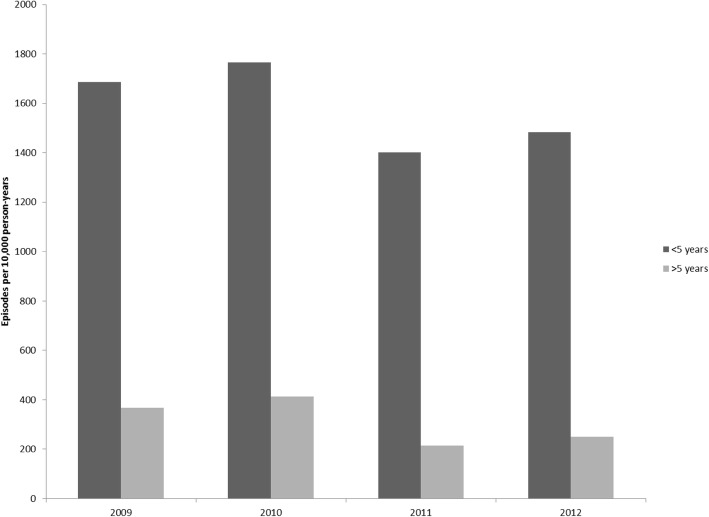
From November 2008 to December 2012, the surveillance system captured 5331 diarrhea cases; among these 1381 (26%) had specimens tested for all enteric pathogens of interest. The adjusted incidence averaged 659 diarrhea cases per 10,000 persons per year, and was highest among children aged < 5 years, averaging 1584 cases per 10,000 children per year. Among 1381 (26%) specimens tested for all the pathogens of interest, 235 (17%) had a viral etiology, 275 (20%) had a bacterial, 50 (4%) had parasites, and 86 (6%) had co-infections. Among 827 (60%) specimens from children aged < 5 years, a virus was identified in 196 (23%) patients; 165 (20%) had norovirus and 99 (12%) rotavirus, including co-infections. Among 554 patients aged ≥5 years, 103 (19%) had a bacterial etiology, including diarrheagenic Escherichia coli in 94 (17%) cases, Shigella spp. in 31 (6%), Campylobacter spp. in 5 (1%), and Salmonella spp. in 4 (1%) cases. Detection of Giardia and Cryptosporidium was infrequent (73 cases; 5%).
Conclusions
There was a substantial burden of viral and bacterial diarrheal diseases in Guatemala, highlighting the importance of strengthening laboratory capacity for rapid detection and control and for evaluation of public health interventions.
-
Subjects:
-
Source:BMC Public Health. 19
-
Pubmed ID:31640646
-
Pubmed Central ID:PMC6805345
-
Document Type:
-
Funding:
-
Place as Subject:
-
Volume:19
-
Collection(s):
-
Main Document Checksum:urn:sha256:671241c0d2672b411844c59b311ea6df5f96fbbde802d80bf39161ce45441f15
-
Download URL:
-
File Type:
 [PDF
- 2.16 MB
]
[PDF
- 2.16 MB
]
Supporting Files


File Language:
English
ON THIS PAGE




CDC STACKS serves as an archival repository of CDC-published products including
scientific findings,
journal articles, guidelines, recommendations, or other public health information authored or
co-authored by CDC or funded partners.
As a repository, CDC STACKS retains documents in their original published format to ensure public access to scientific information.
As a repository, CDC STACKS retains documents in their original published format to ensure public access to scientific information.
You May Also Like
COLLECTION
CDC Public Access