



The Influence of Metabolic Syndrome in Predicting Mortality Risk Among US Adults: Importance of Metabolic Syndrome Even in Adults With Normal Weight
Supporting Files
Public Domain

-
May 21 2020
File Language:
English
Details
-
Journal Article:Preventing Chronic Disease (PCD)
-
Personal Author:
-
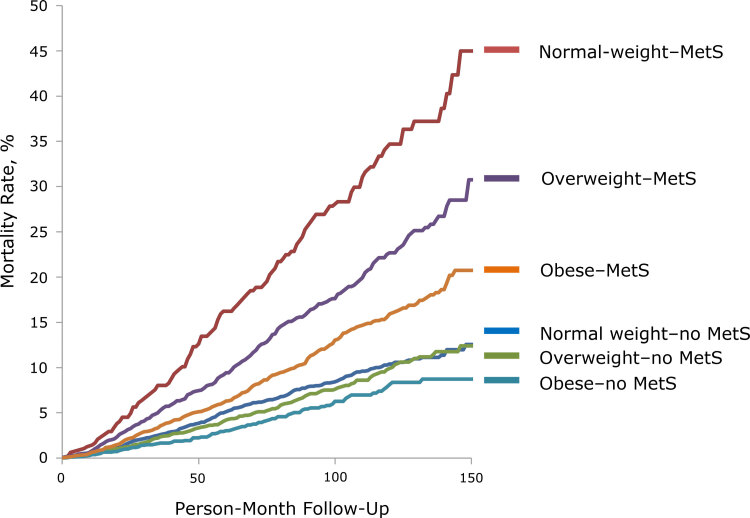
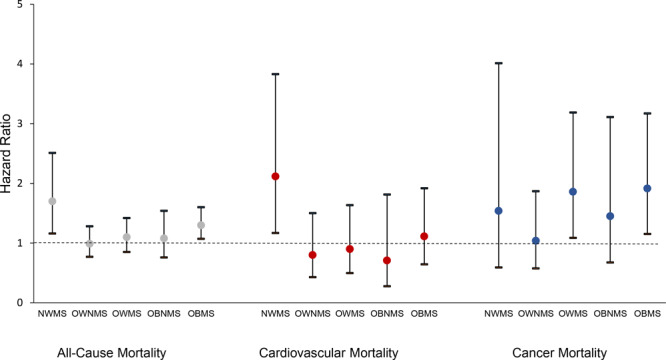
Description:Introduction ; Although metabolic syndrome (MetS) is less prevalent among normal-weight adults than among overweight and obese adults, it does occur. The objective of our study was to examine how mortality risks differed in weight categories stratified by presence/absence of MetS. ; Methods ; We linked data for US adults responding to the National Health and Nutrition Examination Survey from 1999 through 2010 to data released from the National Death Index up to 2011. We grouped data according to categories of body mass index (normal 18.5 to <25.0 kg/m2, overweight 25.0 to <30.0 kg/m2, and obese ≥30.0 kg/m2) and presence/absence of MetS. After conducting unadjusted analyses, we used Cox proportional hazards models to evaluate mortality risk as multivariable hazard ratios among obesity–MetS categories while controlling for selected covariates. ; Results ; The analysis included 12,047 adults. The prevalence of MetS was 61.6% in the obese group, 33.2% in the overweight group, and 8.6% in the normal-weight group. The multivariate adjusted hazard ratio (95% confidence interval) for mortality among the obesity–MetS groups, compared with the normal-weight–no-MetS group, were as follows: normal-weight–MetS (1.70 1.16–2.51), overweight–no-MetS (0.99 0.77–1.28), overweight–MetS (1.10 0.85–1.42), obese–no-MetS (1.08 0.76–1.54), and obese–MetS (1.30 1.07–1.60); differences were significant only for the normal-weight–MetS group and obese–MetS group. ; Conclusion ; MetS is a risk factor for mortality among normal-weight and obese adults. In our study, normal-weight adults with MetS had the highest mortality among the 6 groups studied, suggesting that interventions should also focus on MetS patients with normal weight.
-
Subjects:
-
Source:Prev Chronic Dis. 2020; 17
-
ISSN:1545-1151
-
Pubmed ID:32441641
-
Pubmed Central ID:PMC7279064
-
Document Type:
-
Volume:17
-
Download URL:
-
File Type:
 [PDF - 738.76 KB]
 -
Collection(s):
-
Main Document Checksum:urn:sha-512:035fe3915fd234cb0bc467a0301403051122cd2949989fb15a45036d7d62834b3e2db4cf8959000561d33d7d1d98380ab65d0873b05545a380fa864e25e0388b
Supporting Files


File Language:
English
 Was this page helpful?
 Found an issue?


CDC STACKS serves as an archival repository of CDC-published products including
scientific findings, journal articles, guidelines, recommendations, or other public health information authored or
co-authored by CDC or funded partners.
As a repository, CDC STACKS retains documents in their original published format to ensure public access to scientific information.
As a repository, CDC STACKS retains documents in their original published format to ensure public access to scientific information.
You May Also Like
COLLECTION
Preventing Chronic Disease