



Demographic, physiologic, and lifestyle characteristics observed with serum total folate differ among folate forms: cross-sectional data from fasting samples in the National Health and Nutrition Examination Survey 2011–2016
Supporting Files

-
4 2020
-
Available in CDC Stacks on 2020-05-26T00:00:00Z
File Language:
English
Details
-
Journal Article:J Nutr
-
Personal Author:Fazili, Zia ; Sternberg, Maya R ; Potischman, Nancy ; Wang, Chia-Yih ; Storandt, Renee J ; Yeung, Lorraine ; Yamini, Sedigheh ; Gahche, Jaime J ; Juan, WenYen ; Qi, Yan Ping ; Paladugula, Neelima ; Gabey, Gwendolyn ; Pfeiffer, Christine M
-
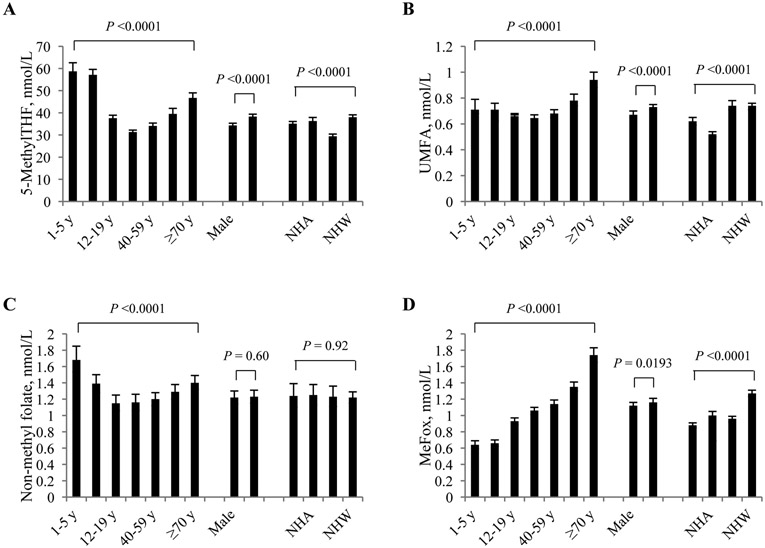
Description:Background: ; Serum folate forms were measured in the US population during recent National Health and Nutrition Examination Surveys (NHANES) to assess folate status. ; Objective: ; We describe post-folic acid-fortification concentrations of serum folate forms in the fasting US population ≥1 y from the NHANES 2011–2016. ; Design: ; We measured 5 biologically active folates and 1 oxidation product (MeFox) of 5-methyltetrahydrofolate. We calculated geometric means of 5-methyltetrahydrofolate, unmetabolized folic acid (UMFA), non-methyl folate (sum of tetrahydrofolate, 5-formyltetrahydrofolate, and 5,10-methenyltetrahydrofolate), total folate (sum of above biomarkers), and MeFox by demographic, physiologic, and lifestyle variables; estimated the magnitude of variables on biomarker concentrations after covariate adjustment; and determined the prevalence of UMFA >2 nmol/L. ; Results: ; After demographic adjustment, age, sex, and race-Hispanic origin were significantly associated with most folate forms. MeFox increased with age, while 5-methyltetrahydrofolate, UMFA, and non-methyl folate displayed an U-shaped age pattern. Compared with non-Hispanic Whites, non-Hispanic Blacks had 23% lower predicted 5-methyltetrahyrofolate but comparable UMFA; non-Hispanic Asians had comparable 5-methyltetrahydrofolate but 28% lower UMFA; Hispanics, non-Hispanic Asians, and non-Hispanic Blacks had ~20% lower MeFox. After additional physiologic and lifestyle adjustment, predicted UMFA and MeFox concentrations were 43% and 112% higher, respectively in adults with chronic kidney disease and 17% and 15% lower, respectively in adults consuming daily 1–<2 alcoholic beverages; 5-methyltetrahydrofolate concentrations were 20% lower in adult smokers. The prevalence of UMFA >2 nmol/L was highest in persons ≥70 y (9.01%) and lowest in 12–19 y olds (1.14%). During 2011–2014, the prevalence was 10.6% in users and 2.22% in non-users of folic acid-containing supplements. ; Conclusions: ; In fasting persons ≥1 y, the demographic, physiologic, and lifestyle characteristics observed with serum total folate differed among folate forms, suggesting biological and/or genetic influences on folate metabolism. High UMFA was mostly observed in supplement users and older persons.
-
Keywords:
- NHANES
- 5-methyltetrahydrofolate
- unmetabolized folic acid
- folate oxidation product
- MeFox
- LC-MS/MS
- Adolescent
- Adult
- Aged
- Aged, 80 and over
- Biomarkers
- Child
- Child, Preschool
- Cross-Sectional Studies
- Female
- Folic Acid
- Humans
- Infant
- Life Style
- Male
- Middle Aged
- Nutrition Surveys
- Prevalence
- Tetrahydrofolates
- Young Adult
-
Source:J Nutr. 150(4):851-860
-
DOI:
-
Pubmed ID:31875475
-
Pubmed Central ID:PMC7138665
-
Document Type:
-
Funding:
-
Genre:
-
Volume:150
-
Issue:4
-
Download URL:
-
File Type:
 [PDF - 509.02 KB]
 -
Collection(s):
-
Main Document Checksum:urn:sha-512:1371df87c92808205e7d1f62289ce360b97bd973362e58bd74b0fbbf13774d4ec199508d9cecd913633ce1d0d8da73e53bee4ed91d4269aa34ebf39d4a06fb89
Supporting Files


File Language:
English
 Was this page helpful?
 Found an issue?




CDC STACKS serves as an archival repository of CDC-published products including
scientific findings, journal articles, guidelines, recommendations, or other public health information authored or
co-authored by CDC or funded partners.
As a repository, CDC STACKS retains documents in their original published format to ensure public access to scientific information.
As a repository, CDC STACKS retains documents in their original published format to ensure public access to scientific information.
You May Also Like
COLLECTION
CDC Public Access