



Progress Toward Maternal and Neonatal Tetanus Elimination — Worldwide, 2000–2018
Supporting Files
Public Domain

-
May 01 2020
File Language:
English
Details
-
Journal Article:Morbidity and Mortality Weekly Report (MMWR)
-
Personal Author:
-
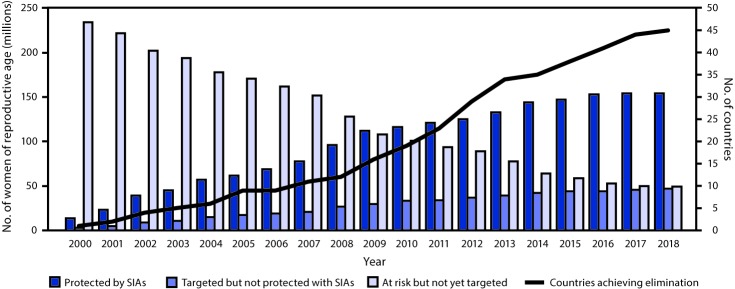
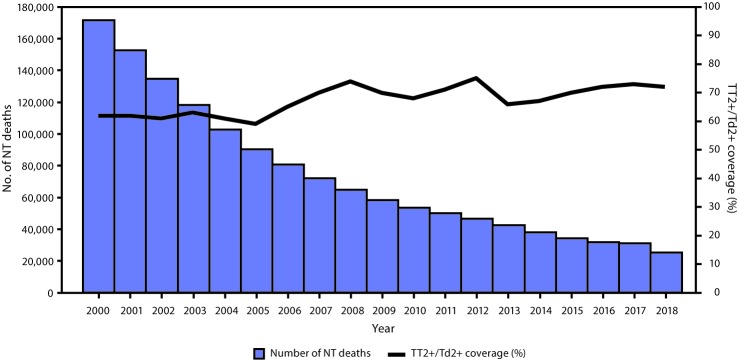
Description:Maternal and neonatal tetanus* (MNT) remains a major public health problem, with an 80%-100% case-fatality rate among neonates, especially in areas with poor immunization coverage and limited access to clean deliveries (i.e., delivery in a health facility or assisted by medically trained attendants in sanitary conditions) and umbilical cord care (1). In 1989, the World Health Assembly endorsed the elimination| of neonatal tetanus (NT), and in 1999, the initiative was relaunched and renamed the MNT elimination| initiative, targeting 59| priority countries (1). Elimination strategies include 1) achieving ≥80% coverage with ≥2 doses of tetanus toxoid-containing vaccine (TTCV) among women of reproductive age through routine immunization of pregnant women and supplementary immunization activities (SIAs)** in high-risk areas and districts|; 2) achieving care at ≥70% of deliveries by a skilled birth attendant (SBA)|; and 3) enhancing Surveillance for NT cases (1). This report summarizes progress toward achieving MNT elimination during 2000-2018. Coverage with ≥2 doses of TTCV (2 doses of tetanus toxoid TT2+ or 2 doses of tetanus-diphtheria toxoid Td2+) among women of reproductive age increased by 16%, from 62% in 2000 to 72% in 2018. By December 2018, 52 (88%) of 59 priority countries had conducted TTCV SIAs, vaccinating 154 million (77%) of 201 million targeted women of reproductive age with TT2+/Td2+. Globally, the percentage of deliveries assisted by SBAs increased from 62% during 2000-2005 to 81% during 2013-2018, and estimated neonatal tetanus deaths decreased by 85%, from 170,829 in 2000 to 25,000 in 2018. By December 2018, 45 (76%) of 59 priority countries were validated by WHO as having achieved MNT elimination. To achieve elimination in the remaining 14 countries and sustain elimination in countries that have achieved it, implementation of MNT elimination strategies needs to be maintained and strengthened, and TTCV booster doses need to be included in country immunization schedules as recommended by the World Health Organization (WHO) (2). In addition, integration of maternal, newborn, and child health services with vaccination services is needed, as well as innovative approaches to target hard-to-reach areas for tetanus vaccination and community engagement to strengthen Surveillance.
-
Subjects:
-
Source:MMWR Morbidity Mortal Weekly Rep. 69(17):515-520
-
Series:
-
ISSN:0149-2195 (print) ; 1545-861X (digital)
-
Pubmed ID:32352953
-
Pubmed Central ID:PMC7206986
-
Document Type:
-
Pages in Document:6 pdf pages
-
Volume:69
-
Issue:17
-
Download URL:
-
File Type:
 [PDF - 176.71 KB]
 -
Collection(s):
-
Main Document Checksum:urn:sha-512:0a1b5020583595d67cf1b60cdd03f70f97bf665d6039674cb7784b7c6a9f07a9bfb52746ef900729f35829bf7f586c7c0d63070a467fec5e85eab76efe57b9f7
Supporting Files


File Language:
English
 Was this page helpful?
 Found an issue?

CDC STACKS serves as an archival repository of CDC-published products including
scientific findings, journal articles, guidelines, recommendations, or other public health information authored or
co-authored by CDC or funded partners.
As a repository, CDC STACKS retains documents in their original published format to ensure public access to scientific information.
As a repository, CDC STACKS retains documents in their original published format to ensure public access to scientific information.
You May Also Like
COLLECTION
Morbidity and Mortality Weekly Report (MMWR)