



Lipid trait variants and the risk of non-Hodgkin lymphoma subtypes: A Mendelian Randomization Study
Supporting Files

-
February 27 2020
-
Available in CDC Stacks on 2020-11-01T00:00:00Z
File Language:
English
Details
-
Alternative Title:Cancer Epidemiol Biomarkers Prev
-
Personal Author:Kleinstern, Geffen ; Camp, Nicola J. ; Berndt, Sonja I. ; Birmann, Brenda M. ; Nieters, Alexandra ; Bracci, Paige M. ; McKay, James D. ; Ghesquières, Hervé ; Lan, Qing ; Hjalgrim, Henrik ; Benavente, Yolanda ; Monnereau, Alain ; Wang, Sophia S. ; Zhang, Yawei ; Purdue, Mark P. ; Zeleniuch-Jacquotte, Anne ; Giles, Graham G. ; Vermeulen, Roel ; Cocco, Pierluigi ; Albanes, Demetrius ; Teras, Lauren R. ; Brooks-Wilson, Angela R ; Vajdic, Claire M. ; Kane, Eleanor ; Caporaso, Neil E. ; Smedby, Karin E. ; Salles, Gilles ; Vijai, Joseph ; Chanock, Stephen J. ; Skibola, Christine F. ; Rothman, Nathaniel ; Slager, Susan L. ; Cerhan, James R.
-
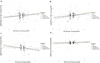
Description:Background ; Lipid traits have been inconsistently linked to risk of non-Hodgkin lymphoma (NHL). We examined the association of genetically predicted lipid traits with risk of diffuse large B-cell lymphoma (DLBCL), chronic lymphocytic leukemia (CLL), follicular (FL) and marginal zone (MZL) lymphoma using Mendelian randomization (MR) analysis. ; Methods ; GWAS data from the InterLymph Consortium were available for 2661 DLBCLs, 2179 CLLs, 2142 FLs, 824 MZLs, and 6221 controls. SNPs associated (P<5×10⁻⁸) with high-density lipoprotein (HDL, N=164), low-density lipoprotein (LDL, N=137), total cholesterol (TC, N=161), and triglycerides (TG, N=123) were used as instrumental variables (IV), explaining 14.6%, 27.7%, 16.8% and 12.8% of phenotypic variation, respectively. Associations between each lipid trait and NHL subtype were calculated using the MR inverse variance-weighted method, estimating odds ratios (OR) per standard deviation, and 95% confidence intervals (CI). ; Results ; HDL was positively associated with DLBCL (OR=1.14, CI:1.00–1.30) and MZL (OR=1.09, CI:1.01–1.18), while TG was inversely associated with MZL risk (OR=0.90, CI:0.83–0.99) all at nominal significance (P<0.05). A positive trend was observed for HDL with FL risk (OR=1.08, CI:0.99–1.19; P=0.087). No associations were noteworthy after adjusting for multiple testing. ; Conclusions ; We did not find evidence of a clear or strong association of these lipid traits with the most common NHL subtypes. While these IVs have been previously linked to other cancers, our findings do not support any causal associations with these NHL subtypes. ; Impact ; Our results suggest that prior reported inverse associations of lipid traits are not likely to be causal and could represent reverse causality or confounding.
-
Subjects:
-
Source:Cancer Epidemiol Biomarkers Prev. 29(5):1074-1078
-
Pubmed ID:32108027
-
Pubmed Central ID:PMC7196490
-
Document Type:
-
Funding:R25 CA092049/CA/NCI NIH HHS/United States ; P30 CA016087/CA/NCI NIH HHS/United States ; UL1 TR000135/TR/NCATS NIH HHS/United States ; R01 CA134958/CA/NCI NIH HHS/United States ; CIHR/Canada ; UM1 CA167552/CA/NCI NIH HHS/United States ; U01 HG007033/HG/NHGRI NIH HHS/United States ; HHSN261201000035C/CA/NCI NIH HHS/United States ; HHSN261201000034C/CA/NCI NIH HHS/United States ; HHSN261201000140C/CA/NCI NIH HHS/United States ; R01 CA098122/CA/NCI NIH HHS/United States ; R01 CA149445/CA/NCI NIH HHS/United States ; U58 DP000807/DP/NCCDPHP CDC HHS/United States ; UM1 CA182934/CA/NCI NIH HHS/United States ; UM1 CA186107/CA/NCI NIH HHS/United States ; R01 CA200703/CA/NCI NIH HHS/United States ; R01 CA129539/CA/NCI NIH HHS/United States
-
Volume:29
-
Issue:5
-
Download URL:
-
File Type:
 [PDF - 97.83 KB]
 -
Collection(s):
-
Main Document Checksum:urn:sha256:0574183c9ef60906700b9d2dd323169e0130ab336a7221484423c01efa882bf9
Supporting Files


File Language:
English
 Was this page helpful?
 Found an issue?

CDC STACKS serves as an archival repository of CDC-published products including
scientific findings, journal articles, guidelines, recommendations, or other public health information authored or
co-authored by CDC or funded partners.
As a repository, CDC STACKS retains documents in their original published format to ensure public access to scientific information.
As a repository, CDC STACKS retains documents in their original published format to ensure public access to scientific information.
You May Also Like
COLLECTION
CDC Public Access