


Respiratory Protection for Oxygen Deficient Atmospheres
Supporting Files

-
2016
-
File Language:
English
Details
-
Alternative Title:J Int Soc Respir Prot
-
Personal Author:
-
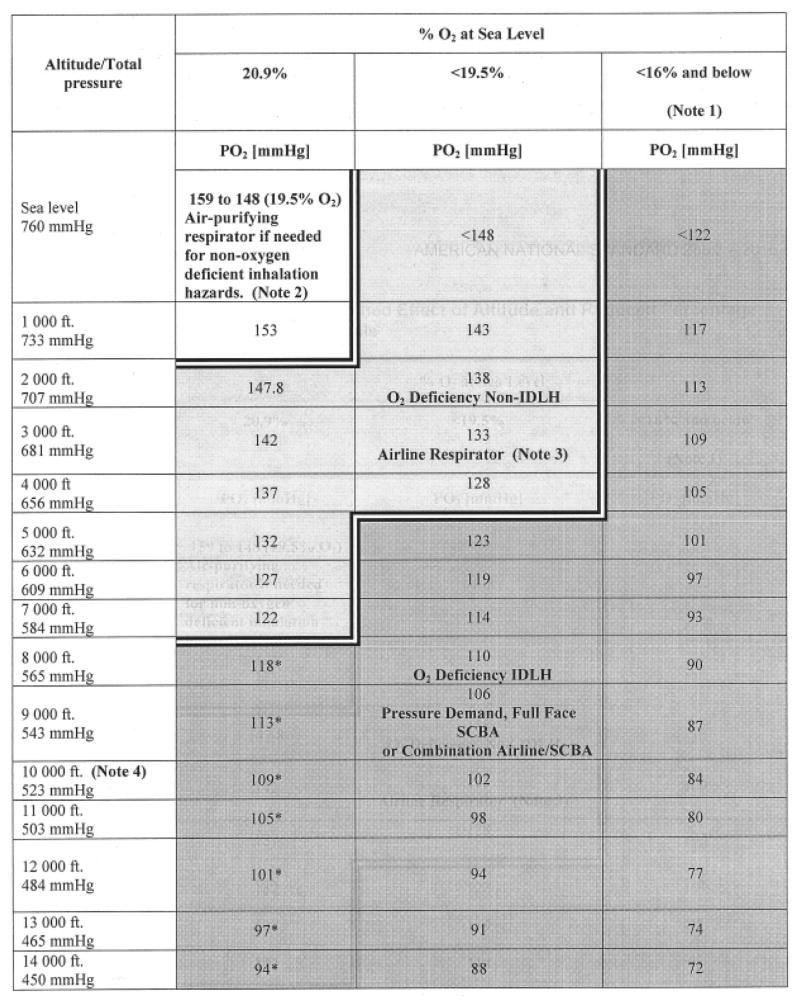
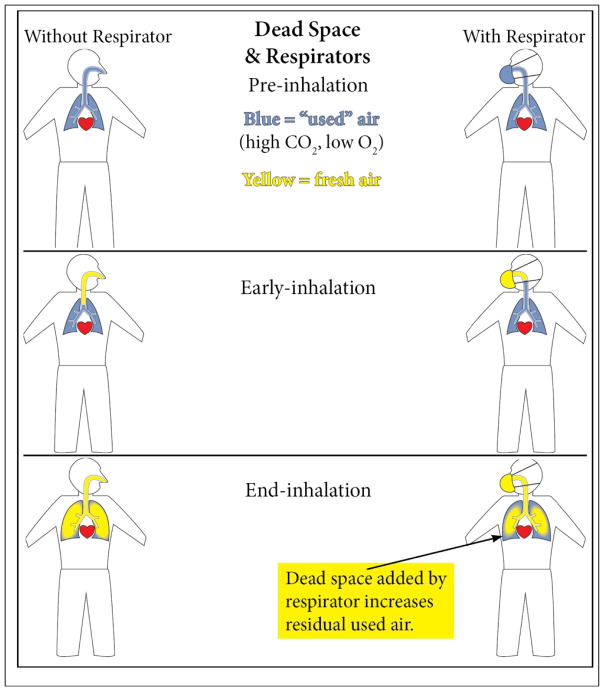
Description:This article describes several aspects of oxygen (O|) deficiency with an emphasis on respirator programs and respirator selection. The Occupational Safety and Health Administration's (OSHA) 29 CFR 1910.134 and ANSI/ASSE Z88.2-2015 (Z88.2) have much in common. However, their exposure criteria and terminology used for describing levels of O|-deficiency and the approaches to assessing O|-deficiency differ. These differences can have a significant impact on an employer's respirator program and respirator selections for workplaces at altitudes above sea level. Under certain circumstances, Z88.2 leads to a more conservative respirator selection than OSHA because its O|-deficiency criteria and hazard assessment approach relies directly on partial pressure of oxygen (PO|) at all altitudes. Z88.2 defines an O|-deficient atmosphere as either immediately dangerous to life or health (IDLH), or non-IDLH based on the atmosphere's PO| and defines respirator selection for these two O|-deficient atmospheres. Unlike Z88.2, OSHA does not directly access the biologically significant aspect of an atmosphere's PO| in its hazard assessment. OSHA defines an O|-deficient atmosphere based upon a percentage of oxygen. OSHA does not use the term "O|-deficient IDLH"; however, OSHA considers any atmosphere with less than 19.5% O| as IDLH and defines respirator selection for IDLH atmospheres. Although OSHA does not use the term "PO|" in their respirator standard, OSHA's exceptions to O|-deficient IDLH respirator selection policy are based on PO| altitude-adjusted, O| percentage criteria. This article provides descriptions of OSHA and Z88.2 requirements to evaluate workplace oxygen deficiency, their approaches to O|-deficiency hazard assessment, and describes their significance on respirator programs and selections. Alternative solutions to wearing respirators for protection against O|-deficiency resulting solely from high altitudes are also discussed. Selection and implementation of alternative solutions by the employer and their Physician or other Licensed Health Care Professional (PLHCP) are not covered by either respirator standard. Appendix A provides information about the physiological effect of wearing respirators and the mechanics of respiration, which is an important consideration in lower O| atmospheres.
-
Keywords:
-
Source:J Int Soc Respir Prot. 33(2)
-
Pubmed ID:32336876
-
Pubmed Central ID:PMC7183576
-
Document Type:
-
Funding:
-
Volume:33
-
Issue:2
-
Collection(s):
-
Main Document Checksum:urn:sha-512:8f706f0f1a42b0000b9b71f3386823f49ec1bff053ad9c1e485821efffb32ba4b034a41aad6c2c4fc9600e311dbc6040198786b5c03f75aa60b96e7f4f771de2
-
Download URL:
-
File Type:
 [PDF
- 1.02 MB
]
[PDF
- 1.02 MB
]
Supporting Files


File Language:
English
ON THIS PAGE

CDC STACKS serves as an archival repository of CDC-published products including
scientific findings,
journal articles, guidelines, recommendations, or other public health information authored or
co-authored by CDC or funded partners.
As a repository, CDC STACKS retains documents in their original published format to ensure public access to scientific information.
As a repository, CDC STACKS retains documents in their original published format to ensure public access to scientific information.
You May Also Like
COLLECTION
CDC Public Access