


Adaptive Design in the National Immunization Survey-Teen Provider Record Check Phase
Supporting Files

-
September 2018
-
File Language:
English
Details
-
Alternative Title:Proc Am Stat Assoc
-
Personal Author:
-
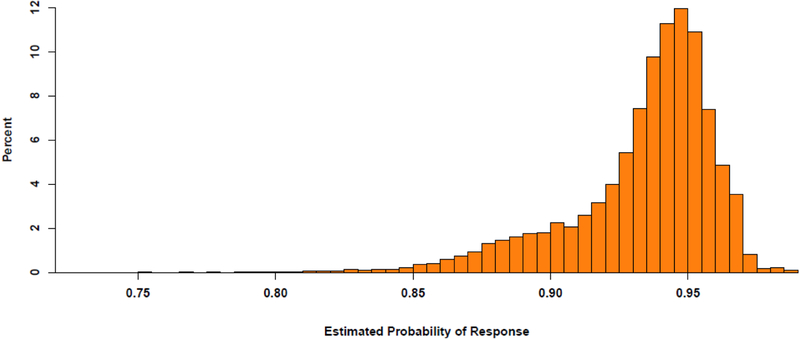
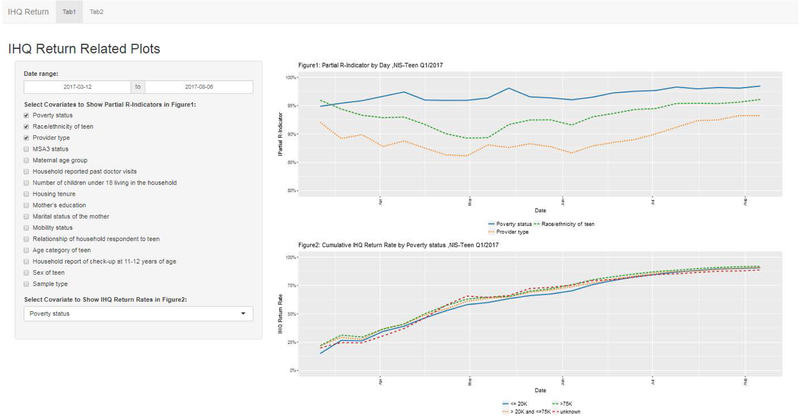
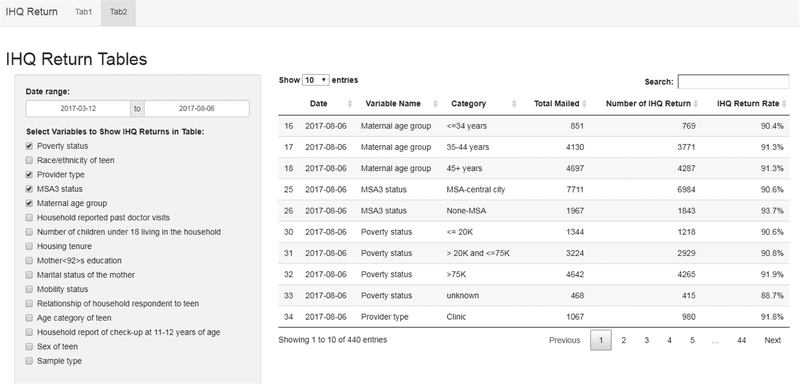
Description:Adaptive design principles are applied to the National Immunization Survey-Teen (NIS-Teen), sponsored by Centers for Disease Control and Prevention, which monitors vaccination coverage of U.S. adolescents age 13-17 years. Data collection is ongoing in two phases: (1) a random-digit-dial telephone survey to interview parents/guardians with age-eligible adolescents, followed by (2) a mail survey to vaccination providers, called the provider record check (PRC), to obtain vaccination histories for the adolescents. A logistic regression model relating the probability that an Immunization History Questionnaire (IHQ) is returned for a teen-provider pair to characteristics of the adolescent, mother, household, and providers was fit. R-indicators and partial R-indicators for the PRC phase of the 2015 NIS-Teen are presented to evaluate the representativeness of response in the PRC. The indicators are visualized using interactive graphics embodied in an R Shiny application to track the real time changes. Programmatic interventions to improve representativeness are discussed, which include strategies for prompting providers and special treatment of certain subgroups.
-
Subjects:
-
Source:Proc Am Stat Assoc. 2018:686-695 ; Proc Am Stat Assoc. 2018:686-695
-
Pubmed ID:32336964
-
Pubmed Central ID:PMC7182395
-
Document Type:
-
Funding:
-
Volume:2018
-
Collection(s):
-
Main Document Checksum:urn:sha256:04d94b6045f21de9e466a39915c3ddda02f9d6e07f73bf03410c8ccf1eadd388
-
Download URL:
-
File Type:
 [PDF
- 682.83 KB
]
[PDF
- 682.83 KB
]
Supporting Files


File Language:
English
ON THIS PAGE

CDC STACKS serves as an archival repository of CDC-published products including
scientific findings,
journal articles, guidelines, recommendations, or other public health information authored or
co-authored by CDC or funded partners.
As a repository, CDC STACKS retains documents in their original published format to ensure public access to scientific information.
As a repository, CDC STACKS retains documents in their original published format to ensure public access to scientific information.
You May Also Like
COLLECTION
CDC Public Access