



State and Territorial Laws Prohibiting Sales of Tobacco Products to Persons Aged <21 Years — United States, December 20, 2019
Supporting Files
Public Domain

-
February 21 2020
File Language:
English
Details
-
Journal Article:Morbidity and Mortality Weekly Report (MMWR)
-
Personal Author:
-
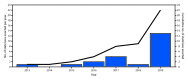
Description:Raising the minimum legal sales age (MLSA) for tobacco products to 21 years (T21) is a strategy to help prevent and delay the initiation of tobacco product use (1). On December 20, 2019, Congress raised the federal MLSA for tobacco products from 18 to 21 years. Before enactment of the federal T21 law, localities, states, and territories were increasingly adopting their own T21 laws as part of a comprehensive approach to prevent youth initiation of tobacco products, particularly in response to recent increases in use of e-cigarettes among youths (2). Nearly all tobacco product use begins during adolescence, and minors have cited social sources such as older peers and siblings as a common source of access to tobacco products (1,3). State and territorial T21 laws vary widely and can include provisions that might not benefit the public's health, including penalties to youths for purchase, use, or possession of tobacco products; exemptions for military populations; phase-in periods; and preemption of local laws. To understand the landscape of U.S. state and territorial T21 laws before enactment of the federal law, CDC assessed state and territorial laws prohibiting sales of all tobacco products to persons aged <21 years. As of December 20, 2019, 19 states, the District of Columbia (DC), Guam, and Palau had enacted T21 laws, including 13 enacted in 2019. Compared with T21 laws enacted during 2013-2018, more laws enacted in 2019 have purchase, use, or possession penalties; military exemptions; phase-in periods of 1 year or more; and preemption of local laws related to tobacco product sales. T21 laws could help prevent and reduce youth tobacco product use when implemented as part of a comprehensive approach that includes evidence-based, population-based tobacco control strategies such as smoke-free laws and pricing strategies (1,4).
-
Subjects:
-
Source:MMWR Morbidity Mortal Weekly Rep. 69(7):189-192
-
Series:
-
ISSN:0149-2195 (print) ; 1545-861X (digital)
-
Pubmed ID:32078593
-
Pubmed Central ID:PMC7043390
-
Document Type:
-
Place as Subject:
-
Pages in Document:4 pdf pages
-
Volume:69
-
Issue:7
-
Download URL:
-
File Type:
 [PDF - 266.14 KB]
 -
Collection(s):
-
Main Document Checksum:urn:sha-512:5c5422823bfe936ebbd72ce00aa355a555b3664f5e55ff5e0d0ccee1aee29b337ae93080652ab54a25d9b0c3e376b50d7153fb8838931eb945c49a0dae06dfa7
Supporting Files


File Language:
English
 Was this page helpful?
 Found an issue?


CDC STACKS serves as an archival repository of CDC-published products including
scientific findings, journal articles, guidelines, recommendations, or other public health information authored or
co-authored by CDC or funded partners.
As a repository, CDC STACKS retains documents in their original published format to ensure public access to scientific information.
As a repository, CDC STACKS retains documents in their original published format to ensure public access to scientific information.
You May Also Like
COLLECTION
Morbidity and Mortality Weekly Report (MMWR)