



Influence of Work Organization and Work Environment on Health Outcomes of Construction Apprentices
Supporting Files

-
2020/03/01
-

File Language:
English
Details
-
Journal Article:Occupational and Environmental Medicine. 32nd Triennial Congress of the International Commission on Occupational Health (ICOH), April 29 - May 4, 2018, Dublin, Ireland
-
Personal Author:
-
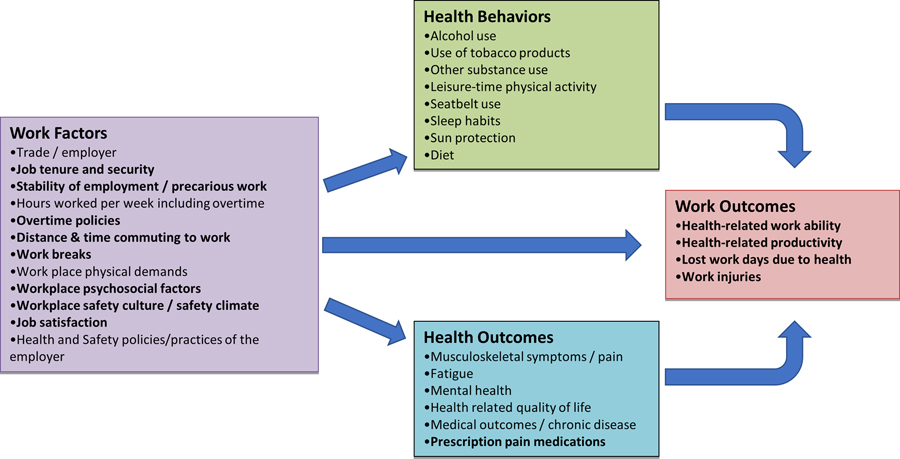
Description:Introduction: Construction is among the most dangerous industries with well-recognised high physical demands and low job autonomy. In addition to traditional hazards for workplace injury and illness, other threats to health and well-being occur from work organisation and work environment factors, including irregular employment, multiple job sites, long commutes, long work hours, and employer policies regarding health and safety. These non-traditional hazards are associated with injury and illness, as well as health behaviours including poor diet, smoking, and psychosocial stress. The cumulative impact of both traditional and non-traditional hazards on the health and well-being of construction workers are largely unknown. Methods: We conducted a survey among a cohort of apprentice construction workers to identify relationships between work organisation, environmental factors, health behaviours, and health outcomes. Results: 960 surveys have been completed to date. Preliminary analyses show that respondents (mean age 28) report high levels of job satisfaction, job security, and social support, but also report high rates of musculoskeletal symptoms and various work organisational factors potentially affecting health and health behaviours. Average commuting distance to work is over 60 km, and 63% report no limits on daily working hours. Despite high smoking rates (28% are current smokers), only 55% report any restrictions on smoking at their worksites. Only 10% report regularly using sunscreen when in the sun for >15 min; only 4% of worksites provided sunscreen. Discussion: These preliminary results highlight non-traditional worksite health risks, and suggest potential interventions that may reduce the high rates of risky heath behaviours among construction workers. As our study progresses, we plan to evaluate the impact of work organisation on health and health behaviours in three construction trades; identify workplace programs, policies, and practices affecting worker health and well-being; and determine readiness for adoption of integrated interventions to improve worker health. [Description provided by NIOSH]
-
Subjects:
-
Keywords:
-
Source:Occup Environ Med 2018 Apr; 75(Suppl 2):A588-A589
-
ISSN:1351-0711
-
Pubmed ID:31774191
-
Pubmed Central ID:PMC7069495
-
Document Type:
-
Funding:
-
Genre:
-
Place as Subject:
-
CIO:
-
Topic:
-
Location:
-
Pages in Document:14 pdf pages
-
Volume:75
-
NIOSHTIC Number:nn:20065906
-
Federal Fiscal Year:2018
-
NORA Priority Area:
-
Performing Organization:University of Iowa
-
Peer Reviewed:False
-
Collection(s):
-
Main Document Checksum:urn:sha-512:d457cb41c4d1ef97e41213a372a7654c7f81b596ba35268b9c5c940907b86cce780564867bcaa6c259ebef8659479ee1f6845b5118a276cda402d781113afeb9
-
Download URL:
-
File Type:
 [PDF
- 284.85 KB
]
[PDF
- 284.85 KB
]
Supporting Files


File Language:
English
 Was this page helpful?
 Found an issue?
CDC STACKS serves as an archival repository of CDC-published products including
scientific findings,
journal articles, guidelines, recommendations, or other public health information authored or
co-authored by CDC or funded partners.
As a repository, CDC STACKS retains documents in their original published format to ensure public access to scientific information.
As a repository, CDC STACKS retains documents in their original published format to ensure public access to scientific information.
You May Also Like