


Cost savings associated with video directly observed therapy for treatment of tuberculosis
Supporting Files

-
01 2019
-
File Language:
English
Details
-
Alternative Title:Int J Tuberc Lung Dis
-
Personal Author:
-
Description:OBJECTIVE:
To calculate the per-session and annual direct program costs to implement directly observed therapy (DOT) for tuberculosis treatment and to conduct a cost attribution analysis under varying proportions of DOT utilization for four DOT types.
DESIGN:
Program data covering the study period from September 2014 to August 2015 in New York City (NYC) were used to conduct a retrospective bottom-up micro-costing economic evaluation. For each DOT type, potential per-session and annual program savings were estimated as the cost averted by adopting a uniform distribution of DOT alternatives. Sensitivity analyses explored aggregate cost impacts of unequal distributions.
RESULTS:
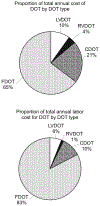
There was a total of 38 035 unique DOT visits, of which 12 002 (32%) were clinic-based (CDOT); 15 483 (41%) were field-based (FDOT); 7185 (19%) were live-video (LVDOT); and 3365 (9%) were recorded-video (RVDOT). The per-session direct costs (in 2016 $US) for DOT services delivered during the study period were $8.46 for CDOT; $19.83 for FDOT; $6.54 for LVDOT; and $5.35 for RVDOT. Sensitivity analyses supported the main findings.
CONCLUSIONS:
Significant cost savings were estimated with increased utilization of VDOT. Assuming equivalent treatment adherence, duration, completion, and adverse events across DOT types, RVDOT was the modality that most minimized cost.
-
Subjects:
-
Source:Int J Tuberc Lung Dis. 23(11):1149-1154
-
Pubmed ID:31718750
-
Pubmed Central ID:PMC7062606
-
Document Type:
-
Funding:
-
Place as Subject:
-
Volume:23
-
Issue:11
-
Collection(s):
-
Main Document Checksum:urn:sha256:82e8741aad18d582d24d01a87075a75b507a21ae1eb3f443f9381994ac88403f
-
Download URL:
-
File Type:
 [PDF
- 189.89 KB
]
[PDF
- 189.89 KB
]
Supporting Files


File Language:
English
ON THIS PAGE

CDC STACKS serves as an archival repository of CDC-published products including
scientific findings,
journal articles, guidelines, recommendations, or other public health information authored or
co-authored by CDC or funded partners.
As a repository, CDC STACKS retains documents in their original published format to ensure public access to scientific information.
As a repository, CDC STACKS retains documents in their original published format to ensure public access to scientific information.
You May Also Like
COLLECTION
CDC Public Access